Do Moroccans Celebrate New Year? What Travelers Should Know
Yes, but it's more layered than one holiday — how the Gregorian New Year, Amazigh New Year (Yennayer), and the Islamic New Year each fit into Moroccan life.
Yes, but the honest answer has more nuance than a simple yes or no, because Morocco doesn't run on a single calendar. Three different "New Year" moments coexist in Moroccan life, and understanding the difference helps set realistic expectations for a December visit.
[!NOTE] Fast-Facts & Direct Answer Summary
Yes, but it's more layered than one holiday — how the Gregorian New Year, Amazigh New Year (Yennayer), and the Islamic New Year each fit into Moroccan life.
- Destination Focus: Authentic Moroccan culture, scenic routes, and local travel insights
- Currency & Payments: Moroccan Dirham (MAD; ~10 MAD ≈ €1 / $1.08 USD). Cash is essential outside major hotels
- Best Travel Window: October through April offers ideal temperate weather across Morocco and the desert
- Local Hospitality: Berber culture is renowned for warm hospitality, mint tea welcoming rituals, and rich musical heritage.
Three different New Years
The Gregorian New Year — December 31 into January 1 — is the one most visitors are asking about, and it's genuinely present in Morocco's tourism and hospitality economy: hotels run gala dinners, restaurants put together special menus, and cities like Marrakech, Casablanca, and Rabat have a real, if uneven, party scene around it. How much any individual Moroccan family marks the date privately varies a lot — some treat it as a normal night, others enjoy a festive dinner, and it isn't treated as a major religious or cultural milestone the way it is in some Western countries.
Amazigh New Year, known as Yennayer, is a separate and culturally significant occasion tied to the indigenous Amazigh (Berber) calendar, and it falls in mid-January rather than around December 31 — worth knowing if you assumed all of Morocco's "New Year" energy clusters around the Gregorian date. It's marked with traditional meals, family gatherings, and real cultural weight, particularly in Amazigh communities across the country.
The Islamic New Year (Hijri New Year) follows the lunar Islamic calendar, so its date shifts each year on the Gregorian calendar. It's religiously meaningful for many Moroccan Muslims, but its character is quieter and more reflective than a party — a different kind of significance than either of the other two.
None of these contradict each other. A Moroccan household might acknowledge all three in different ways, or emphasize one over the others — there isn't a single "correct" way this plays out nationally.
Where the December 31 energy is strongest
Marrakech has the most active Gregorian New Year's scene of any Moroccan city, with the widest range of hotel events, restaurant dinners, and desert-camp options built around the date. Casablanca has a real, modern nightlife scene that shows up on New Year's Eve too. Rabat tends to be calmer and more understated. Fez leans quieter and more cultural in tone generally, though it still has quality hotel dinners and events for visitors who want them.
Outside these tourism-heavy contexts, plenty of Moroccan neighborhoods treat December 31 as an ordinary night — there's no expectation that the whole country is out celebrating, and it's worth not assuming otherwise if you're staying somewhere off the main tourist circuit.
Practical notes for travelers
Alcohol, if that matters to your plans, is available in many licensed hotels, bars, and restaurants in tourism-facing areas, but far less so outside them — worth confirming your specific venue serves it rather than assuming (see our alcohol guide for Marrakech for the fuller picture). Fireworks show up at some private venues and hotel events, especially in Marrakech, but Morocco doesn't run one unified public fireworks display the way some capitals do — expect venue-based celebrations rather than one central spectacle.
Basic cultural courtesy goes a long way: dress appropriately for wherever you are, be mindful near mosques and prayer spaces, keep noise reasonable in residential streets late at night, and be considerate toward service staff working a holiday evening. None of this requires much beyond ordinary good sense as a guest in someone else's country.
Is New Year's a good time to visit?
For most travelers, yes — December brings mild daytime weather across much of Morocco, real festive energy in the main cities, and the option to combine a celebratory night with cultural sightseeing. The trade-off is that it's also peak booking season: accommodation and popular dinners fill up well in advance, so if a specific hotel or event matters to your plans, book earlier than you'd think necessary.
Frequently Asked Questions (FAQ)
Do Moroccans celebrate Gregorian New Year on December 31st?
Yes, Moroccans celebrate Gregorian New Year, particularly in major cities like Casablanca, Marrakech, and Rabat. While January 1st is a public holiday, Morocco also observes the Islamic (Hijri) New Year and the Amazigh New Year (Yennayer on January 13th).
Is January 1st a public holiday in Morocco?
Yes, January 1st is an official public holiday across Morocco. Government offices, banks, and post offices are closed, but tourist facilities, restaurants, markets, and tour operations function as normal.
How do local Moroccan families spend New Year's Eve?
Urban Moroccan families often purchase festive pastries and cakes from local pâtisseries, enjoy home-cooked chicken or lamb pastilla dinners, and watch special televised musical variety specials on national Moroccan television channels.
Is December 31st noisy or disruptive for travelers in Morocco?
No. Outside of nightlife districts like Hivernage in Marrakech or the Corniche in Casablanca, Morocco remains calm and peaceful. Quiet desert camps and traditional medina riads offer serene retreats away from loud party crowds.
Plan a trip around it
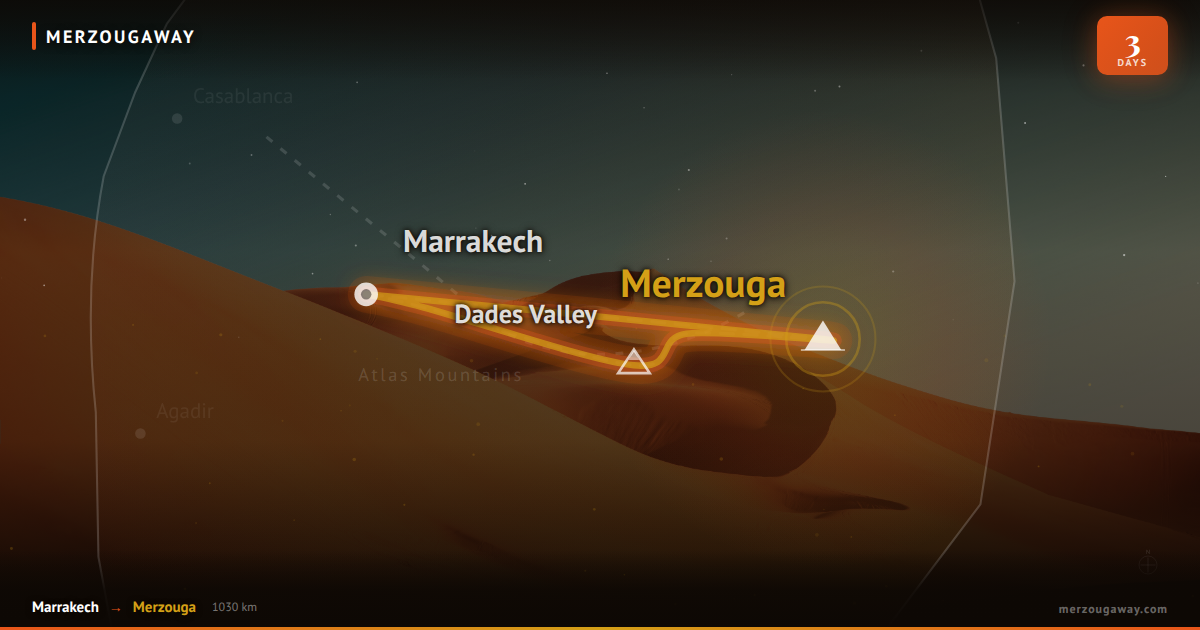
We help travelers build itineraries that combine a Marrakech New Year's Eve with real time in the Sahara — a private desert tour to Merzouga pairs naturally with a few nights in the city either side of December 31.
Contact us:
- Email: [email protected]
- WhatsApp: +212675203319 / +212668534981
Sahara Route & Drive-Time Estimator
Calculate realistic driving hours across the High Atlas (Tizi n'Tichka pass), compare scenic stops (Dadès, Todra, Ziz), and plan your custom desert itinerary.
MerzougaWay Team
We are a passionate team of local guides dedicated to sharing the beauty and culture of our home, Morocco. Our journey began with a simple desire to offer authentic, memorable experiences that go beyond the typical tourist trails.