Marrakech to Merzouga Desert: Geography, Landscape & Route Overview 2026
What the ~560km drive from Marrakech to the Merzouga desert actually looks like on the ground — the mountain passes, valleys, and dune landscape you pass through, and why it's a multi-day trip rather than a single drive.
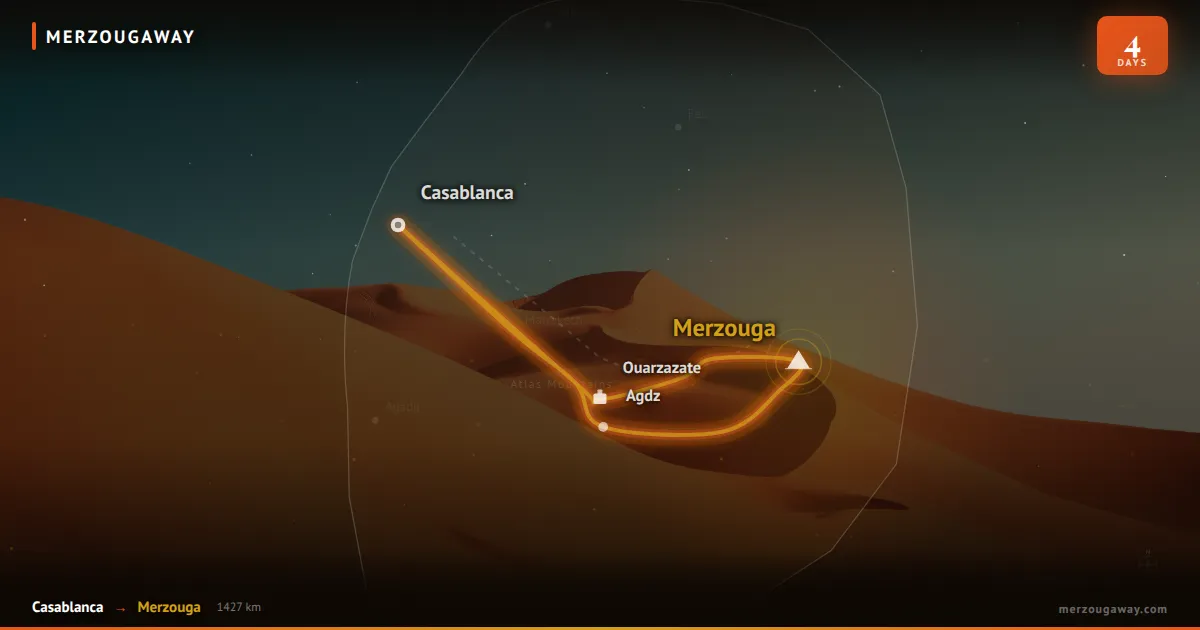
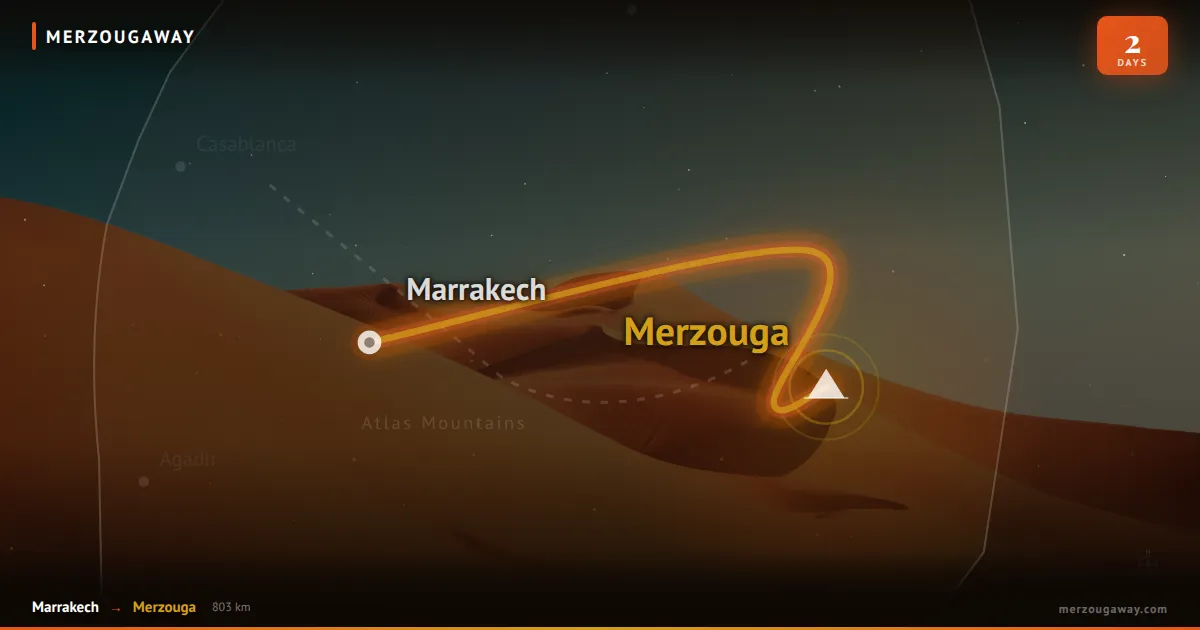
The trip from Marrakech to the Merzouga desert covers roughly 560 km, and calling it a single "drive to the desert" undersells what's actually in between. You don't go from city to sand dunes in one transition — you cross an entire mountain range, drop through a belt of kasbahs and river valleys, and only then does the landscape turn properly Saharan. It's this gradual unfolding, more than the destination itself, that makes most travelers extend the trip into 3 or 4 days rather than treating it as a means to an end.
[!NOTE] Fast-Facts & Direct Answer Summary
A desert journey from Marrakech to Merzouga spans ~560 km across the High Atlas Mountains (Tizi n'Tichka pass, 2,260m). The drive takes 9–10 hours, making a 3-Day or 4-Day tour the minimum recommended duration for safety and comfort.
- Recommended Duration: 3 Days (Classic) or 4 Days (Relaxed & In-Depth)
- Primary Road Routes: N9 across the Atlas ➔ N10 through Dadès Valley ➔ N13 to Erg Chebbi
- Realistic Pricing: 1,800–4,500 MAD (€180–€420) per person for private tours with luxury desert camp
- Key Highlights: Aït Benhaddou UNESCO ksar, Todra Gorge canyons, sunset camel trek, and Erg Chebbi dunes
- Local Expert Tip: Avoid 2-day Merzouga tours (18–20 hours driving in 48h). Opt for Agafay Desert if you only have 1–2 days.
Out of Marrakech and into the Atlas
The first stretch out of Marrakech still feels like Morocco's fertile heartland — olive groves, palmeries, and small Berber villages along the road, with the snow-capped (in winter) High Atlas visible ahead almost as soon as you clear the city. Within an hour or so the road starts climbing in earnest toward the Tizi n'Tichka pass, at just over 2,260m the highest point of the whole journey. It's a genuinely dramatic stretch of driving — switchbacks cut into bare mountainside, Berber hamlets clinging to slopes that look barely habitable, and viewpoints where the whole Marrakech plain drops away behind you. This is also where the trip stops being scenery-from-a-highway and starts being an actual mountain crossing: the road is well-maintained but narrow and slow, and a good driver takes the pass at a pace that matches the terrain rather than a schedule.
Kasbahs, valleys, and the descent toward the desert
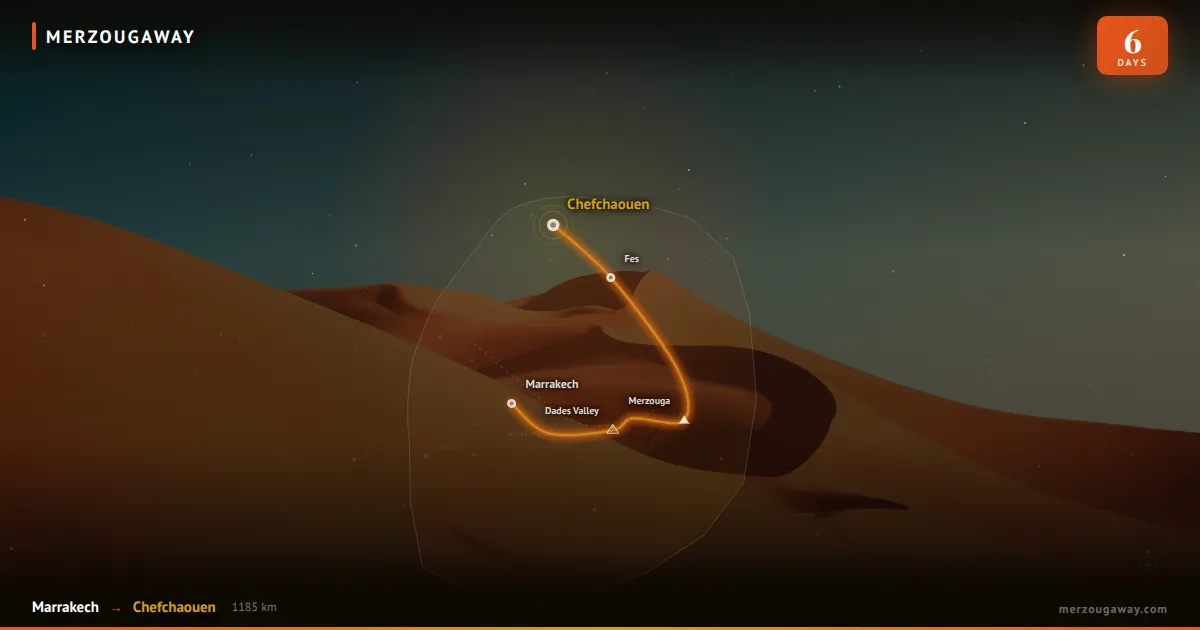
Coming down the far side of the Atlas, the road runs through Ait Ben Haddou — the fortified earthen kasbah that's the region's best-known UNESCO site — and on to Ouarzazate, the small city that's served as Morocco's gateway to the south (and, famously, as a stand-in backdrop for a long list of film productions) for decades. From there the route bends east through a run of valleys — Skoura's palm groves, the Dades Valley's red-rock canyon walls, and Todgha Gorge's narrow, near-vertical passage — that together form the most visually varied part of the whole trip. This is kasbah country: mudbrick fortress architecture that's centuries old, still inhabited in places rather than preserved as a museum piece, built with thick walls and small windows that make more sense the further you get from the mountains and the hotter the days become.
Past the Dades and Todgha valleys the land starts thinning out — vegetation gets sparser, the valleys widen into semi-desert plains, and towns like Erfoud and Rissani mark the last proper settlements before the dunes. These were historically caravan towns, trading posts on the routes that once carried salt and gold across the Sahara, and they still feel like a threshold rather than a destination in their own right.
Arriving at Erg Chebbi
The last stretch into Merzouga is where the landscape actually becomes what people picture when they imagine "the Sahara" — Erg Chebbi's dunes rising up to roughly 150 meters, the flat rocky plain giving way abruptly to an ocean of sand that shifts color through the day, pale gold at midday and deep orange-red by sunset. It's a striking change after hours of mountains and river valleys, and it's also why the final approach tends to land in late afternoon on purpose: arriving in time for a camel ride out to camp as the sun drops is the whole point of timing the trip this way.
Climate, ecology, and what actually lives out here
Temperatures swing hard between day and night in this part of Morocco, and the swing gets more extreme the further you travel from the mountains — expect real heat during the day for most of the year and a sharp, sometimes near-freezing drop after dark in winter. The desert itself isn't lifeless: acacia and jujube grow in the drier stretches, argan trees appear as you get toward the semi-desert zone, and date palm oases mark wherever underground water reaches the surface. Berber communities along the route have managed water here for generations through khettara systems — underground channels that carry water from mountain aquifers down to villages and fields without it evaporating in the heat, a genuinely clever piece of low-tech engineering that predates any modern irrigation.
Wildlife is present but mostly out of sight — desert foxes and scorpions are nocturnal and rarely encountered, hawks and other birds of prey are the animals you're actually likely to spot during the day, and camels (working animals as much as tourist transport) are the one desert creature you're guaranteed to see up close. None of it poses a real risk to travelers on an organized tour; the main practical precautions are the boring ones — sun protection, hydration, and a warm layer for the evening temperature drop, not wildlife avoidance.
Why this is a multi-day trip, not a drive
It's worth being direct about one thing: 560 km one-way, most of it over mountain roads, is genuinely 9-10 hours of driving — a round trip in a single day isn't realistic, and there's no train or flight that shortcuts it (Merzouga has no airport of its own; the nearest is Errachidia, about two hours away). Every well-planned version of this trip breaks the drive into at least two days each direction, usually with a stop in the Dades or Ouarzazate area, which turns what would be an exhausting haul into the most scenic part of the whole itinerary rather than a chore to get through.
Have questions about how the route breaks down, or want help planning where to stop along the way? Reach out and we'll help you build the itinerary.
- WhatsApp: +212675203319 / +212668534981
- Email: [email protected]
Last updated: August 2026.
Master Route Anatomy: High Atlas to Erg Chebbi Dunes
The overland crossing from Marrakech across the High Atlas mountain chain to the monumental dunes of Erg Chebbi in Merzouga is one of the world's most geographically dramatic road journeys. Spanning 560 kilometers (348 miles), the route traverses five distinct ecological and geological zones, ascending from the fertile Mediterranean Haouz plain over 2,260-meter alpine passes, winding through red clay river canyons and pre-Saharan date oases, and terminating in the golden sand sea of the true Sahara.
The following master geographic matrix breaks down each territorial segment along the classic Marrakech to Merzouga corridor:
| Geographic Zone & Highway | Elevation Profile | Dominant Landscape & Geology | Primary Cultural & Historical Landmarks | Regional Culinary Specialties | | :--- | :--- | :--- | :--- | :--- | | Haouz Plain (Marrakech to Ait Ourir - N9) | 450m to 700m | Olive orchards, eucalyptus avenues, Haouz clay plain | Menara Gardens, Berber weekly livestock souks | Fresh orange juice, Msemmen flatbreads with honey | | High Atlas Crossing (Taddert to Tizi n'Tichka - N9)| 1,200m to 2,260m | Alpine granite, snow-capped peaks, terraced walnut valleys | Tizi n'Tichka pass monument, Berber stone hamlets | Sizzling roadside lamb tagines, mountain thyme tea | | Ounila Valley & Ouarzazate Basin (P1506 & N9) | 1,100m to 1,400m | Red clay badlands, gypsum river canyons, almond groves | Telouet Kasbah, UNESCO Ksar Ait Benhaddou, Atlas Film Studios | Almond-blossom honey, slow-cooked beef tagine with prunes | | Valley of the Kasbahs (Skoura to Dades - N10) | 1,400m to 1,600m | 4,500-hectare date palm oases, limestone cliffs | Kasbah Amridil, Kelaat M'Gouna rose distilleries, Monkey Fingers | Damask rose water infusions, free-range chicken tagine | | Todra Gorge & Tafilalet Basin (N10 & N13) | 800m to 1,300m | Vertical 300m limestone slot canyons, fossil-rich plains | Todra Gorge, ancient khettara aqueducts, Erfoud fossil quarries | Fresh Majhoul dates, roasted cumin almonds | | Erg Chebbi Sand Sea (Merzouga & Hassilabied - N13)| 700m to 850m | 150m golden sand dunes, black basalt hammada | Khamlia Gnawa village, lead mines of M'Fis, nomad camps | Desert Madfouna (stuffed Berber pizza), slow-roasted Mechoui |
Erg Chebbi vs Agafay vs Zagora: Why Erg Chebbi Is Unmatched
First-time travelers to Morocco are often misled by travel brochures that market all three southern destinations under the generic umbrella of "the desert":
- Erg Chebbi (Merzouga): The authentic Sahara Desert. A true erg—a massive sand sea spanning 28 kilometers long and 7 kilometers wide, featuring majestic orange-gold sand dunes rising up to 150 meters (nearly 500 feet). This is where you find the cinematic rolling sand dunes of your imagination.
- Agafay Desert: Located 45 minutes from Marrakech, Agafay is a stone plateau (hammada) of rolling dry clay hills. It has zero sand dunes. While beautiful for sunset dinners and quad biking, it is not the Sahara.
- Zagora: Located 6 hours south of Marrakech, Zagora is a flat, gravelly stone desert dotted with sparse acacia scrub. Its small sand dune field (Tinfou) is tiny, heavily trodden, and cannot compare to the awe-inspiring majesty of Erg Chebbi.
The Five-Star Glamping Standard in Erg Chebbi
In the heart of Erg Chebbi, MerzougaWay delivers an extraordinary standard of sustainable Saharan luxury:
- Private Canvas Living Suites: Spanning 45 to 55 m² on raised hardwood platforms, each tent features insulated multi-layer canvas, hand-knotted Berber carpets, plush king-sized orthopedic mattresses, and European 220V power outlets.
- En-Suite Ceramic Bathrooms: Private partitioned bathrooms inside every tent suite feature running pressurized hot water supplied by solar boilers, porcelain western flush toilets connected to subterranean ecological septic systems, marble vanities, and organic argan bath amenities.
- Active Climate Control: Reverse-cycle heating and air conditioning units ensure cozy comfort during cold winter nights (0°C to 4°C / 32°F to 39°F) and warm summer afternoons.
- Authentic Desert Hospitality: Multi-course Moroccan dinners, evening campfire drumming circles under the Milky Way, and private sunrise camel treks.
The Dynamic Colors & Light of Erg Chebbi
One of the most awe-inspiring natural phenomena in the Sahara Desert is the shifting color palette of the Erg Chebbi dune field:
- Sunrise Palette (06:00 – 07:30 AM): As the sun crests the eastern horizon, the cool dawn violet and pale amber sands ignite into blazing gold and fiery terracotta. The low-angle sunlight casts razor-sharp shadows across the knife-edge dune ridges, creating dramatic high-contrast textures that photographers cherish.
- Midday Reflection (12:00 – 15:00 PM): Under high midday sun, the sands take on a uniform, warm apricot hue. The immense scale of the 150-meter-tall dunes becomes fully apparent against the deep, cloudless Saharan blue sky.
- Sunset and Twilight Magic (18:00 – 19:30 PM): In the late afternoon, the dunes deepen into rich copper, crimson, and deep plum. As twilight falls, the warm sand begins releasing its heat into the crisp evening air, creating a sublime sensory transition as the first stars appear.
Desert Wildlife and Ecological Preservation
Contrary to popular belief, the Sahara Desert around Merzouga is a thriving, delicate ecosystem:
- Native Saharan Fauna: Keep an eye out for the adorable fennec fox (Vulpes zerda) with its oversized ears, desert hedgehogs, and the agile sandfish lizard (Scincus scincus) that "swims" through loose sand to escape midday heat.
- Sustainable Glamping Practices: MerzougaWay is committed to protecting this fragile biome. Our luxury camps generate 100% of their operational energy from solar microgrids, ban single-use plastic water bottles in the dunes, utilize eco-friendly subterranean bio-septic waste systems, and support local desert wildlife conservation initiatives.
Essential Clothing Strategy for the Desert Transition
Navigating the dramatic temperature swings between the High Atlas mountains and the Sahara requires a thoughtful layering approach:
- Daytime Sun Protection: Lightweight, loose-fitting linen trousers and long-sleeve cotton shirts reflect intense UV radiation while allowing desert breezes to circulate. Polarized UV400 sunglasses prevent sand glare headache, and a traditional 3-meter cotton Amazigh shesh turban protects your face, ears, and neck from windblown sand.
- Evening Stargazing Warmth: Once the sun sets, bare sand radiates heat rapidly into space. Pack a warm fleece pullover, merino wool base layer, and windbreaker jacket for outdoor evening campfires.
- Footwear Recommendations: Closed-toe trail running shoes or lightweight hiking sneakers are ideal for trekking up sand dunes. Avoid sandals during high midday sun, as loose surface sand can reach over 50°C (122°F).
Geological Splendor: The Draa-Tafilalet River Basins
The journey toward Erg Chebbi crosses the historic pre-Saharan hydrological networks that have sustained nomadic pastoralists and sedentary oasis farmers for thousands of years. The seasonal waters of the Dades, Todra, Ziz, and Gheris rivers flow from High Atlas snowfields into the desert sands, nourishing millions of date palms and sustaining fortified ksour. Experiencing this ancient oasis landscape in comfort with MerzougaWay reveals the timeless synergy between water, sand, and indigenous Amazigh ingenuity.
Frequently Asked Questions (FAQ)
What landscapes will I see between Marrakech and the Merzouga desert?
This route is one of the most geographically diverse drives in Africa: pine-forested High Atlas mountains, dramatic red sandstone canyons, limestone gorges in Todra, lush date palm oases in the Draa and Ziz valleys, volcanic black rock hammada, and finally the golden dunes of Erg Chebbi.
How hot does Merzouga get in summer?
In July and August, afternoon temperatures in Erg Chebbi reach 40°C to 45°C (104°F–113°F). Tours during summer adjust schedules with early morning camel treks, air-conditioned vehicle transit during peak midday heat, and evenings under the cooling desert night breeze.
Are there wild animals or dangerous insects in Erg Chebbi?
Erg Chebbi is home to desert foxes (fennecs), desert sparrows, and gentle camels. Scorpions and desert horned vipers exist in the Sahara but hibernate in winter and stay deep underground in summer, avoiding human camp areas. Standard walking shoes keep you completely safe.
What is the electricity situation in Merzouga desert camps?
Camps operate on solar power batteries backed by quiet generators. You can charge smartphones, cameras, and laptops in your private tent throughout the night.
Sahara Route & Drive-Time Estimator
Calculate realistic driving hours across the High Atlas (Tizi n'Tichka pass), compare scenic stops (Dadès, Todra, Ziz), and plan your custom desert itinerary.
MerzougaWay Team
We are a passionate team of local guides dedicated to sharing the beauty and culture of our home, Morocco. Our journey began with a simple desire to offer authentic, memorable experiences that go beyond the typical tourist trails.