Golden Camp Merzouga: Luxury Under the Endless Sahara Stars
What a luxury desert camp near Merzouga actually looks like — private en-suite tents, a sunset camel trek, and one of the darkest skies in Africa, without a multi-day road trip.
At the foot of the Erg Chebbi dunes, "desert camp" covers a much wider range of experiences than the phrase suggests — from a basic shared tent to something closer to a private hotel room made of canvas, deep in the sand, with nobody else's camp visible in any direction. This is what the luxury end of that range actually looks like in Merzouga, what's genuinely included, and how it compares to the standard option if budget is a factor.
[!NOTE] Fast-Facts & Direct Answer Summary
What a luxury desert camp near Merzouga actually looks like — private en-suite tents, a sunset camel trek, and one of the darkest skies in Africa, without a multi-day road trip.
- Destination Focus: Authentic Moroccan culture, scenic routes, and local travel insights
- Currency & Payments: Moroccan Dirham (MAD; ~10 MAD ≈ €1 / $1.08 USD). Cash is essential outside major hotels
- Best Travel Window: October through April offers ideal temperate weather across Morocco and the desert
- Local Hospitality: Berber culture is renowned for warm hospitality, mint tea welcoming rituals, and rich musical heritage.
What "luxury camp" actually means here
A luxury tent, in practice, means a private en-suite bathroom with a flushing toilet and a solar-heated hot shower, a proper bed rather than a sleeping mat, clean cotton linens and wool blankets for cold nights, decorative Berber rugs, and solar-powered lighting since there's no grid power this deep in the dunes. Some tents add a small private terrace facing the dune field. The standard-camp alternative delivers the same location, the same sunset trek, dinner, and music — just with shared bathroom facilities a short walk from your tent rather than a private en-suite. Both are genuinely comfortable; the difference is really about privacy and whether an en-suite bathroom is a non-negotiable for you.
For travelers who want to go a step further still, a private VIP camp option exists too — an exclusive camp for just your own group, with a private chef, dedicated butler service, and a fully customized evening, rather than sharing camp facilities and a group dinner with other guests. It's a different tier of experience built for honeymoons, anniversaries, and proposals specifically, and priced accordingly.
The evening itself
The appeal of a luxury camp isn't really the tent — it's what the tent lets you do with the evening around it. Departure from Merzouga is timed around sunset, with a camel trek of forty-five minutes to an hour into the dunes, ending at a high ridge just as the light turns from gold to deep amber to violet. Dinner back at camp is a traditional Moroccan spread — tagine or couscous, salads, harira soup, fresh bread — eaten at tables lit by lanterns rather than electric light, and once the meal winds down, camp musicians bring out hand drums and a sintir (the desert bass lute) for an hour or so of Gnawa-influenced Berber music around the fire, with guests usually invited to join in.
By the time the music quiets, the real reason most people book this trip becomes obvious: the sky. Merzouga sits far enough from any real light source that on a clear night — which is most nights — the Milky Way is visible as a distinct band directly overhead, not just a smudge, and shooting stars are common. Many guests simply lie back on a blanket in the sand for an hour rather than heading straight to bed.
Morning brings a second camel ride or a quick 4x4 transfer back toward sunrise, breakfast at camp (msemen flatbread, argan-honey dip, boiled eggs, fresh fruit, unlimited mint tea), and a return to Merzouga by mid-morning — leaving the rest of the day free if you're continuing on elsewhere.
Getting there
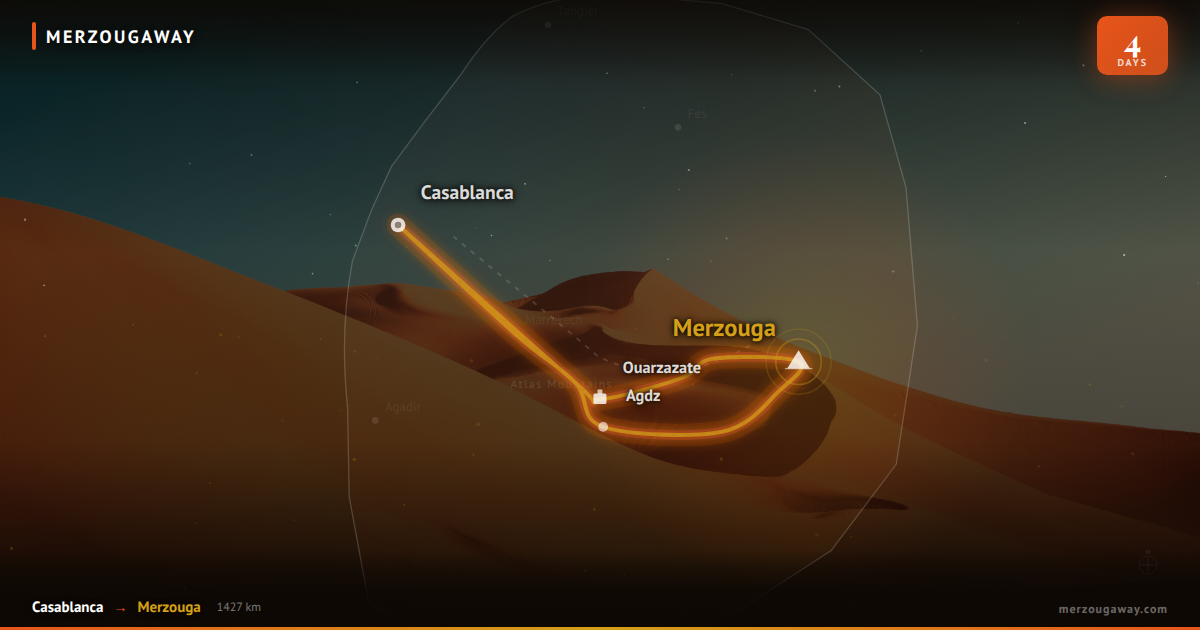
Merzouga has no airport of its own — the nearest is Errachidia, roughly two hours away by road — and no direct train connects to it, so every route in is overland. From within Merzouga itself, reaching camp is a short 4x4 transfer of about twenty minutes. Coming from further afield, plan on roughly eight to nine hours from Fes and around nine to eleven hours from Marrakech, both crossing genuinely scenic mountain or valley routes rather than a dull motorway stretch — which is part of why most travelers treat the drive itself as the first day of the trip rather than something to rush through.
Best time to visit
Spring (March-May) and autumn (September-November) offer the most comfortable balance of warm days and cool, clear nights. Winter (December-February) brings cold nights — sometimes close to freezing — but also some of the year's clearest, darkest skies, and the camp's blankets and heating are built for exactly that. Summer (June-August) is intensely hot during the day, though mornings and evenings remain genuinely pleasant once the sun is low, and the desert is noticeably quieter with fewer travelers around.
What to bring
Light, breathable clothing covers the daytime heat, but a proper warm layer for the evening is essential regardless of season — desert nights get cold even when the day was scorching. Comfortable closed shoes handle the sand and dune walking better than sandals, and sun protection (hat, sunglasses, sunscreen) matters throughout the day. The camp provides towels, blankets, and basic toiletries, so there's no need to overpack.
Frequently Asked Questions (FAQ)
What makes Golden Camp Merzouga a luxury glamping experience?
Golden Camp features spacious, custom-crafted canvas suites decorated with genuine Berber carpets and artisanal brass lanterns. Amenities include plush king-size beds, en-suite bathrooms with hot-water rainforest showers and flushing porcelain toilets, electricity, and fine dining under the open Sahara stars.
Where is Golden Camp located within Erg Chebbi?
Golden Camp is situated in a secluded valley of high dunes away from the noisy perimeter roads, offering absolute tranquility, pristine wind-rippled sand, and zero light pollution for world-class stargazing.
What dining is offered at Golden Camp Merzouga?
Guests enjoy gourmet Moroccan cuisine prepared by an on-site chef: fresh seasonal salads, slow-simmered beef and prune tagines, chicken pastilla, organic desert date platters, and fresh French pastries for breakfast.
How do guests reach Golden Camp?
Guests can choose between a leisurely 1-hour sunset camel caravan into camp or a swift 15-minute 4x4 dune shuttle departing from Merzouga village.
Booking a night at camp
Our Merzouga overnight desert camp experience covers exactly this — sunset camel trek, dinner, music, stargazing, and sunrise, with the choice between standard and luxury en-suite tents built into the same booking.
Contact Us
Ready to book a night at a luxury desert camp near Merzouga? Get in touch and we'll help you choose between the standard, luxury, and private VIP options based on your budget and occasion.
Email: [email protected] WhatsApp/Phone: +212675203319 / +212668534981
Sahara Route & Drive-Time Estimator
Calculate realistic driving hours across the High Atlas (Tizi n'Tichka pass), compare scenic stops (Dadès, Todra, Ziz), and plan your custom desert itinerary.
MerzougaWay Team
We are a passionate team of local guides dedicated to sharing the beauty and culture of our home, Morocco. Our journey began with a simple desire to offer authentic, memorable experiences that go beyond the typical tourist trails.