Marrakech to Merzouga to Chefchaouen: The Ultimate Morocco Route & Itinerary (2026)
The complete Marrakech to Merzouga to Chefchaouen travel guide. Master 5-day and 7-day itineraries connecting the Red City, the Sahara dunes, Fes, and the Blue City.
Marrakech's vibrant red-brick Medina energy, Merzouga's towering golden Sahara dunes, and Chefchaouen's tranquil blue-washed mountain alleys are about as distinct from one another as three destinations in a single country can be. Stringing them together into one seamless overland journey creates the ultimate cross-section of Morocco: The Red City, The Golden Desert, and The Blue Pearl.
Covering approximately 1,150 kilometers (715 miles) from the southern foothills of the High Atlas across the Sahara Desert and up into the northern Rif Mountains, this route traverses four distinct climate zones and three mountain ranges. It is widely considered the most photogenic road trip in North Africa.
In this comprehensive 2026 itinerary planner, our local team at MerzougaWay provides the definitive 5-day express and 7-day immersive day-by-day itineraries, driving routes, photo spot guides, transport options, and essential travel tips.
⚡ Quick Summary: The Marrakech ➔ Sahara ➔ Chefchaouen Arc
[!NOTE] At a Glance — The Red, Gold & Blue Cross-Country Route
- Total Route Distance: ~1,150 km (715 miles) one-way point-to-point (Zero backtracking!)
- Recommended Duration: 5 Days (Fast-Track Highlights) to 7 Days (Ideal Immersive Pace)
- Overnight Stops (5-Day): Night 1: Dades Valley | Night 2: Merzouga Luxury Camp | Night 3: Fes Medina | Night 4: Chefchaouen
- Key Highlights: Marrakech (Jemaa el-Fnaa), Tizi n'Tichka Pass (2,260m), Aït Benhaddou Kasbah (UNESCO), Dades Gorges, Todra Gorges (300m cliffs), Erg Chebbi sand dunes, sunset camel trek, Ziz Valley Gorge, Azrou Cedar Forest (wild Barbary monkeys), Fes Medina (Chouara Tannery), and Chefchaouen (Spanish Mosque sunset)
- Best Season: October to May (crisp desert nights and comfortable city walking temperatures)
- Best Flight Setup: Fly into Marrakech (RAK) and fly out of Tangier (TNG) or take the high-speed Al Boraq train to Casablanca (CMN).
┌─────────────────────────────────────────────────────────────────────────────────┐
│            MARRAKECH ➔ MERZOUGA ➔ CHEFCHAOUEN ROUTE TIMELINE                    │
├─────────┬─────────────────────────────┬─────────────────────────────────────────┤
│ DAY     │ ROUTE LEG                   │ HIGHLIGHT SIGHTS & EXPERIENCES          │
├─────────┼─────────────────────────────┼─────────────────────────────────────────┤
│ Day 1   │ Marrakech ➔ Dades Valley    │ Tizi n'Tichka, Aït Benhaddou, Ouarzazate│
│         │ (330 km / ~6.5 hrs drive)   │ Kasbah Hotel with canyon views          │
├─────────┼─────────────────────────────┼─────────────────────────────────────────┤
│ Day 2   │ Dades ➔ Merzouga Camp       │ Todra Gorges, Erfoud, Sunset Camels     │
│         │ (250 km / ~4 hrs drive)     │ Luxury Sahara Desert Camp & Bonfire     │
├─────────┼─────────────────────────────┼─────────────────────────────────────────┤
│ Day 3   │ Merzouga ➔ Fes Medina       │ Sunrise, Ziz Valley, Azrou Cedar Forest │
│         │ (470 km / ~7.5 hrs drive)   │ Wild Barbary Monkeys, Fes Riad          │
├─────────┼─────────────────────────────┼─────────────────────────────────────────┤
│ Day 4   │ Fes Medina ➔ Chefchaouen    │ Guided Fes Medina Tour, Rif Mountains   │
│         │ (200 km / ~3.5 hrs drive)   │ Blue City, Spanish Mosque Sunset View   │
├─────────┼─────────────────────────────┼─────────────────────────────────────────┤
│ Day 5   │ Chefchaouen ➔ Tangier       │ Ras el-Maa Waterfall, Blue Alleys,      │
│         │ (115 km / ~2 hrs drive)     │ Tangier Med Ferry to Spain or TNG Flight│
└─────────┴─────────────────────────────┴─────────────────────────────────────────┘
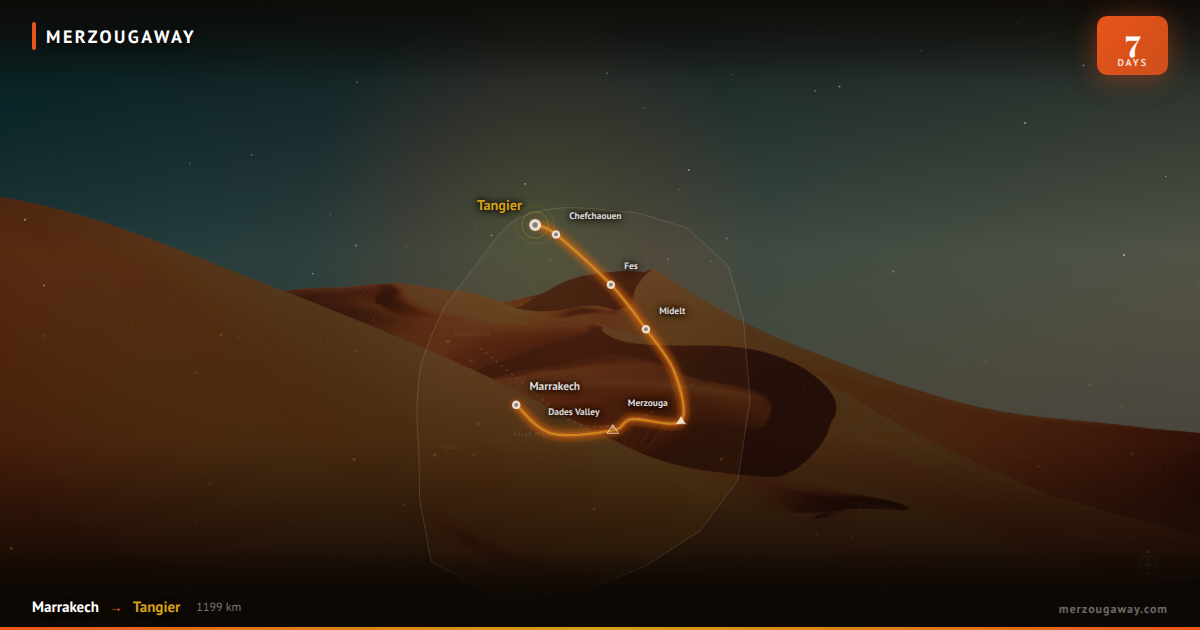
Visual Route Map: South-to-North Trans-Moroccan Crossing
                                [MEDITERRANEAN SEA / SPAIN]
                                             ▲
                                             │ (Ferry / Flight)
                                      TANGIER (TNG)
                                             ▲
                                             │ (2h Drive)
                                     CHEFCHAOUEN (Night 4 - The Blue Pearl)
                                             ▲
                                             │ (Rif Mountains / 3.5h)
                                      FES MEDINA (Night 3 - Imperial Capital)
                                             ▲
                                             │ (Middle Atlas: Ifrane & Cedar Forest)
                                           MIDELT
                                             ▲
                                             │ (Ziz Valley Canyon & Erfoud)
                                     MERZOUGA SAHARA (Night 2 - Erg Chebbi Dunes)
                                             ▲
                                             │ (Todra Gorges & Tinghir)
                                       DADES VALLEY (Night 1 - Kasbah Hotel)
                                             ▲
                                             │ (Ouarzazate & Aït Benhaddou UNESCO)
                                    Tizi n'Tichka Pass (2,260m)
                                             ▲
                                             │ (High Atlas Ascent)
                                         MARRAKECH (The Red City)
Part 1: Detailed 5-Day Master Itinerary
Day 1: Marrakech to Dades Valley via Tizi n'Tichka & Aït Benhaddou
- 07:30 AM — Departure from Marrakech: Your private English-speaking driver meets you at your riad in Marrakech in a modern 4x4. We head southeast, climbing the High Atlas Mountains.
- 09:30 AM — Tizi n'Tichka Pass (2,260m / 7,415 ft): Ascend North Africa's highest paved highway pass. Pause at panoramic mountain viewpoints for photographs and fresh mint tea.
- 11:30 AM — Aït Benhaddou Kasbah (UNESCO World Heritage Site): Tour the famous 11th-century fortified mud village along the ancient caravan route. Explore the winding clay towers and climb to the hilltop granary for a 360-degree panorama.
- Film Sets: Discover where Hollywood blockbusters like Gladiator, The Mummy, and Game of Thrones were filmed.
- 01:30 PM — Shaded Terrace Lunch: Savor fresh Moroccan salads and chicken tagine overlooking the river.
- 03:00 PM — Ouarzazate, Skoura Oasis & Rose Valley: Pass through Ouarzazate and drive along the "Road of a Thousand Kasbahs" through Kelaat M'Gouna in the Valley of the Roses.
- 06:00 PM — Arrival in Dades Valley (Night 1): Wind up into the red canyon, photographing the surreal "Monkey Fingers" rock formations. Check into your boutique Kasbah hotel overlooking the canyon for dinner and overnight.
Day 2: Dades Valley to Todra Gorges & Merzouga Sahara Luxury Camp
- 08:30 AM — Breakfast with Canyon Views: Enjoy breakfast on the terrace before driving east toward Tinghir.
- 10:00 AM — Walking Through Todra Gorges: Walk beneath the sheer 300-meter-tall red limestone canyon walls along the crystal-clear river.
- 12:30 PM — Tinjdad & Traditional Berber Lunch: Stop in Tinjdad to savor authentic wood-fired Medfouna ("Berber Pizza").
- 02:30 PM — Erfoud Marine Fossils: Discover 380-million-year-old prehistoric marine fossils quarried from the surrounding desert plateaus.
- 05:00 PM — Sunset Camel Caravan into Erg Chebbi: Arrive at Merzouga. Leave heavy luggage for 4x4 transport. Mount your camel for a 1-hour sunset trek across the golden dunes of Erg Chebbi as the sands shift from gold to crimson.
- 07:00 PM — Welcome at Luxury Desert Camp (Night 2): Check into your private canvas suite with king spring beds, electricity, and private en-suite bathroom with hot shower and flushing toilet.
- 08:30 PM — Starlit Dinner & Campfire Berber Drumming: Enjoy a 3-course Moroccan banquet, gather around the roaring bonfire for live Saharan drumming music, and stargaze under zero light pollution.
Day 3: Sahara Sunrise to Fes via Ziz Gorge, Midelt & Azrou Cedar Forest
- 06:30 AM — Sahara Sunrise: Climb the high dune behind camp for the breathtaking sunrise over the Algerian border.
- 08:00 AM — Desert Breakfast & Departure: Enjoy breakfast at camp and depart northward toward the Middle Atlas.
- 10:30 AM — Ziz Valley Gorge & Palm Oasis: Pause at the panoramic Mirador du Ziz overlooking one million green date palms winding through canyon walls.
- 01:00 PM — Mountain Lunch in Midelt: Dine on roasted chicken and fresh fruit in Morocco's apple capital.
- 03:30 PM — Azrou Cedar Forest & Wild Barbary Macaques: Enter the ancient cedar forests of the Middle Atlas. Stop near Azrou to feed and photograph wild Barbary macaque monkeys in the trees.
- 05:00 PM — Ifrane ("Little Switzerland"): Stroll through the alpine resort town of Ifrane, admiring clean alpine architecture and the stone Lion statue.
- 06:30 PM — Arrival in Fes (Night 3): Arrive in medieval Fes. Check into your luxury medina riad (e.g., Riad Fes or Riad Salam) for dinner and overnight.
Day 4: Morning Fes Medina Tour & Scenic Drive to Chefchaouen
- 08:30 AM — Guided Walking Tour of Fes el-Bali (UNESCO): Meet your licensed historian guide for a 3-hour private tour:
- Chouara Tannery: Observe artisans dyeing leather in 1,000-year-old stone vats using natural saffron, indigo, and poppy dyes.
- Al-Qarawiyyin University: The world's oldest continuously operating university, founded in 859 AD.
- Bab Bou Jeloud (The Blue Gate): The magnificent blue-and-green mosaic gate.
- 12:00 PM — Departure North into the Rif Mountains: Board your 4x4 and head north through the rolling olive hills and jagged peaks of the Rif Mountains.
- 03:30 PM — Arrival in Chefchaouen (Night 4): Check into your charming blue-painted boutique riad (e.g., Lina Ryad & Spa or Riad Cherifa).
- 05:30 PM — Sunset at the Spanish Mosque (Bouzafer): Take a gentle 20-minute walk up the hill to the abandoned Spanish Mosque. Settle onto the hillside to watch the entire blue-washed valley glow beneath the setting sun as the evening call to prayer echoes across the mountains.
- 08:00 PM — Dinner in Plaza Uta el-Hammam: Dine on a rooftop terrace in the main town square, enjoying fresh goat cheese salads, tagines, and mint tea.
Day 5: Exploring Chefchaouen & Transfer to Tangier (or Casablanca)
- 08:30 AM — Morning Photography in the Blue Medina: Spend the morning wandering through the quietest, most photogenic blue-washed streets (Callejon El Asri, Rue Targui) before day-trippers arrive.
- 10:30 AM — Ras el-Maa Mountain Spring: Walk to the eastern edge of the medina where fresh mountain spring water rushes over small waterfalls and local women wash wool rugs.
- 12:30 PM — Onward Departure Logistics:
- Option A (Tangier): Drive 2 hours north to Tangier Menara Airport (TNG) or the Tangier Med Port for the 1-hour fast ferry crossing to Tarifa, Spain.
- Option B (Casablanca): Transfer 1.5 hours to Tangier or Kenitra station and take the Al Boraq High-Speed Bullet Train (2 hours 10 minutes) directly to Casablanca Airport (CMN).
Part 2: The 7-Day Extended Itinerary (The Immersive Version)
If you have 7 days, this extended version transforms the route into an unhurried vacation:
| Day | 7-Day Relaxed Route Plan | Overnight Location | | :--- | :--- | :--- | | Day 1 | Arrive Marrakech, Jemaa el-Fnaa, Souks & Rooftops | Luxury Marrakech Medina Riad | | Day 2 | Full Day Marrakech: Bahia Palace, Majorelle Gardens, Ben Youssef | Luxury Marrakech Medina Riad | | Day 3 | Marrakech ➔ Tizi n'Tichka ➔ Aït Benhaddou ➔ Dades Valley | Dades Boutique Kasbah Hotel | | Day 4 | Dades ➔ Todra Gorges ➔ Erfoud ➔ Merzouga Luxury Camp | Erg Chebbi Luxury Desert Camp | | Day 5 | Merzouga ➔ Ziz Gorge ➔ Azrou Cedar Forest ➔ Fes Medina | Luxury Fes Medina Riad | | Day 6 | Morning Fes Guided Tour ➔ Rif Mountains ➔ Chefchaouen | Chefchaouen Boutique Blue Riad | | Day 7 | Full Day Chefchaouen ➔ Transfer to Tangier Airport / Ferry | Departure Flight or Ferry |
Part 3: North-to-South vs South-to-North (Which Direction?)
You can easily travel this route in either direction:
┌─────────────────────────────────────────────────────────────────────────────────┐
│               DIRECTIONAL COMPARISON: MARRAKECH vs CHEFCHAOUEN                  │
├────────────────────┬─────────────────────────────┬──────────────────────────────┤
│ FEATURE            │ MARRAKECH ➔ CHEFCHAOUEN     │ CHEFCHAOUEN ➔ MARRAKECH      │
├────────────────────┼─────────────────────────────┼──────────────────────────────┤
│ Direction          │ South to North (Ascending)  │ North to South (Descending)  │
│ Best For           │ Flying into RAK, out of TNG │ Arriving by Ferry from Spain │
│ Visual Climax      │ Ends with peaceful Blue City│ Ends with energetic Red City │
│ Desert Timing      │ Sahara on Day 2 of trip     │ Sahara on Day 3 of trip      │
└────────────────────┴─────────────────────────────┴──────────────────────────────┘
Part 4: Real Pricing Breakdown (Marrakech to Chefchaouen)
Our private trans-Morocco expeditions include private 4x4 transport, dedicated English-speaking driver, fuel, tolls, boutique hotels, luxury desert camp, and breakfasts/dinners:
| Group Size | 5-Day Private Tour Rate | 7-Day Private Tour Rate | | :--- | :--- | :--- | | 2 Travelers (Couple / Duo) | €650 per person | €880 per person | | 3 Travelers | €490 per person | €690 per person | | 4 to 5 Travelers (Family / Friends) | €390 per person | €550 per person | | 6+ Travelers (Small Group) | €340 per person | €480 per person |
❓ Frequently Asked Questions (FAQ)
Can I do Marrakech to Merzouga to Chefchaouen in 4 days?
While 4 days is technically possible on paper, it requires 8 to 10 hours of daily driving with almost zero time to explore Fes or Chefchaouen. 5 days is the absolute recommended minimum, and 7 days is the ideal sweet spot to truly enjoy each destination without exhaustion.
What is the best way to leave Morocco at the end of this tour in Chefchaouen?
You have two outstanding departure options from Chefchaouen:
- Fly from Tangier (TNG): Tangier airport is just a 2-hour drive north with extensive direct flights across Europe and the UK.
- Fast Ferry to Spain: Transfer 2 hours to Tangier Med or Tangier Ville port for the fast 1-hour passenger ferry across the Strait of Gibraltar to Tarifa/Algeciras, Spain.
- High-Speed Train to Casablanca (CMN): Take the modern Al Boraq bullet train from Tangier directly to Casablanca in just 2 hours and 10 minutes.
What is the luggage allowance on this multi-city tour?
Because you travel in a private 4x4 (Toyota Land Cruiser / Prado) or luxury Mercedes van, there is ample room in the vehicle trunk for standard large suitcases and carry-on bags. During the desert night in Merzouga, your heavy luggage travels by 4x4 directly to your luxury tent while you ride camels with a small daypack.
How does the weather vary between Marrakech, Merzouga, and Chefchaouen?
This route spans four climate zones:
- Marrakech & Fes: Warm and sunny (22°C–28°C / 72°F–82°F in spring and autumn).
- High Atlas Mountains & Chefchaouen: Crisp mountain air; light jacket needed for mornings and evenings.
- Sahara Desert (Merzouga): Hot, sunny days with chilly, clear starry nights (dropping to 5°C–12°C / 41°F–54°F). Dress in versatile layers!
Is a local guide provided in Fes and Aït Benhaddou?
Yes! Our private tours include official licensed local historian guides in Aït Benhaddou and Fes el-Bali to navigate the ancient UNESCO medinas, ensuring you bypass tourist traps and discover authentic artisan workshops.
🇲🇦 Book Your Red, Gold & Blue Expedition with MerzougaWay
Experience Morocco's three most iconic destinations with MerzougaWay—locally owned and operated by Berber travel specialists with over 15 years of desert and cross-country guiding expertise.
- Explore All One-Way Tours: Marrakech to Chefchaouen Tour Packages
- Direct WhatsApp Inquiries: +212 675 203 319 / +212 668 534 981
- Email: [email protected]
Guide updated and verified for 2026 travel season.
Sahara Route & Drive-Time Estimator
Calculate realistic driving hours across the High Atlas (Tizi n'Tichka pass), compare scenic stops (Dadès, Todra, Ziz), and plan your custom desert itinerary.
MerzougaWay Team
We are a passionate team of local guides dedicated to sharing the beauty and culture of our home, Morocco. Our journey began with a simple desire to offer authentic, memorable experiences that go beyond the typical tourist trails.