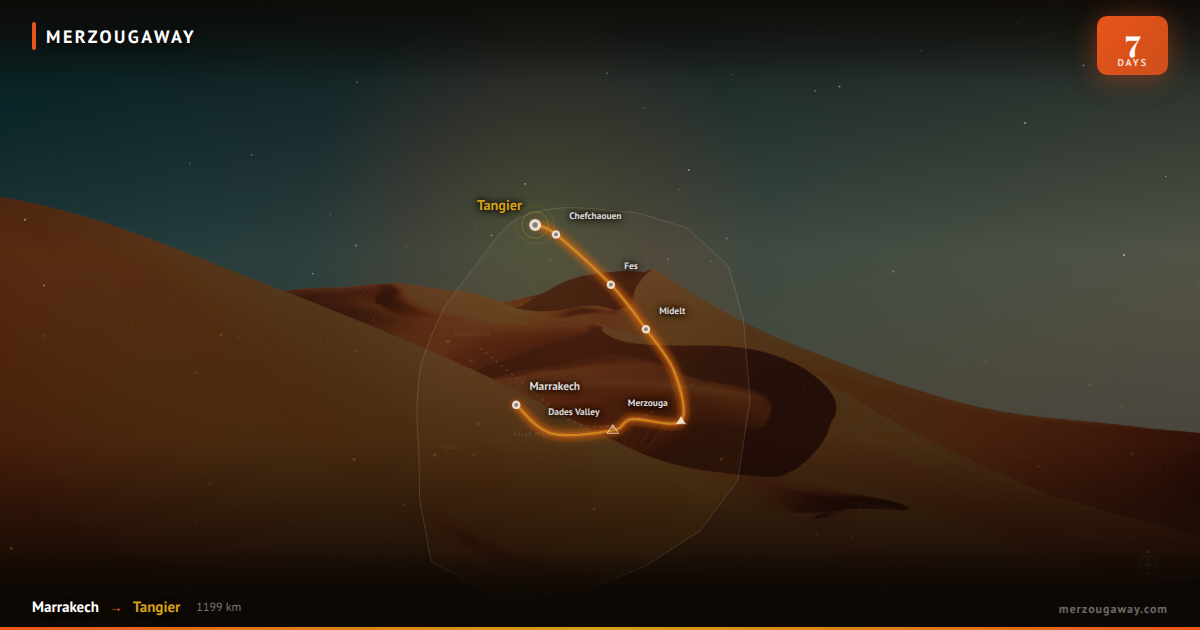
7-Day Marrakech to Tangier One-Way Tour via Desert, Fes & Chefchaouen
🌟 Overview
This is the #1 most-requested Morocco tour route — and for good reason. Travel from Marrakech to Tangier through every highlight Morocco has to offer, without ever retracing your steps. Cross the Atlas Mountains, sleep under the stars in the Sahara, explore the ancient medina of Fes, wander the blue streets of Chefchaouen, and end your journey at the gateway to Europe.
We call this The Great Moroccan Arc — a sweeping south-to-north traverse that captures the full geographical and cultural diversity of the country in a single, seamless journey. In seven days, you move from the red earth of the Sahara to the whitewashed Atlantic coast, from Berber kasbahs carved from desert clay to mountain villages painted in impossible shades of blue. No other route in Morocco covers this much ground, this many UNESCO sites, or this many distinct landscapes without ever doubling back on itself.
Perfect for Americans and international travelers who fly into Marrakech and fly out of Tangier — or take the ferry across to Spain and continue into Europe. Every single day brings completely new scenery, new architecture, and a new chapter of the Moroccan story.
Tour Highlights
- One-way route: Marrakech → Sahara → Fes → Chefchaouen → Tangier
- Cross the High Atlas Mountains via Tizi n'Tichka Pass
- Visit UNESCO-listed Aït Ben Haddou kasbah
- Walk through Todra Gorge and the Dades Valley
- Sunset camel trek and overnight in a luxury desert camp
- Guided tour of the Fes medina — oldest medieval city in the world
- Full day in Chefchaouen, the famous blue city
- End in Tangier — ferry port to Spain or international airport
Why Choose This Tour?
- Most Popular Route: the #1 booked Morocco tour format worldwide
- Zero Backtracking: every kilometer is new territory
- The Great Moroccan Arc: covers the full diversity of Morocco from south to north
- Flight Flexibility: fly into Marrakech, fly out of Tangier — or continue to Spain by ferry
- 7 Days: the ideal length for a first Morocco trip, paced to feel immersive but never rushed
Who Is This Tour For?
This tour is designed for travelers who want the most complete picture of Morocco possible within one week. Use the table below to see if it matches your travel style.
| Traveler Type | Is This Tour Right For You? |
|---|---|
| First-time Morocco visitor | ✅ Ideal — covers all the country's iconic highlights |
| Fly-in Marrakech / fly-out Tangier | ✅ Perfect one-way airport-to-airport format |
| Solo traveler | ✅ Safe, guided, and social — many solo guests each week |
| Couple or small group | ✅ Private vehicle, flexible pacing |
| Photography enthusiast | ✅ Dunes, gorges, blue medinas, mountain light — exceptional |
| Traveler who hates retracing routes | ✅ Zero backtracking, 100% forward momentum |
| Traveler with only 5 days | ❌ Consider our 5-day Marrakech to Fes route instead |
| Traveler wanting a beach holiday | ❌ This is a cultural and landscape tour |
Itinerary
Day 1 — Marrakech → Aït Ben Haddou → Dades Valley
Your driver picks you up from your Marrakech accommodation at 7:30 AM, early enough to make the most of the day's extraordinary drive. Almost immediately, the city gives way to the southern foothills of the High Atlas, and within an hour you're climbing the dramatic switchbacks of the Tizi n'Tichka Pass — Morocco's highest paved mountain road at 2,260 metres. Pull over at a viewpoint to photograph the stacked Berber villages clinging to the ridgelines below; on clear mornings you can see for fifty kilometres in every direction.
By midday, you'll reach Aït Ben Haddou, a UNESCO World Heritage ksar that rises from the banks of a dry river bed like something from a dream. This ancient fortified village of sun-dried earth towers has appeared in Gladiator, Game of Thrones, and dozens of other productions — but nothing quite prepares you for seeing it in person. Cross the river on stepping stones, walk up through the narrow alleys to the granary at the top, and take in the view over the surrounding palmery. Budget around 90 minutes here.
After lunch in a local restaurant, continue through Ouarzazate — Morocco's film capital — and wind eastward into the Valley of Roses, where in spring the roadside villages are fragrant with Damask rose petals. You arrive in the Dades Valley as the light turns golden, just in time to watch the red rock formations known as the Monkey Fingers glow in the evening sun. Dinner and overnight in a gorge-side guesthouse.
Day 2 — Dades Valley → Todra Gorge → Merzouga Desert
Wake to a breakfast served on a terrace overlooking the gorge — this is one of those slow, unhurried mornings that stay with you. By 9:00 AM, you're on the road east toward one of Morocco's most spectacular natural features: Todra Gorge. Here, the Todra River has carved a slot canyon through the High Atlas, leaving sheer walls of salmon-pink limestone rising 300 metres on either side of a narrow walkway. Walk the floor of the gorge, feel the cool air rising from the stream, and watch local rock climbers work the vertical faces above. Even in summer, the air inside Todra feels twenty degrees cooler than the open desert.
From Todra, the landscape transforms dramatically as you head southeast. The green ribbon of the Drâa and Gheris valleys narrows and then dissolves entirely into open hammada — the rocky, gravel desert of pre-Saharan Morocco. The palm oasis towns thin out, the sky grows larger, and the horizon shimmers.
By late afternoon, the first orange dunes of Erg Chebbi appear on the horizon — the largest sea of sand dunes in Morocco, rising to 150 metres at their peak. At the edge of the desert, you mount your camel for the sunset trek into the dunes, arriving at your luxury camp just as the sky turns scarlet and violet above the Sahara. After a traditional Berber dinner under a sky of impossible stars, drummers and musicians gather around the fire. Sleep in a private en-suite canvas tent, with proper beds and desert silence.
Day 3 — Merzouga → Ziz Valley → Midelt
Set your alarm early. The Sahara sunrise is not something to sleep through. By 6:00 AM, climb to the crest of the nearest dune — a 20-minute scramble through soft sand — and watch the light arrive in layers of amber, rose, and gold across an ocean of ribbed dunes. There is nothing like it. Return to camp for a leisurely breakfast, and if time and energy allow, try sandboarding down the slip face of the big dunes or arrange a short 4x4 excursion into the deeper erg.
By mid-morning, you turn the compass north and begin the long, rewarding drive through the Ziz Valley — one of Morocco's great hidden roads. The Ziz River, born in the Atlas snows, has created a ribbon of dense palmery running through the pre-Saharan plain, dotted with fortified villages, ancient irrigation channels, and children waving from rooftops. Stop at the Tunnel de Legionnaire viewpoint for a sweeping panorama of the valley, and pause in a roadside café for mint tea.
The road climbs steadily back into the Atlas as the afternoon progresses, and by early evening you descend into Midelt — a market town straddling the boundary between the Sahara and the cedar highlands of the Middle Atlas. Overnight in Midelt, a restful transition between Morocco's two very different interiors.
Day 4 — Midelt → Middle Atlas → Fes
This morning's drive is one of the most underrated in Morocco. Leaving Midelt, the road rises into the Middle Atlas highlands — a world of cedar forests, mountain streams, and alpine meadows that feels entirely removed from the desert landscapes of the previous days. Stop in the forest near Azrou, where wild Barbary macaques descend to roadside viewpoints, often close enough to observe from a metre or two. These are Morocco's only wild primates, and the cedar groves they inhabit are ancient and magnificent.
Pass through Ifrane, a planned town of chalet-style buildings and manicured parks built in the French Protectorate era and known as the "Switzerland of Morocco." It sits at 1,665 metres and is a striking architectural anomaly that generates genuine double-takes. By early afternoon, the Middle Atlas gives way to the Saïs plain and the first sprawl of Fes appears below.
Arrive in Fes in the early afternoon and begin your guided tour of the Fes el-Bali medina — a UNESCO World Heritage site and the largest car-free urban zone in the world. Your guide leads you through a circuit that most independent visitors never manage on their own:
- Al-Qarawiyyin University — founded in 859 AD and recognised by UNESCO as the oldest continuously operating university on earth
- Chouara Tanneries — viewed from the elevated terrace of a leather merchant, where workers in round stone vats dye hides in saffron, poppy, and indigo using methods unchanged for centuries
- Bou Inania Madrasa — a 14th-century theological college with some of the finest zellij tilework and carved cedarwood stucco in all of Morocco
- The souks — medieval guild streets where coppersmiths, weavers, carpenters, and spice merchants still work as they always have
Overnight in Fes — ideally in a riad in the medina itself, where the call to prayer echoes off the courtyard tiles at dawn.
Day 5 — Fes — Free Day and Optional Excursions
Fes rewards those who give it more than a single afternoon, and today the city is entirely yours. Rise early for the medina at morning light — by 7:00 AM the bread sellers and water carriers are already moving through the lanes, and the souks are quiet enough to explore without the midday crowds. Revisit any sections that caught your attention yesterday: the Nejjarine Fountain and woodwork museum, the spice souk near Bab Rcif, or the Andalusian quarter on the eastern bank of the Fes River.
By mid-morning, make your way to the Merenid Tombs on the hill above Fes el-Bali — the ruins themselves are modest, but the panoramic view over the medina is extraordinary. This is the best place in the city to understand its scale: thousands of white rooftops, minarets, and tannery vats spreading out below you.
In the afternoon, consider a traditional hammam (steam bath) experience — your accommodation can recommend a neighbourhood hammam used by locals rather than tourists. The optional Volubilis and Meknes day trip is available for an additional supplement: Volubilis is one of the best-preserved Roman sites in North Africa, and Meknes is the most undervisited of Morocco's imperial cities, with a stunning monumental gate and a compact, navigable medina. Overnight in Fes.
Day 6 — Fes → Chefchaouen
The drive from Fes to Chefchaouen threads northwest through the foothills of the Rif Mountains, a region of olive groves, red-roofed villages, and wide river valleys. The journey takes roughly three hours, arriving in Chefchaouen by midday — the ideal time to settle into your riad before the afternoon light arrives.
Chefchaouen was founded in 1471 as a mountain stronghold, and its medina was painted in shades of blue — from pale sky to deep cobalt — by Jewish refugees in the 1930s. The result is one of the most photogenic urban environments on earth. Spend your afternoon exploring without agenda: the blue is everywhere, in every alley, staircase, and doorway, and the best approach is simply to wander.
For photography, the golden light of late afternoon (4:00–6:00 PM) is exceptional. Head into the upper medina, above Plaza Uta el-Hammam, where the lanes narrow to shoulder-width and the blue walls glow in the low sun. The Rue Lalla el-Hora and its adjacent passages are some of the most beautiful in the city. Early morning — 7:00–9:00 AM — is the other peak time, before the day-trippers arrive from Fes, when the streets are quiet and the light is soft and horizontal.
In the late afternoon, walk the 30-minute path up to the Spanish Mosque on the hill above the city. Built but never consecrated, the mosque now serves as one of the finest viewpoints in northern Morocco, with the medina spread below you in an ocean of blue and white. Return to the city for dinner in one of the Plaza Uta el-Hammam restaurants — the harira soup and kefta tagine here are excellent. Overnight in a traditional riad.
Day 7 — Chefchaouen → Tangier
Take your final Chefchaouen breakfast slowly — fresh msemen flatbread with argan oil and honey, served on a rooftop terrace with views of the surrounding Rif peaks. Leave your luggage at the riad and spend the last free hour on a morning walk through the medina before it wakes fully. The quietest and most beautiful alleyways are often found by simply turning away from the well-photographed main streets: look for the Quartier Al-Andalus and the area around Bab El-Ain for lanes that most visitors never find.
The drive from Chefchaouen to Tangier covers approximately 120 kilometres through the heart of the Rif Mountains — a spectacular and often underappreciated road that climbs through dense cork oak and cedar forests before descending gradually toward the coast. The Rif is Morocco's northern mountain spine, and the views west toward the Atlantic on clear days are exceptional.
You arrive in Tangier in the early-to-mid afternoon, completing The Great Moroccan Arc. Tangier is a city of layers — Phoenician, Roman, Arab, Portuguese, Spanish, and French — and if time allows before your onward journey, the Tangier medina is a compact and manageable exploration: visit the Kasbah Museum overlooking the Strait of Gibraltar, walk the ramparts, and sit in a café where you can watch Europe on the horizon. Cape Spartel, 14 kilometres west, marks the precise point where the Atlantic meets the Mediterranean — a fitting geographical endpoint to a journey that has crossed an entire country.
Drop-off at Tangier Ibn Batouta Airport, Tangier Ville train station, or the ferry terminal for boats to Tarifa or Algeciras in Spain.
Included & Not Included
- • Private air-conditioned 4x4 or minivan
- • Professional English-speaking driver/guide
- • 6 nights accommodation (Dades area, luxury desert camp, Fes, Chefchaouen, Tangier)
- • Daily breakfast; dinners included at desert and kasbah accommodations only
- • Sunset camel trek in Erg Chebbi dunes
- • Guided Fes medina tour
- • Pick-up from Marrakech accommodation
- • Drop-off at Tangier port, airport, or accommodation
- • Sandboarding (optional)
- • Traditional Berber cheche (turban/scarf) — yours to keep
- • Polished fossil souvenir from Erfoud
- • Lunches and drinks
- • Entrance fees to monuments and attractions
- • Tips for guides and drivers
Duration
7 Days, 6 Nights
Group Type
Private
Transportation
4×4 or Minibus
Payment Methods
PayPal
Bank Transfer (IBAN)
Only 10% deposit required
Email:
[email protected]What Our Travelers Say
Real reviews from Google and TripAdvisor
We traveled to Morocco in a group of 6 adults, including my parents, who are already seniors, in the middle of summer. For my family it was a leap of faith to trust an agency we found online for the first time, but it turned out to be a wonderful surprise. Hamid, the trip organizer, was very kind and attentive both before and throughout the whole tour. It was a fully personalized tour - we got to do everything we wanted, from visiting the Sahara to enjoying the beach. He always looked out for our comfort, especially my parents': comfortable transport, well-timed stops at places with restrooms, beautiful air-conditioned hotels, and varied, plentiful food. Thanks to his organization we were able to enjoy the trip with real peace of mind. It was a great experience we would absolutely recommend.
Last week I did a self-drive trip from Fes to Merzouga, leaving the car rental, the riad in Merzouga, the desert camp, and the guided desert activities all in the hands of MerzougaWay and Hamid, and I can only say that everything was perfectly organized, right on time. Thanks to everyone at the riad we stayed at and the desert camp, as well as the guides who joined us for the 4x4 experience, Berber culture, and the camel transfer. Thanks to Hamid and MerzougaWay for that quad-bike ride back to the riad from the camp - what an experience, riding a quad across the dunes early in the morning. If you're thinking of traveling to Merzouga, I definitely recommend Hamid as the organizer of your adventure.
Excellent!! We loved the tour. Thank you Hamid for everything. Everything well organized, the guide Eljo (Elhousain) was very attentive, highly recommend. Everything super clean, we had a great driver, we felt very safe with him. Unbeatable desert excursion. Thanks MerzougaWay!
Trustworthy tour agency. I wrote Hamid what I wanted and he just made it happen. He arranged everything so quick and smooth. We had a 3-day Merzouga tour from Marrakech. Said was our guide and he made me and my wife very comfortable. He took us from our riad and carried us in his modern 4x4 Toyota to magnificent places. He gave us the confidence to ask him whatever we wanted to do and wherever we wanted to drive - like old friends. He is open-minded and respectful. I recommend asking the agency for Said to be your driver. In the 3-day tour you cross the Atlas mountains, stay one night in a perfect hotel in Dades with great food, then stay one night in Erg Chebbi dunes in a luxury glamp camp. One night wasn't enough for a real desert experience - if you have time, take two nights in the desert.
Unforgettable holiday. An 8-day itinerant tour in Morocco, including 3 days organized by Hamid - MerzougaWay: a route from Fes to Marrakech, spending a night in the desert and in Ouarzazate. Our guide Youssef, who drove us all along the way, was very professional and took us to try real experiences that not all tourists get to see. Breathtaking landscapes - Morocco amazed and fascinated us. We drove many miles but still traveled comfortably. Absolutely recommend it - they are a highly professional agency and managed to take us to unique places, like a Berber village in the desert where we were the only tourists. A spectacular, unforgettable experience.
Morocco from the heart with MerzougaWay. Heartfelt congratulations to Hamid, who organized our trip impeccably - present, correct, and extremely helpful. A special mention for our driver Ali, who was by our side through 3 intense days toward the desert: attentive, polite, discreet, and a genuinely good, nice driver. We found snow in the Atlas range and then sun in Ait Ben Haddou, visited women's cooperatives working argan oil and roses, saw the Dades Gorges, and finally reached the Sahara dunes by camel before sleeping in a tented desert camp. 3 intense and exciting days. Next time in Morocco I'll rely on you again, inshallah!
Read more reviews on
Ready to Start Your Adventure?
Contact us today and let's plan your perfect Moroccan desert experience

MerzougaWay Team
We are a passionate team of local guides dedicated to sharing the beauty and culture of our home, Morocco. Our journey began with a simple desire to offer authentic, memorable experiences that go beyond the typical tourist trails.
Complete Your Morocco Trip
Two more services from our team, based in Marrakech.
You Might Also Like
Discover more amazing tours in Morocco
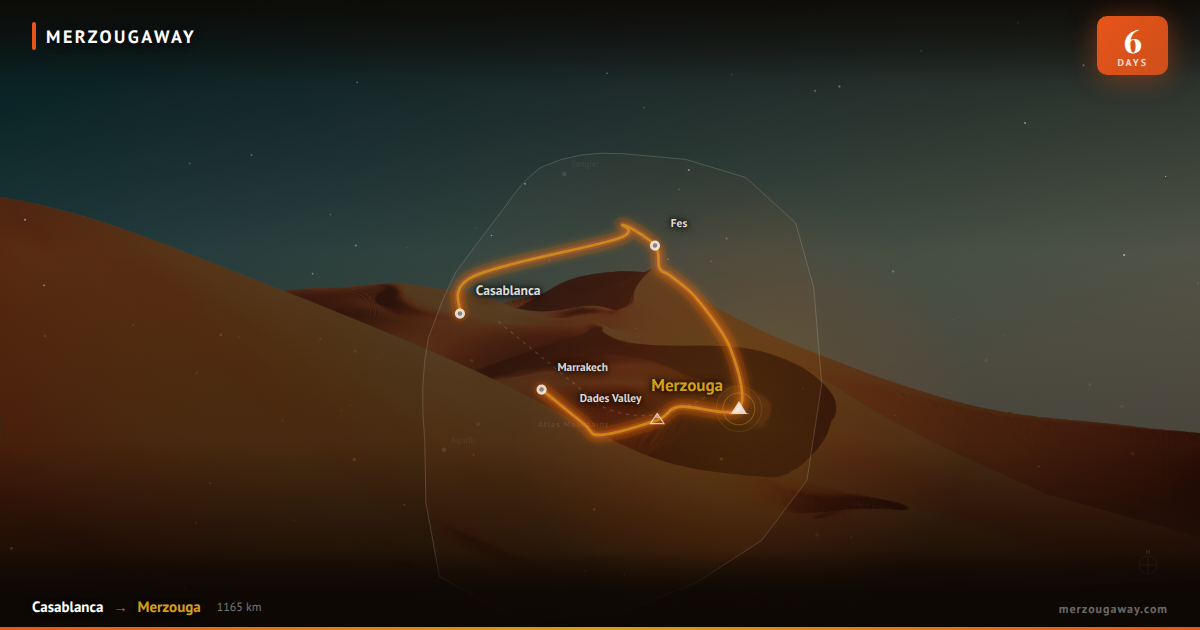
Grand 6-Day Casablanca to Merzouga & Marrakech: Complete Morocco Experience
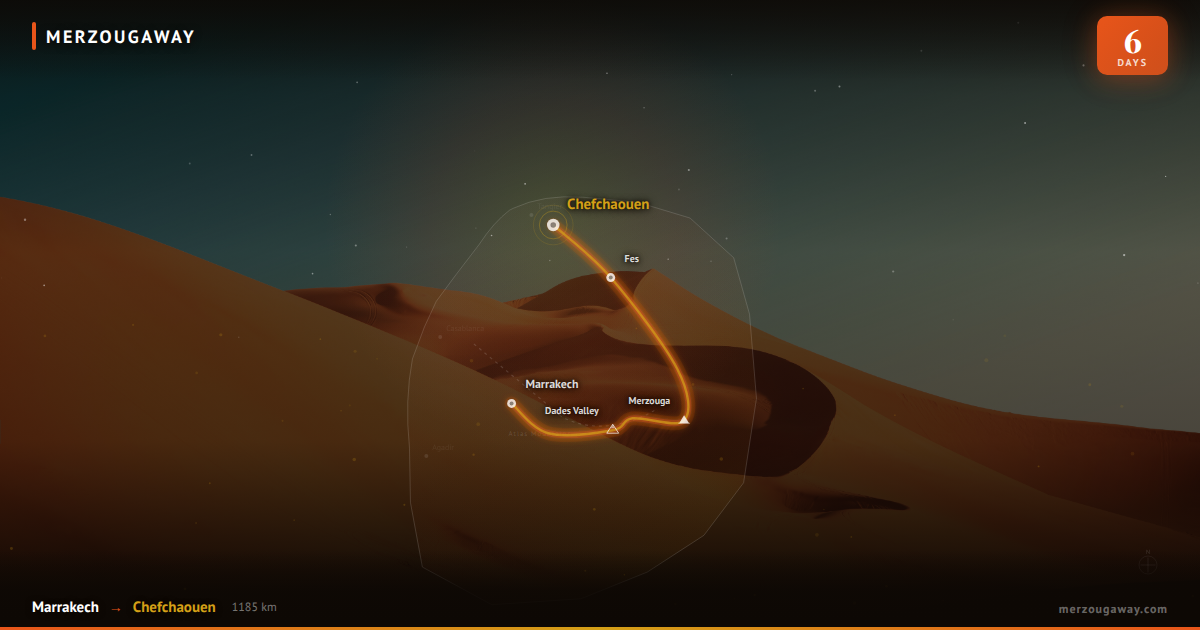
6-Day Marrakech to Chefchaouen One-Way Tour via Desert & Fes
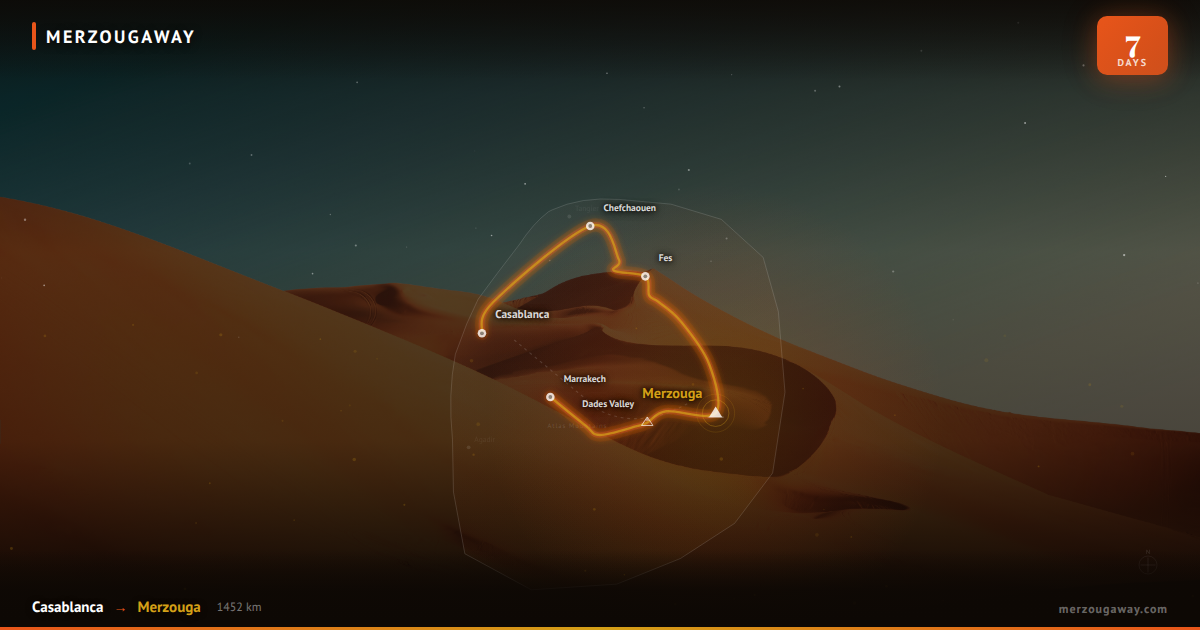
Ultimate 7-Day Casablanca to Merzouga & Marrakech: Grand Morocco Adventure
More Activities You'll Love
Explore more things to do in Morocco
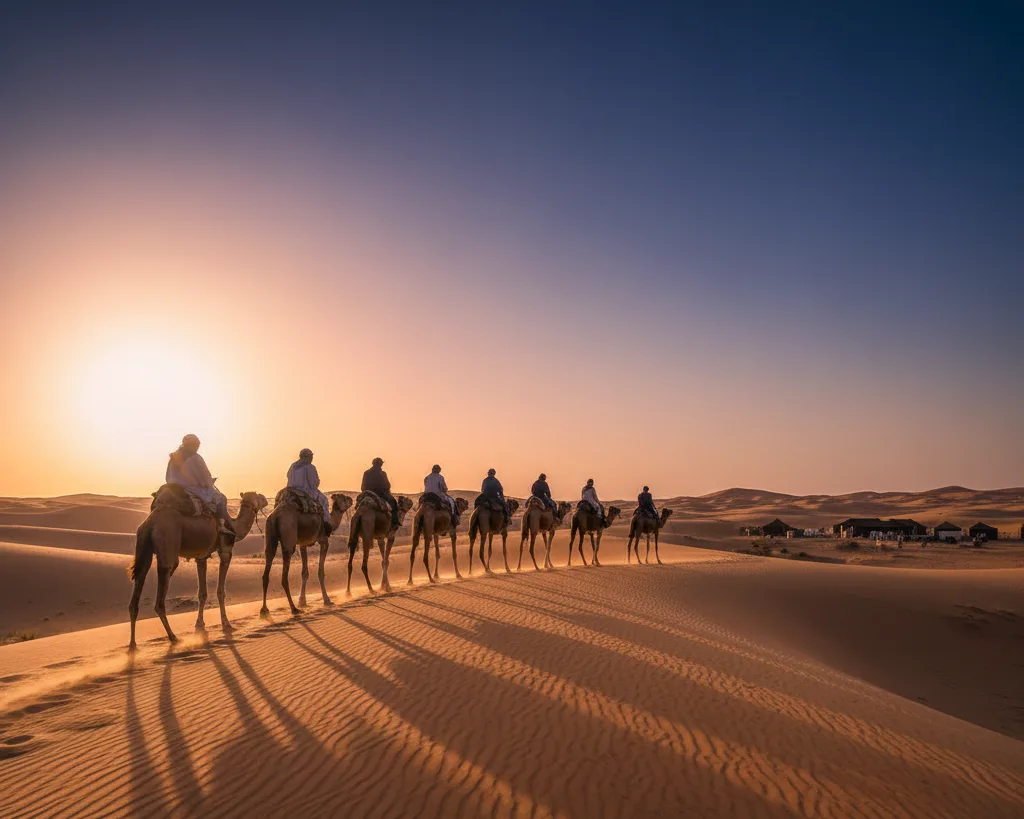
Camel Ride in the Sahara Desert
Experience the timeless magic of the Sahara on camelback. Watch the sun set over Erg Chebbi's golden dunes on a guided camel trek.
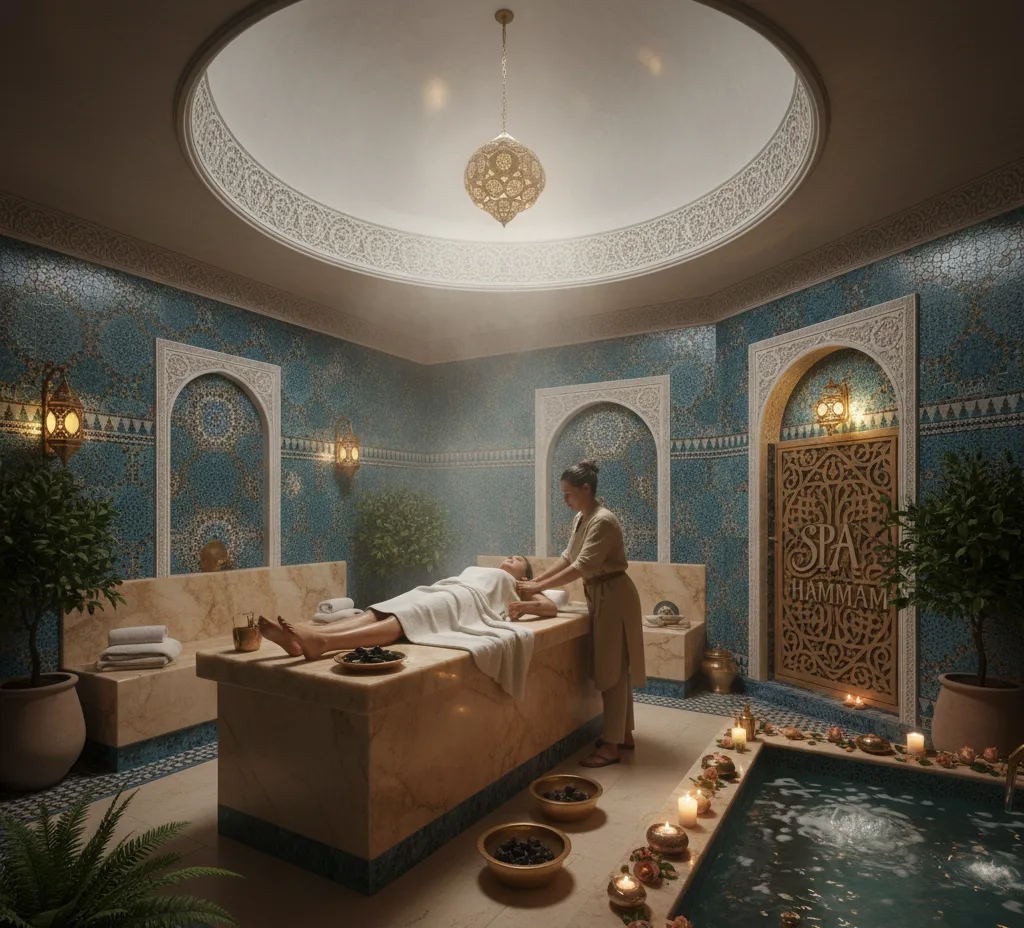
Traditional Hammam & Spa Experience in Marrakech
Unwind with a traditional Moroccan hammam in the heart of Marrakech. Steam, black soap scrub, and argan oil massage in an authentic riad spa.
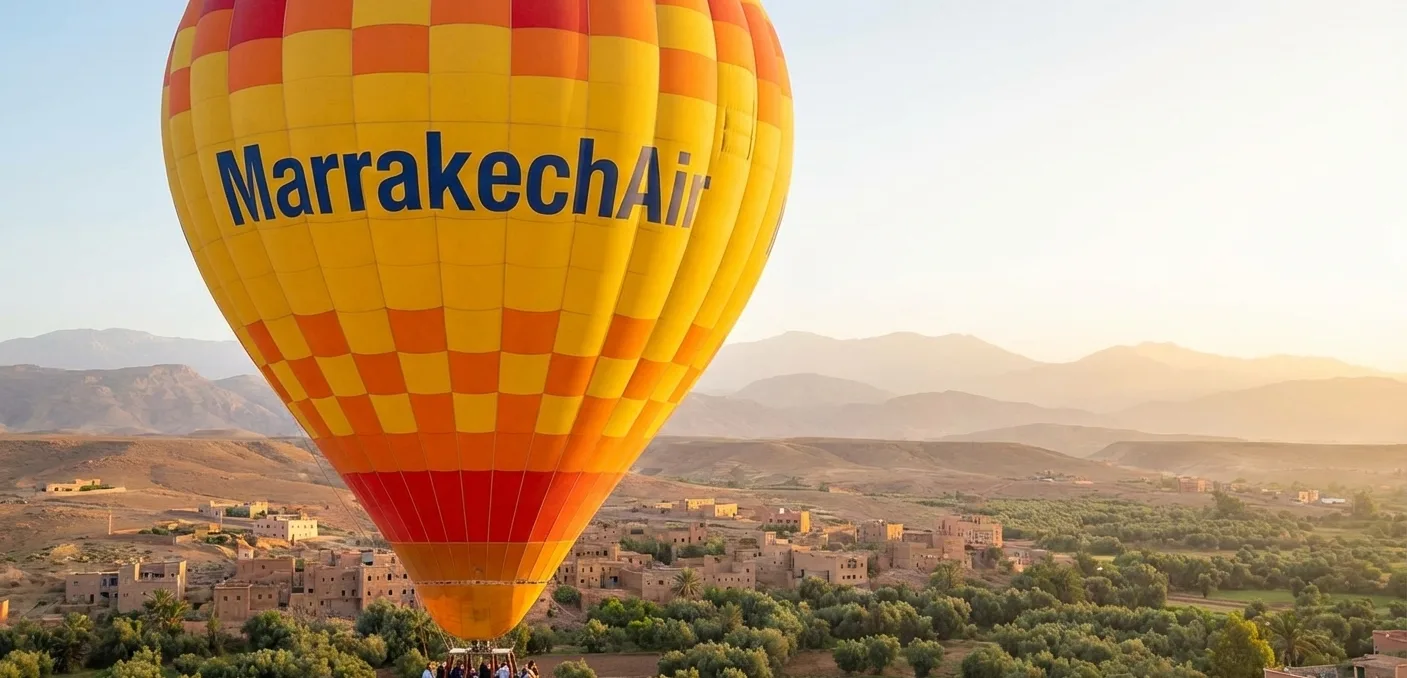
Hot Air Balloon Ride over Marrakech
Float silently above the ancient city of Marrakech at sunrise. A hot air balloon over the Palmeraie and Atlas Mountains offers an unforgettable perspective of Morocco.