Atlas Mountains Trekking & Berber Villages (2-Day)
🌟 Overview
The High Atlas Mountains rise like a wall behind Marrakech — snow-capped peaks, deep river valleys, and traditional Berber villages that haven't changed in centuries. This 2-day trek takes you off the tourist trail and into the heart of the mountains, walking through terraced farms, walnut and cherry orchards, and small stone villages where families still live the way their ancestors did.
You'll sleep in a traditional Berber guesthouse, eat home-cooked meals with your host family, and wake up to views of Mount Toubkal — North Africa's highest peak. This is a world away from the medina and the desert, and it's only 90 minutes from Marrakech. Whether you're a first-time trekker looking for an accessible mountain experience or a seasoned traveller seeking genuine cultural immersion, this two-day journey delivers something that no guided tour of a palace or souk ever can: the quiet, unhurried rhythm of Berber mountain life.
Tour Highlights
- Berber villages: walk through Imlil, Armed, and smaller hamlets with terraced fields
- Mountain scenery: snow-capped peaks, dramatic valleys, and cascading rivers
- Mount Toubkal views: see North Africa's highest peak from the trail
- Guesthouse stay: sleep in a traditional Berber home, eat family meals
- Cultural immersion: tea with families, learn about mountain agriculture and daily life
- Varied terrain: river valleys, orchards, high plateaus, and rocky trails
Why Choose This Trek?
- Authentic Morocco: see a side of the country most visitors miss entirely
- No Camping Needed: comfortable guesthouse with beds, blankets, and hot meals
- Moderate Difficulty: suitable for anyone with reasonable fitness — no mountaineering skills required
- Year-Round: spring for wildflowers, summer for orchards, autumn for harvest, winter for snow
- Great Combo: pair with a desert tour for the ultimate mountains-to-Sahara experience
Who Is This Tour For?
This trek is designed to be genuinely accessible without sacrificing authenticity. Here's a quick guide to help you decide if it's the right fit:
| Traveller Type | Is This Trek Right for You? |
|---|---|
| First-time trekker | ✅ Yes — moderate pace, no technical terrain |
| Solo traveller | ✅ Yes — guides provide safety and local connection |
| Couple or small group | ✅ Yes — intimate experience, flexible pace |
| Family with older children (10+) | ✅ Yes — engaging, educational, memorable |
| Senior traveller with good fitness | ✅ Yes — mule support available for bags |
| Toubkal summit aspirant | ❌ Better suited to our 3-day Toubkal trek |
| Traveller with limited mobility | ❌ Uneven mountain trails make this unsuitable |
| Someone expecting hotel-style comfort | ❌ Guesthouse is simple but clean and warm |
Difficulty Guide
What Does "Moderate" Actually Mean?
The word "moderate" is overused in trekking descriptions, so here's exactly what to expect on this route.
Daily walking distance: 10–14 km per day across both days combined, split into morning and afternoon sessions with a lunch break in between.
Elevation profile: You begin at Imlil at approximately 1,740 metres above sea level. The trail climbs steadily through the valley, reaching viewpoints and village stops between 2,000 and 2,500 metres on Day 1. The highest point of the route sits around 2,400–2,500 metres. Day 2 involves a predominantly downhill descent through an alternate valley, with one optional short climb to a panoramic viewpoint.
Terrain type: A mix of stone-paved mule paths, dirt trails through orchards, rocky sections along river gorges, and occasional loose scree on steeper ascents. There are no vertical scrambles or exposed ridgelines.
What "moderate" means in practice:
- You should be comfortable walking uphill for 60–90 minutes without needing to stop repeatedly
- You do not need hiking poles, although they are welcome
- The pace is relaxed — this is not a race, and your guide will adjust for your group
- A mule carries your main bag between guesthouses, so you only manage a small daypack
Cumulative ascent: approximately 600–700 metres on Day 1, with most of that gain recovered on the Day 2 descent.
Honest benchmark: if you can comfortably walk for three hours in hilly terrain — think a long coastal walk or a hill country ramble — you can do this trek.
What Makes This Different from the Toubkal Trek?
Many travellers arrive in Marrakech with Mount Toubkal on their minds. It's understandable — at 4,167 metres, it's the highest peak in North Africa and a genuine bucket-list achievement. But the Toubkal summit trek and this Berber village trek serve very different purposes, and understanding the difference will help you choose wisely.
| Feature | Berber Village Trek (This Tour) | Toubkal Summit Trek |
|---|---|---|
| Duration | 2 days | 2–3 days |
| Maximum altitude | ~2,400–2,500m | 4,167m |
| Altitude sickness risk | Very low | Moderate to significant |
| Physical demand | Moderate | Strenuous to challenging |
| Cultural immersion | Deep — village life, family meals | Limited — focus is on summit |
| Suitable for beginners | Yes | No — prior mountain experience recommended |
| Accommodation | Traditional Berber guesthouse | Mountain refuge hut (basic) |
| Key reward | Cultural connection + mountain scenery | Summit achievement + panoramic views |
In short: if your goal is to experience Berber culture, sleep in a village home, and walk through living landscapes with a human story at every turn, this trek is the better choice. If your goal is to stand on the roof of Africa, speak to us about our Toubkal summit itinerary. Many travellers do both on the same trip.
Itinerary
Day 1 — Marrakech to the Atlas Mountains
Morning (8:00 AM)
Your guide collects you from your Marrakech hotel or riad at 8:00 AM, and within minutes the city begins to fall away behind you. The road south climbs through the flat Haouz plain before the pale brown foothills of the Atlas appear on the horizon, growing larger and more dramatic with every kilometre. By the time you reach the Tizi n'Tichka road junction and begin the ascent in earnest, you'll understand why travellers who make this journey often say it feels like entering another country entirely. After approximately 90 minutes, you arrive in Imlil (1,740 metres) — a small, energetic village that serves as the main gateway to the Toubkal massif. Here you'll meet your local Berber mountain guide, adjust your daypack, and take your first steps onto the trail.
Morning Trek (10:00 AM – 1:00 PM)
The trail leaves Imlil along the valley floor, immediately threading through a patchwork of terraced fields carved into the hillside over generations. In spring, the air carries the scent of wild herbs and blossoming cherry trees; in summer, the orchards are heavy with walnuts and apricots; in autumn, harvested barley is spread across flat stone threshing floors to dry. You'll cross narrow stone bridges over fast-moving irrigation channels — khettaras — that bring snowmelt down from the peaks above, feeding crops that have grown here since the medieval period.
After about an hour, the path climbs into Armed (Aremd), one of the highest permanently inhabited villages in the valley, perched dramatically on a rocky promontory above the river. Stone and mud-brick houses stack against the hillside in earthy tones that blend almost perfectly with the mountain behind them. Your guide may stop here to introduce you to a local family — an invitation to sit, drink sweet mint tea, and practise a few words of Tachelhit Berber. These moments are unscripted and genuinely warm.
Lunch (1:00 PM)
Lunch is served at a family house — one of the most memorable meals many travellers have in Morocco precisely because of its simplicity and sincerity. Fresh bread emerges hot from a clay oven. A vegetable tagine, slow-cooked over charcoal, arrives at the table alongside a spread of salads — grated carrot, roasted pepper, spiced tomato. Seasonal fruit follows, then mint tea poured with theatrical height to create a light foam in the glass. Eat slowly. There's no rush here.
Afternoon Trek (2:30 – 5:00 PM)
The afternoon section of the trail moves into higher, more open terrain where the valley walls fall away and the sky seems impossibly large. Rocky paths wind between sparse juniper trees and exposed ridgelines, and at several points the trail opens onto panoramic viewpoints directly facing the great southern face of Mount Toubkal. At 4,167 metres, the summit is usually dusted with snow well into spring. Your guide will point out the surrounding peaks by name — Ouanoukrim, Timesguida, Aksouâl — and explain the role each plays in the local mythology and seasonal herding cycles.
The afternoon also takes you along a narrow mountain river gorge, where the sound of water echoes off the cliffs and the shade offers welcome relief in summer heat. By around 5:00 PM, the trail delivers you into your guesthouse village — a cluster of stone buildings that seems to grow organically from the mountainside.
Evening — Guesthouse Life After Dark
This is where the trek reveals its real soul. Your room is simple: firm beds with heavy woollen blankets, a small window, stone walls that hold the day's warmth well into the night. There are no televisions, no notifications, and no noise beyond what the mountain provides. After washing off the day's trail dust, step out onto the guesthouse terrace.
The light at this hour is extraordinary. From roughly 5:30 PM, the setting sun catches the western faces of the peaks and turns them amber, then rose, then deep purple — a slow colour show that takes about 45 minutes to complete. If you have a camera, this is your moment. If you don't, it doesn't matter. The view works perfectly well with just your eyes.
Dinner is served around 7:00–7:30 PM, often around a low communal table in the family's main room. Expect harira — the thick, warming Moroccan soup of tomato, lentils, chickpeas, and spices — followed by a mixed salad spread, a tagine of chicken or lamb with preserved lemon and olives, and perhaps a Berber omelette fragrant with cumin and herbs. Bread is ever-present. The family may join you at the table or sit nearby; conversation flows through your guide, through gestures, through the universal language of sharing food.
After dinner, the terrace becomes a natural observatory. At altitudes above 2,000 metres with no nearby city glow, the Milky Way is not a faint smear but a full architectural feature of the sky — a dense river of stars arching from horizon to horizon. The village itself falls quiet early. You'll hear the sound of the river below, the occasional bark of a dog, perhaps the call to prayer drifting up from the valley. Sleep comes easily here.
Day 2 — Mountain Walk & Return
Morning (7:30 AM)
The mountains wake up before you do. By the time you open your eyes, the peaks above the guesthouse are already catching the first sharp light of the day — a pale gold that creeps down the rock faces as sunrise advances. Step outside with your coffee and watch the valley below emerge from shadow. The air at this hour is cold, clean, and genuinely reviving. Breakfast arrives at the table: msemen (layered Moroccan flatbreads), honey from local hives, argan or olive oil, fruit jam, soft cheese, and strong coffee or mint tea. Eat well — the morning walk deserves fuel.
Morning Trek (8:30 AM – 12:30 PM)
Day 2's route descends through a completely different valley, ensuring the return journey feels as fresh as the approach. The trail passes through a landscape that shifts from high rocky terrain to gentler, cultivated slopes as you lose altitude. Seasonal waterfalls thread down cliff faces in spring and early summer, disappearing to trickles by late August. Ancient stone threshing floors — circular flat platforms cut into the hillside — speak to agricultural traditions that predate the arrival of Islam in these mountains.
The villages you pass through on the descent are quieter and less visited than those on the main Imlil trail. Children playing on flat rooftops will wave enthusiastically; elderly men sitting outside a shop may nod and offer a greeting; women carrying loads of firewood on their backs will smile and look away. This is everyday Berber life, not a performance for visitors. Walk respectfully, move at a gentle pace, and let your guide narrate the details that a photograph can't capture.
Before returning to Imlil, your guide may lead you on a short optional detour to a final high viewpoint — a rocky outcrop or ridge that offers one last panoramic sweep across the massif. This is your farewell look at Toubkal. Take your photo. Take a breath. Then begin the final descent.
Lunch & Departure (1:00 PM)
Back in Imlil, lunch is taken at a local restaurant — a relaxed meal of salads, bread, and a main course — before the vehicle collects you for the return drive to Marrakech. You'll arrive back at your accommodation between 3:00 and 3:30 PM, returning to the city with dusty boots, a full memory card, and a clearer picture of what Morocco looks like beyond the medina walls.
📅 Book your mountain adventure — swap the medina for the peaks!
Included & Not Included
- • Round-trip transfer from Marrakech
- • Experienced English-speaking mountain guide
- • 1 night in a Berber mountain guesthouse
- • All meals (lunch x2, dinner, breakfast)
- • Mule for luggage transfer
- • Soft drinks and bottled water
- • Tips for guide and guesthouse staff
- • Travel insurance
- • Personal trekking gear
Frequently Asked Questions
How difficult is the trek?
This trek is rated moderate, which means it is accessible to most healthy adults without any specialist training or equipment. You'll walk 4–6 hours per day across mixed mountain terrain — stone paths, dirt trails, river gorges, and some steeper ascents. The most demanding sections are relatively short, and the pace is entirely flexible. A mule carries your main luggage between stages, so you only manage a light daypack. If you walk regularly and feel comfortable on uneven ground, you will manage this comfortably.
What should I know about altitude on this trek?
The trek reaches approximately 2,200–2,500 metres at its highest points. This is well below the threshold at which altitude sickness (acute mountain sickness) becomes a genuine concern for most people — that typically begins above 3,000 metres for susceptible individuals. You may notice slightly heavier breathing on steep sections, and some people feel mildly lightheaded on their first day at elevation, but these sensations usually pass quickly. If you have a history of heart or respiratory conditions, consult your doctor before booking. Staying well hydrated throughout both days makes a significant difference.
Can I get altitude sickness on this route?
Serious altitude sickness is extremely unlikely at the elevations covered on this trek. True altitude sickness — involving severe headache, nausea, disorientation, or difficulty breathing at rest — is primarily a risk above 3,000 metres, particularly when ascent is rapid. Because you drive up to 1,740 metres and then ascend gradually on foot, your body has time to adjust. As a precaution, drink at least two litres of water per day, avoid alcohol on the first evening, and let your guide know immediately if you feel unwell. We carry basic first aid supplies and know these trails well.
What should I wear and bring?
Sturdy walking shoes or hiking boots are essential — trainers with flat soles are manageable but not ideal on rocky descents. Dress in layers: mornings and evenings above 2,000 metres can be cold even in summer, while afternoons on the trail can be warm. A lightweight waterproof jacket is worthwhile year-round. Bring sunscreen and a hat — UV intensity at altitude is higher than at sea level. A 1.5–2 litre water bottle or hydration pack, a small first aid kit, any personal medication, and cash for tipping round out your essentials. We provide a full kit list on confirmation.
Is photography welcome in the villages?
Photography is welcome in the landscape and in open areas, but Berber mountain communities deserve the same respect you would offer anywhere in the world. Always ask permission before photographing individuals — your guide will help facilitate this naturally during the trek. Many local women prefer not to be photographed, and this preference should be respected without question. Children are generally enthusiastic about photos and will often request to see the result on your screen. Photographing daily life — a weaver, a shepherd, a family lunch — is perfectly normal when done with courtesy and awareness. Delete images if requested.
Is this trek suitable for families with children?
Yes, for families with children aged 10 and above who are reasonably active. The trek is not suitable for very young children given the uneven terrain, full-day walking distances, and altitude. Older teenagers tend to find the experience genuinely engaging — the combination of physical challenge, cultural encounter, and excellent food makes a strong impression. If you're travelling as a family, let us know when booking so we can adjust the pace, add extra rest stops, and arrange additional mule support for younger walkers' daypacks if needed.
Duration
2 Days, 1 Night
Group Type
Private
Transportation
4×4 or Minibus
Payment Methods
PayPal
Bank Transfer (IBAN)
Only 10% deposit required
Email:
[email protected]What Our Travelers Say
Real reviews from Google and TripAdvisor
We traveled to Morocco in a group of 6 adults, including my parents, who are already seniors, in the middle of summer. For my family it was a leap of faith to trust an agency we found online for the first time, but it turned out to be a wonderful surprise. Hamid, the trip organizer, was very kind and attentive both before and throughout the whole tour. It was a fully personalized tour - we got to do everything we wanted, from visiting the Sahara to enjoying the beach. He always looked out for our comfort, especially my parents': comfortable transport, well-timed stops at places with restrooms, beautiful air-conditioned hotels, and varied, plentiful food. Thanks to his organization we were able to enjoy the trip with real peace of mind. It was a great experience we would absolutely recommend.
Last week I did a self-drive trip from Fes to Merzouga, leaving the car rental, the riad in Merzouga, the desert camp, and the guided desert activities all in the hands of MerzougaWay and Hamid, and I can only say that everything was perfectly organized, right on time. Thanks to everyone at the riad we stayed at and the desert camp, as well as the guides who joined us for the 4x4 experience, Berber culture, and the camel transfer. Thanks to Hamid and MerzougaWay for that quad-bike ride back to the riad from the camp - what an experience, riding a quad across the dunes early in the morning. If you're thinking of traveling to Merzouga, I definitely recommend Hamid as the organizer of your adventure.
Excellent!! We loved the tour. Thank you Hamid for everything. Everything well organized, the guide Eljo (Elhousain) was very attentive, highly recommend. Everything super clean, we had a great driver, we felt very safe with him. Unbeatable desert excursion. Thanks MerzougaWay!
Trustworthy tour agency. I wrote Hamid what I wanted and he just made it happen. He arranged everything so quick and smooth. We had a 3-day Merzouga tour from Marrakech. Said was our guide and he made me and my wife very comfortable. He took us from our riad and carried us in his modern 4x4 Toyota to magnificent places. He gave us the confidence to ask him whatever we wanted to do and wherever we wanted to drive - like old friends. He is open-minded and respectful. I recommend asking the agency for Said to be your driver. In the 3-day tour you cross the Atlas mountains, stay one night in a perfect hotel in Dades with great food, then stay one night in Erg Chebbi dunes in a luxury glamp camp. One night wasn't enough for a real desert experience - if you have time, take two nights in the desert.
Unforgettable holiday. An 8-day itinerant tour in Morocco, including 3 days organized by Hamid - MerzougaWay: a route from Fes to Marrakech, spending a night in the desert and in Ouarzazate. Our guide Youssef, who drove us all along the way, was very professional and took us to try real experiences that not all tourists get to see. Breathtaking landscapes - Morocco amazed and fascinated us. We drove many miles but still traveled comfortably. Absolutely recommend it - they are a highly professional agency and managed to take us to unique places, like a Berber village in the desert where we were the only tourists. A spectacular, unforgettable experience.
Morocco from the heart with MerzougaWay. Heartfelt congratulations to Hamid, who organized our trip impeccably - present, correct, and extremely helpful. A special mention for our driver Ali, who was by our side through 3 intense days toward the desert: attentive, polite, discreet, and a genuinely good, nice driver. We found snow in the Atlas range and then sun in Ait Ben Haddou, visited women's cooperatives working argan oil and roses, saw the Dades Gorges, and finally reached the Sahara dunes by camel before sleeping in a tented desert camp. 3 intense and exciting days. Next time in Morocco I'll rely on you again, inshallah!
Read more reviews on
Ready to Start Your Adventure?
Contact us today and let's plan your perfect Moroccan desert experience

MerzougaWay Team
We are a passionate team of local guides dedicated to sharing the beauty and culture of our home, Morocco. Our journey began with a simple desire to offer authentic, memorable experiences that go beyond the typical tourist trails.
Complete Your Morocco Trip
Two more services from our team, based in Marrakech.
You Might Also Like
Discover more amazing tours in Morocco
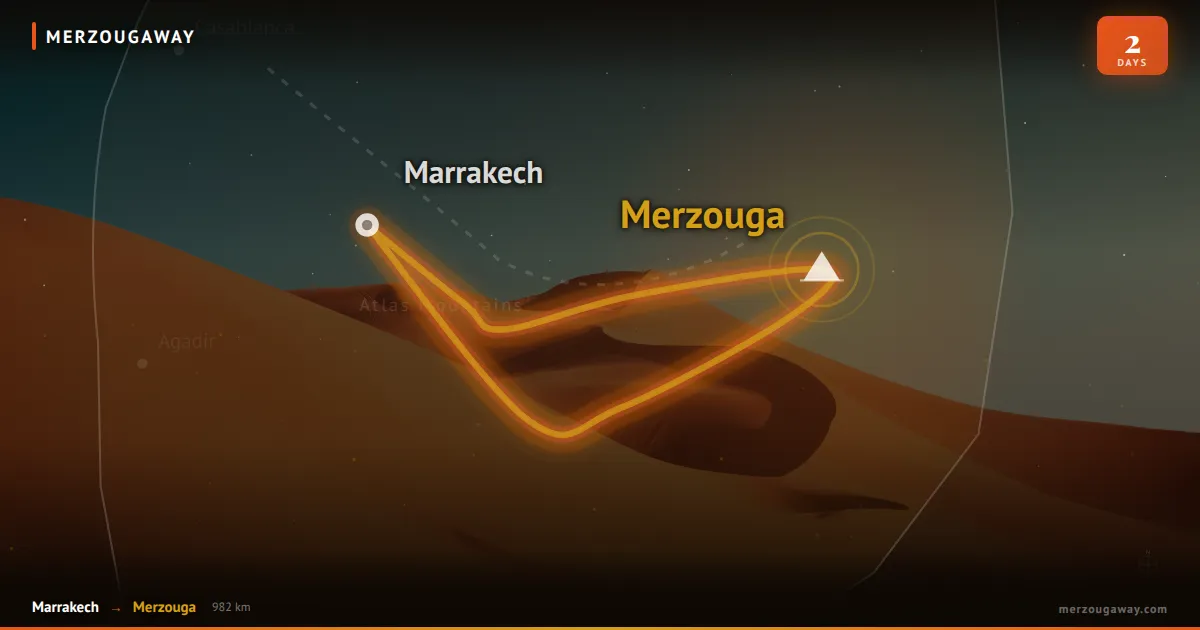
2-Day Marrakech to Merzouga Sahara Desert Tour & Camel Trek
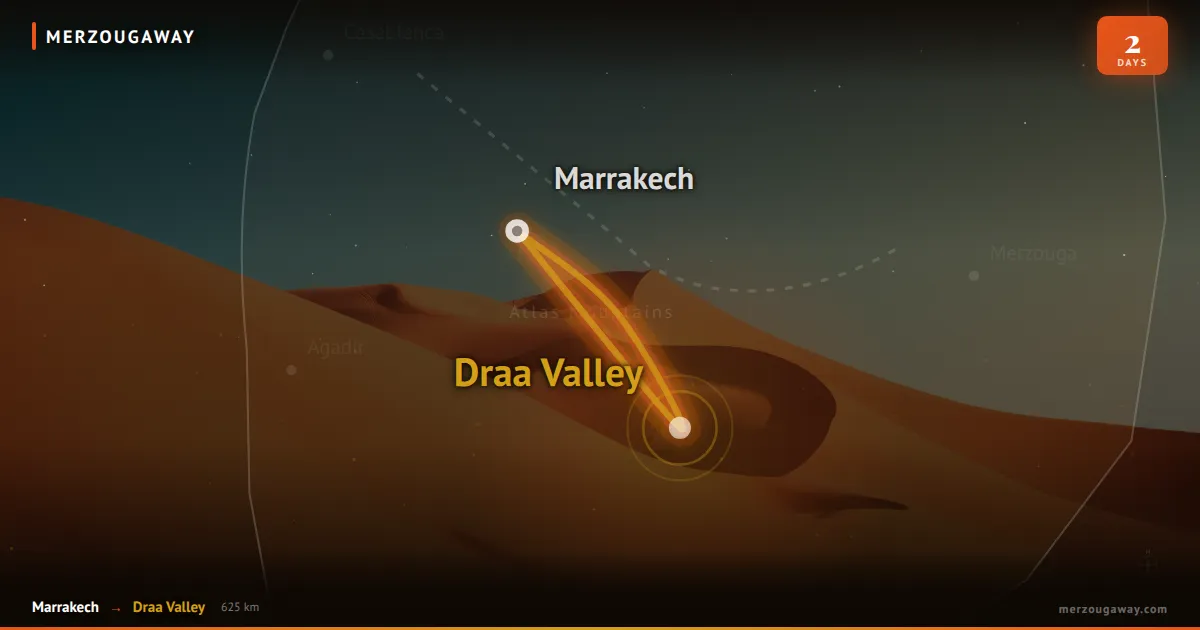
2-Day Marrakech to Zagora Desert Tour: Draa Valley & Sahara Camp
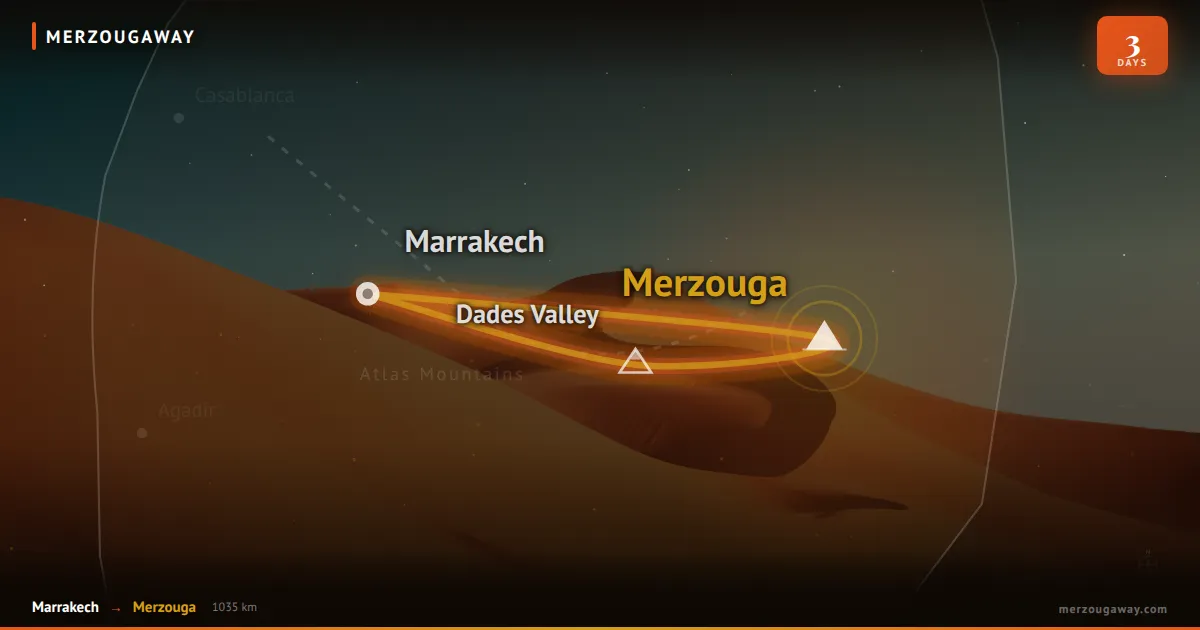
3-Day Marrakech to Merzouga Honeymoon Escape
More Activities You'll Love
Explore more things to do in Morocco
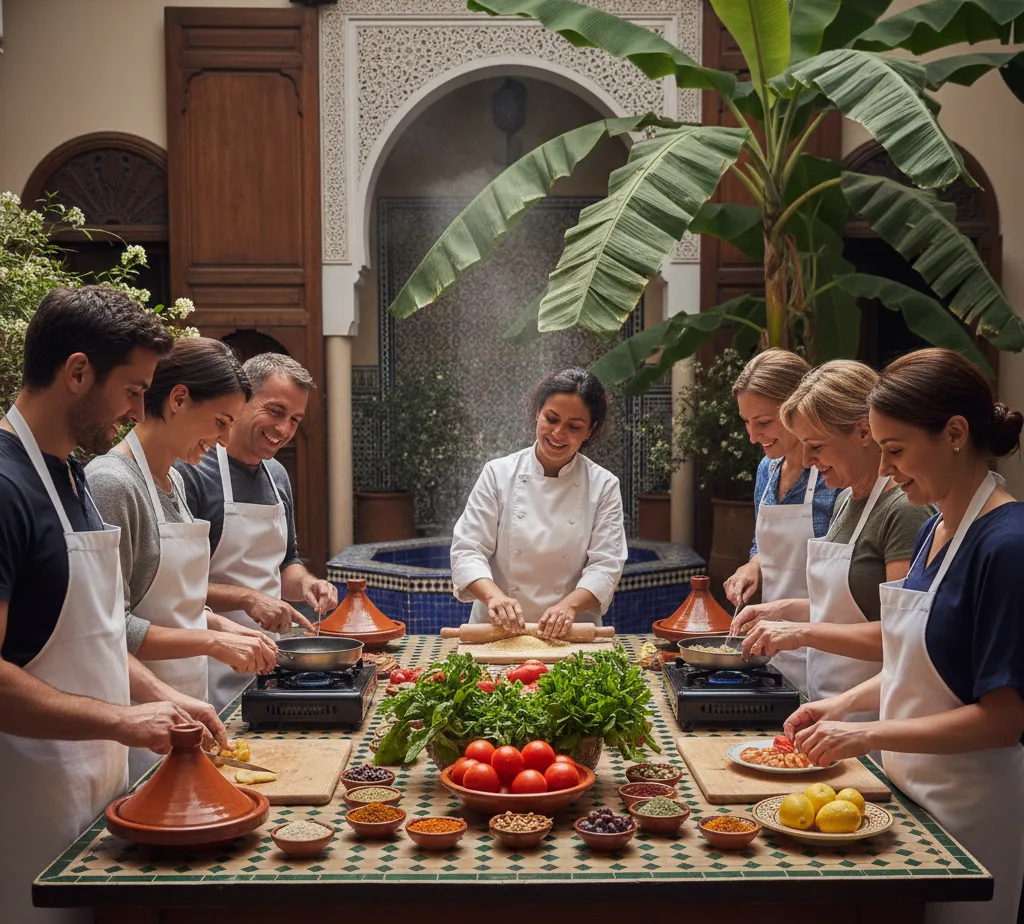
Moroccan Cooking Class in Marrakech
Learn to cook authentic Moroccan dishes — tagine, couscous, pastilla — with a local family in Marrakech. Visit the souk for spices, then cook and eat together.
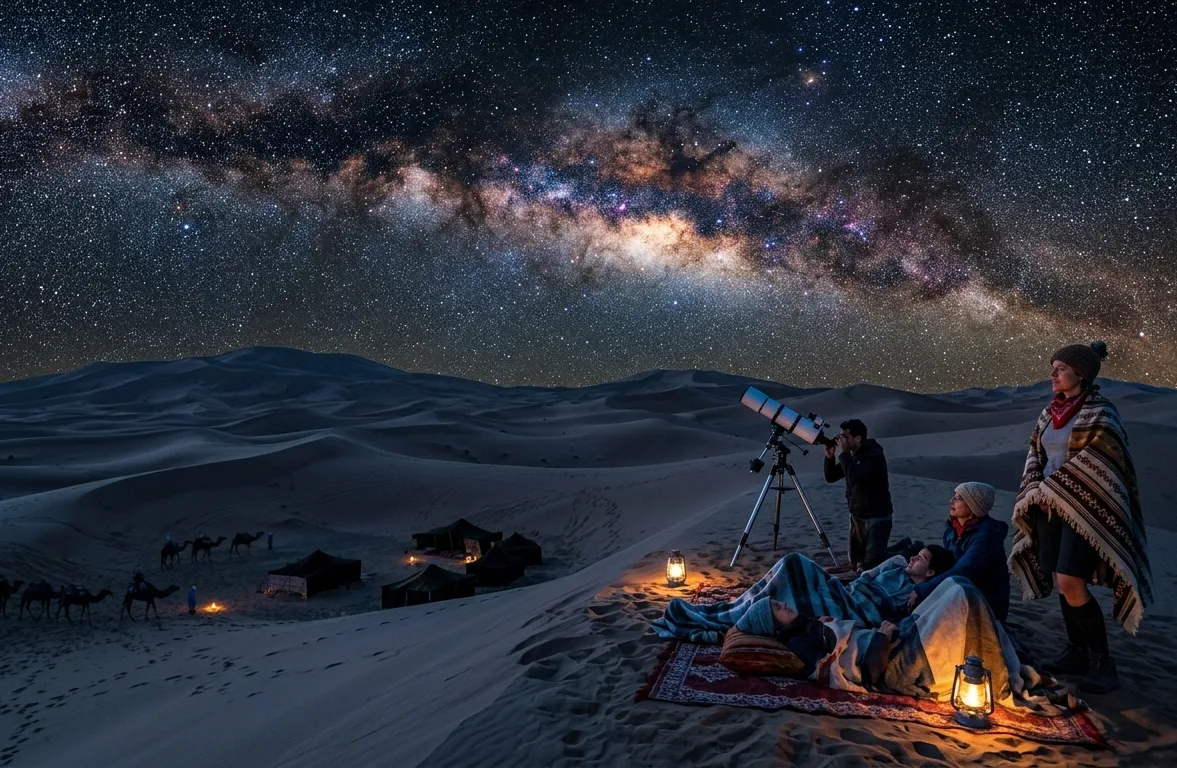
Sahara Stargazing Experience
The Sahara has zero light pollution and one of the clearest skies on Earth. A guided stargazing night in Merzouga is an astronomical experience you won't forget.