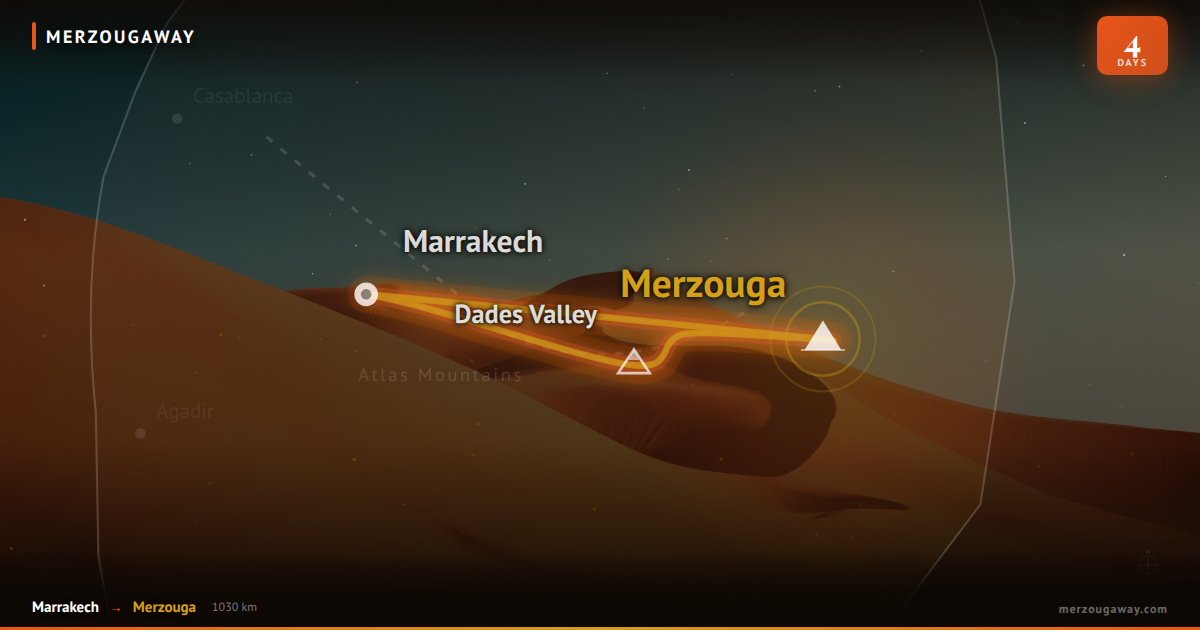
Merzouga International Music Festival Tour (October Seasonal)
🌟 Overview
Every October, the sands of Merzouga come alive with the Merzouga International Music Festival — an extraordinary open-air event featuring traditional Saharan, Gnawa, Berber, and world music performed under the stars at the foot of the Erg Chebbi dunes. This tour combines the festival experience with the classic desert adventure: camel treks, luxury camping, and stunning landscapes along the way.
There's no venue like it anywhere in the world — a natural amphitheatre of towering golden dunes, the Milky Way blazing overhead, and the deep, resonant pulse of ancient desert music rising into the cool night air. The Sahara itself becomes the concert hall, and the experience stays with you long after the last note fades.
This is not a packaged festival holiday in the conventional sense. It is a living cultural immersion — a chance to sit close to masters of the guembri, to feel the trance-like rhythms of Gnawa ceremony music vibrate through the sand beneath you, and to understand, firsthand, why the desert has always been a place of profound spiritual and artistic expression.
Tour Highlights
- Merzouga Music Festival: live performances in the desert under the stars
- Traditional Saharan, Gnawa, and world music from local and international artists
- Sunset camel trek across the Erg Chebbi dunes
- Overnight in a luxury desert camp
- Scenic route through the Atlas Mountains and Dades Gorges
- Cultural immersion with local musicians and communities
- Visit to Khamlia village, the heartland of Gnawa tradition near Merzouga
- October only: a unique, unrepeatable seasonal experience
Why Choose This Tour?
- Exclusive Festival Access: this experience simply does not exist at any other time of year — October is your only window
- Unrivalled Venue: music performed in the Sahara under the stars is unlike any concert stage on earth
- Full Package: festival access, desert adventure, scenic mountain drive, and cultural visits combined into one seamless journey
- Cultural Depth: connect with Morocco's living, breathing musical traditions — Gnawa, Tuareg blues, Berber rhythms — not as a tourist spectacle, but as a genuine participant
- Perfect Weather: October brings cool nights, warm days, and crystal-clear desert skies — one of the finest months of the year to visit Merzouga
- Private Experience: your own group, never combined with strangers at the festival grounds
Who Is This Tour For?
This festival tour attracts a wonderfully diverse range of travellers. Use the table below to see if it fits your travel style:
| Traveller Type | Is This Tour Right for You? |
|---|---|
| Music lovers and world music fans | ✅ Absolutely — this is the core experience |
| First-time visitors to Morocco | ✅ Yes — a perfect introduction combining culture, landscape, and music |
| Adventure travellers | ✅ Yes — camel treks, desert camping, mountain roads |
| Couples seeking a romantic escape | ✅ Yes — sunsets over the dunes and starlit evenings |
| Solo travellers | ✅ Yes — a welcoming, communal atmosphere |
| Families with older children (12+) | ✅ Yes — with some flexibility on late-night festival hours |
| Families with very young children | ⚠️ Consider carefully — late-night performances may be challenging |
| Luxury-only travellers | ✅ Yes — luxury tent accommodation is included |
| Budget backpackers | ⚠️ Basic camp alternatives may be available — ask us |
Itinerary
Day 1 — Marrakech → Atlas Mountains → Dades Valley
Your driver and guide will collect you from your Marrakech accommodation at 7:30 AM, giving you the full day to absorb one of Morocco's most dramatic overland routes before arriving comfortably at your first night's rest.
Leaving the red city behind, you climb steadily into the High Atlas Mountains, the air cooling noticeably as the urban bustle gives way to Berber villages clinging to steep valley walls. The road crests at the Tizi n'Tichka Pass at 2,260 metres — a sweeping panorama of ridgelines and canyon shadows that sets the tone for everything that follows. Your guide will point out the traditional earthen architecture of the villages as you descend toward the pre-Saharan landscape.
Around midday, you arrive at Aït Ben Haddou, a UNESCO World Heritage Site and one of the finest surviving examples of southern Moroccan ksar (fortified village) architecture. The honey-coloured towers rise above the dry riverbed like a film set — because it actually has been one, for Lawrence of Arabia, Gladiator, and Game of Thrones among others. Allow an hour to explore the interior alleyways and climb to the hilltop granary for a view across the valley.
Continuing east through Ouarzazate — Morocco's so-called Hollywood of the desert — you follow the road deeper into the pre-Saharan valley to reach the Dades Valley by late afternoon. The towering rust-red rock formations of the Dades Gorges glow in the low golden light of early evening — an ideal short walk before dinner. You'll dine on a traditional Moroccan menu at your guesthouse and rest well before an early start tomorrow. Overnight: Dades Valley guesthouse.
Day 2 — Dades Valley → Todra Gorge → Merzouga (Festival Night 1)
After breakfast at the guesthouse, the morning belongs to Todra Gorge — one of Morocco's most spectacular natural wonders. The road threads between limestone canyon walls that rise nearly 300 metres on either side, narrowing to a slot of blue sky above as a clear mountain stream runs along the base. This is a popular spot for local climbers and a breathtaking place for a morning walk. Arrive early (around 8:30–9:00 AM) before tour buses arrive, and you'll have the echo of the gorge almost to yourself.
From Todra, the landscape opens dramatically as the road descends toward the Saharan fringe. The colours shift from ochre to rose to pale gold, the vegetation thins, and the horizon stretches to an immense distance. By early afternoon you begin to see the first hints of the Erg Chebbi — the enormous sand dune field that rises, almost impossibly, from the flat hammada plain south of Merzouga. At up to 150 metres high, these are some of the tallest dunes in Morocco, and the sight of them materialising on the horizon never loses its impact no matter how many times you make this journey.
You'll arrive in Merzouga in the mid-afternoon with time to freshen up before the main event. At sunset — around 6:00 PM in October — you mount your camels and begin the slow, rhythmic trek into the Erg Chebbi dunes. The light is extraordinary at this hour, the sand cycling through shades of amber, copper, and deep violet as the sun drops. Your luxury desert camp sits in a sheltered hollow between the dunes, insulated from wind and noise.
After settling in and watching the stars emerge — a Saharan sky in October is genuinely one of the darkest and most star-dense skies most travellers will ever experience — the evening shifts to the festival. The open-air festival grounds are a short walk from camp, the stage lit warmly against the dark wall of the dunes. Tonight's performances typically open with local Saharan musicians and Gnawa ensembles, easing the crowd into the sound world of the desert. Dance if you feel moved to — and you will be. Overnight: luxury desert camp.
Day 3 — Merzouga (Festival Day — Full Day)
Set your alarm for 6:00 AM — this is not a morning to sleep through. Climb the nearest dune as the sky begins to lighten in the east, the colours shifting from deep indigo to peach to brilliant gold as the sun crests the horizon. The silence of a Saharan dawn is total, broken only by the wind drawing delicate ripple patterns across the sand. Few travel experiences anywhere in the world rival this one.
Breakfast at camp is served around 8:00 AM — mint tea, msemen flatbreads, honey, argan oil, and fresh fruit. The morning is yours to explore at your own pace. The most culturally rewarding option is a visit to Khamlia village, approximately 7 kilometres south of Merzouga. Khamlia is home to a community of Gnawa descent, and the musicians here are among the finest practitioners of this ancient trance-healing tradition. A private performance in one of the village houses — guembri bass lute, qraqeb metal castanets, rhythmic call-and-response vocals — is intimate, powerful, and utterly different from anything you will see on a festival stage.
Optional afternoon activities include sandboarding on the steep dune faces, quad biking across the hammada desert plain, or a quiet visit to a nomad family for tea and conversation. By mid-afternoon, rest is genuinely advisable — the evening ahead is the festival's peak night.
Festival Night 2 brings the headline performances: typically a blend of Tuareg guitar acts, Berber musicians from the High Atlas, international world music collaborations, and extended Gnawa ceremonies. Impromptu jam sessions between artists from different traditions are one of the festival's great joys — a Malian kora player sitting in with a Moroccan oud master, or a Tuareg electric guitarist trading solos with a Berber percussionist. The artisan market and food stalls running alongside the stage offer the chance to eat grilled mechoui lamb, sip spiced coffee, and browse handcrafted jewellery and textiles from Saharan craftspeople. The night ends whenever you choose — campfire music and storytelling continue long after the main stage goes quiet. Overnight: Merzouga accommodation or luxury camp.
Day 4 — Merzouga → Marrakech
Breakfast in Merzouga, with one final look at the dunes in the soft morning light. The return journey follows a different, equally beautiful route via the Ziz Valley — a lush ribbon of date palms threading through a dramatic gorge — before climbing back through the Atlas Mountains in the afternoon. Your driver will pace the stops to suit the group, and you'll arrive back in Marrakech in the early evening, in time for dinner in the medina if you choose. Drop-off is at your accommodation.
Included & Not Included
- • Private air-conditioned 4x4 or minivan
- • Professional English-speaking driver/guide
- • 3 nights accommodation (Dades area, luxury desert camp, Merzouga)
- • Daily breakfast; dinners included at desert and kasbah accommodations only
- • Merzouga Music Festival access
- • Sunset camel trek in Erg Chebbi dunes
- • Pick-up and drop-off at your Marrakech accommodation
- • Traditional Berber cheche (turban/scarf) — yours to keep
- • Polished fossil souvenir from Erfoud
- • Lunches and drinks
- • Entrance fees to monuments
- • Tips for guides and drivers
- • Festival merchandise
🎵 About the Merzouga Music Festival
- When: usually held in October (exact dates announced each year — typically mid to late October)
- Where: at the foot of the Erg Chebbi dunes, near Merzouga — one of the most dramatic natural settings imaginable
- Music styles: Saharan desert blues, Gnawa, Berber, Tuareg, and world music
- Atmosphere: intimate, open-air, under the stars — closer in feel to a boutique cultural gathering than a large commercial festival
- Artists: a curated mix of local Saharan musicians, Moroccan national artists, and international guest performers
- Instruments: guembri, bendir, qraqeb, drums, oud, sintir, and increasingly, electric guitar in the Tuareg blues tradition
- Festival size: deliberately kept small to preserve intimacy and respect for the desert environment
🎶 What to Expect at a Desert Festival
Attending a music festival in the Sahara is a fundamentally different experience from any urban or stadium concert. Understanding what makes it unique will help you arrive prepared and fully present.
The Stage and Setting The festival stage is positioned at the base of the Erg Chebbi dunes, with the sand wall rising behind the performers like a natural screen. There are no indoor spaces, no barriers between audience and landscape — the desert is simply there, enormous and indifferent, as the music plays into it. Bring a blanket or floor cushion to sit on; seating is informal and communal.
The Sound World The musical programming deliberately celebrates the indigenous music of the Saharan region. Gnawa music — rooted in sub-Saharan African spiritual traditions and brought to Morocco centuries ago — uses the deep-voiced guembri bass lute alongside percussion and repetitive vocal patterns designed to induce trance states. Tuareg blues from the Mali-Niger-Algeria triangle translates ancient desert melodies into electric guitar, a sound that has drawn comparisons to American blues for its emotional directness. Berber music from the High Atlas brings polyphonic singing, ahwach circle dances, and the piercing tones of traditional flutes. World music collaborations connect these traditions to international forms.
The Atmosphere The festival draws a passionate but relaxed crowd — travellers, music lovers, local Moroccan families, Saharan communities, and cultural pilgrims. The absence of heavy commercial infrastructure means the focus stays on the music and the landscape. Alcohol is generally not served in keeping with local customs; instead, the mood is elevated by tea, music, and the natural intoxication of the desert environment.
After Dark October nights in the Sahara cool rapidly after sunset — temperatures can drop to 8–12°C well after midnight. The contrast between the warm afternoon and the cold night sky is part of the experience, and the star visibility it enables is extraordinary. Campfire circles after the main performances are where the most memorable informal music-making often happens.
Frequently Asked Questions
When does the Merzouga Music Festival take place?
The festival is typically held in October each year, running over 3–4 consecutive evenings, usually in the second or third week of the month. Exact dates are confirmed and announced by the festival organisers several months in advance. We strongly recommend booking your tour as early as possible once dates are published, as accommodation in and around Merzouga fills rapidly during this period. Contact us and we will notify you as soon as official dates are confirmed for the coming year.
How do I get festival access — is it included in the tour price?
Festival access arrangements vary year to year depending on the event format. In most years, the festival operates on a free or low-cost entry model to ensure it remains accessible to local communities, with optional donations welcome. Where entry tickets are required, the cost is either included in your tour package or clearly communicated as a small additional fee at the time of booking. We handle all logistics so you never need to worry about queuing for entry or navigating the festival grounds alone.
What should I wear to an outdoor desert festival in October?
Layering is essential for an October desert festival. During the day, light cotton or linen clothing is comfortable as temperatures reach 25–30°C. As soon as the sun sets — which happens early in October — temperatures drop sharply, and by 10 PM you will want a warm jacket, fleece, or woollen layer. A scarf or shawl is invaluable both for warmth and for the dusty desert wind. For footwear, flat-soled shoes or trainers work best on sand; avoid heels entirely. Comfortable, casual clothing in neutral or earthy tones is the natural aesthetic for the setting.
What should I bring to the festival?
Pack light but thoughtfully. Essential items include a warm layer for cold nights, a headlamp or small torch for navigating the festival grounds after dark, a reusable water bottle (hydration is critical in the desert even at night), a small cushion or blanket for sitting on the sand, and any personal medications. A camera or phone for photography is welcome; tripods may be needed for low-light shots of the stage. Leave valuables at camp. Cash in Moroccan dirhams is useful for food stalls and the artisan market, as card payment facilities are limited.
Is the desert festival suitable for all ages?
The festival is genuinely welcoming for a wide range of ages. Adults and older teenagers will find the late-night format completely manageable and deeply rewarding. Families with younger children should be aware that headline performances often begin after 9 PM and continue past midnight — a schedule that may be challenging for small children. That said, the festival atmosphere is family-friendly in character, and we are happy to discuss adjusted arrangements or early-evening attendance for families with young children. Please speak with us at the time of booking.
What type of accommodation is available during the festival period?
Our standard tour includes overnight stays in a luxury desert camp — a beautifully appointed Berber-style tent camp with private ensuite tents, comfortable beds, electricity, hot showers, and full dinner and breakfast service. For travellers who want an even more immersive experience, basic traditional camp options are available at lower cost, with shared facilities and a simpler style closer to how local desert communities actually live. Both options place you within easy walking distance of the festival grounds. We do not recommend day-tripping to the festival from Merzouga town, as the round trip across the sand in the dark is tiring and detracts from the experience.
Can I attend the festival without booking the full 4-day tour?
In some cases, yes. If you are already based in Merzouga independently and simply wish to join the festival evenings with a local guide and camp access, we can arrange a shorter 2-night festival package covering Days 2 and 3 of the itinerary. However, the 4-day tour from Marrakech represents the complete experience — the journey through the Atlas Mountains, Aït Ben Haddou, and the Dades and Todra Gorges is genuinely part of what makes this trip memorable, and most travellers who take the shorter option tell us afterward they wish they had built in the extra days. If your schedule only allows for the festival itself, contact us and we will design a package that fits your timeframe.
Duration
4 Days, 3 Nights
Group Type
Private
Transportation
4×4 or Minibus
Payment Methods
PayPal
Bank Transfer (IBAN)
Only 10% deposit required
Email:
[email protected]What Our Travelers Say
Real reviews from Google and TripAdvisor
We traveled to Morocco in a group of 6 adults, including my parents, who are already seniors, in the middle of summer. For my family it was a leap of faith to trust an agency we found online for the first time, but it turned out to be a wonderful surprise. Hamid, the trip organizer, was very kind and attentive both before and throughout the whole tour. It was a fully personalized tour - we got to do everything we wanted, from visiting the Sahara to enjoying the beach. He always looked out for our comfort, especially my parents': comfortable transport, well-timed stops at places with restrooms, beautiful air-conditioned hotels, and varied, plentiful food. Thanks to his organization we were able to enjoy the trip with real peace of mind. It was a great experience we would absolutely recommend.
Last week I did a self-drive trip from Fes to Merzouga, leaving the car rental, the riad in Merzouga, the desert camp, and the guided desert activities all in the hands of MerzougaWay and Hamid, and I can only say that everything was perfectly organized, right on time. Thanks to everyone at the riad we stayed at and the desert camp, as well as the guides who joined us for the 4x4 experience, Berber culture, and the camel transfer. Thanks to Hamid and MerzougaWay for that quad-bike ride back to the riad from the camp - what an experience, riding a quad across the dunes early in the morning. If you're thinking of traveling to Merzouga, I definitely recommend Hamid as the organizer of your adventure.
Excellent!! We loved the tour. Thank you Hamid for everything. Everything well organized, the guide Eljo (Elhousain) was very attentive, highly recommend. Everything super clean, we had a great driver, we felt very safe with him. Unbeatable desert excursion. Thanks MerzougaWay!
Trustworthy tour agency. I wrote Hamid what I wanted and he just made it happen. He arranged everything so quick and smooth. We had a 3-day Merzouga tour from Marrakech. Said was our guide and he made me and my wife very comfortable. He took us from our riad and carried us in his modern 4x4 Toyota to magnificent places. He gave us the confidence to ask him whatever we wanted to do and wherever we wanted to drive - like old friends. He is open-minded and respectful. I recommend asking the agency for Said to be your driver. In the 3-day tour you cross the Atlas mountains, stay one night in a perfect hotel in Dades with great food, then stay one night in Erg Chebbi dunes in a luxury glamp camp. One night wasn't enough for a real desert experience - if you have time, take two nights in the desert.
Unforgettable holiday. An 8-day itinerant tour in Morocco, including 3 days organized by Hamid - MerzougaWay: a route from Fes to Marrakech, spending a night in the desert and in Ouarzazate. Our guide Youssef, who drove us all along the way, was very professional and took us to try real experiences that not all tourists get to see. Breathtaking landscapes - Morocco amazed and fascinated us. We drove many miles but still traveled comfortably. Absolutely recommend it - they are a highly professional agency and managed to take us to unique places, like a Berber village in the desert where we were the only tourists. A spectacular, unforgettable experience.
Morocco from the heart with MerzougaWay. Heartfelt congratulations to Hamid, who organized our trip impeccably - present, correct, and extremely helpful. A special mention for our driver Ali, who was by our side through 3 intense days toward the desert: attentive, polite, discreet, and a genuinely good, nice driver. We found snow in the Atlas range and then sun in Ait Ben Haddou, visited women's cooperatives working argan oil and roses, saw the Dades Gorges, and finally reached the Sahara dunes by camel before sleeping in a tented desert camp. 3 intense and exciting days. Next time in Morocco I'll rely on you again, inshallah!
Read more reviews on
Ready to Start Your Adventure?
Contact us today and let's plan your perfect Moroccan desert experience
MerzougaWay Team
We are a passionate team of local guides dedicated to sharing the beauty and culture of our home, Morocco. Our journey began with a simple desire to offer authentic, memorable experiences that go beyond the typical tourist trails.
Complete Your Morocco Trip
Two more services from our team, based in Marrakech.
You Might Also Like
Discover more amazing tours in Morocco
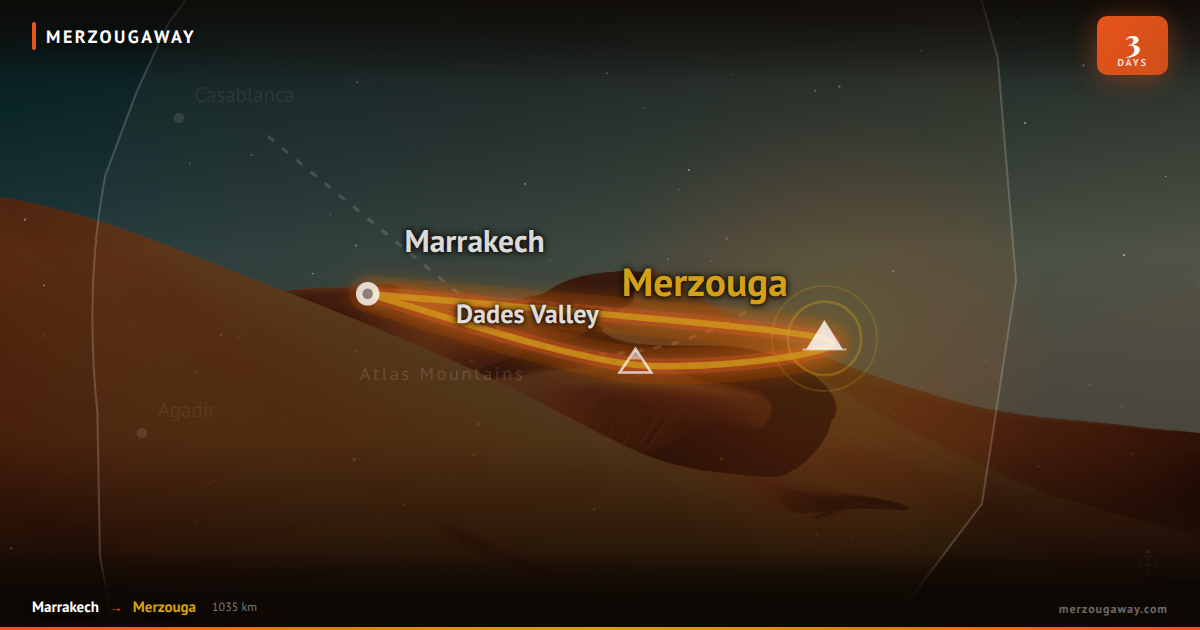
3-Day Marrakech to Merzouga Honeymoon Escape
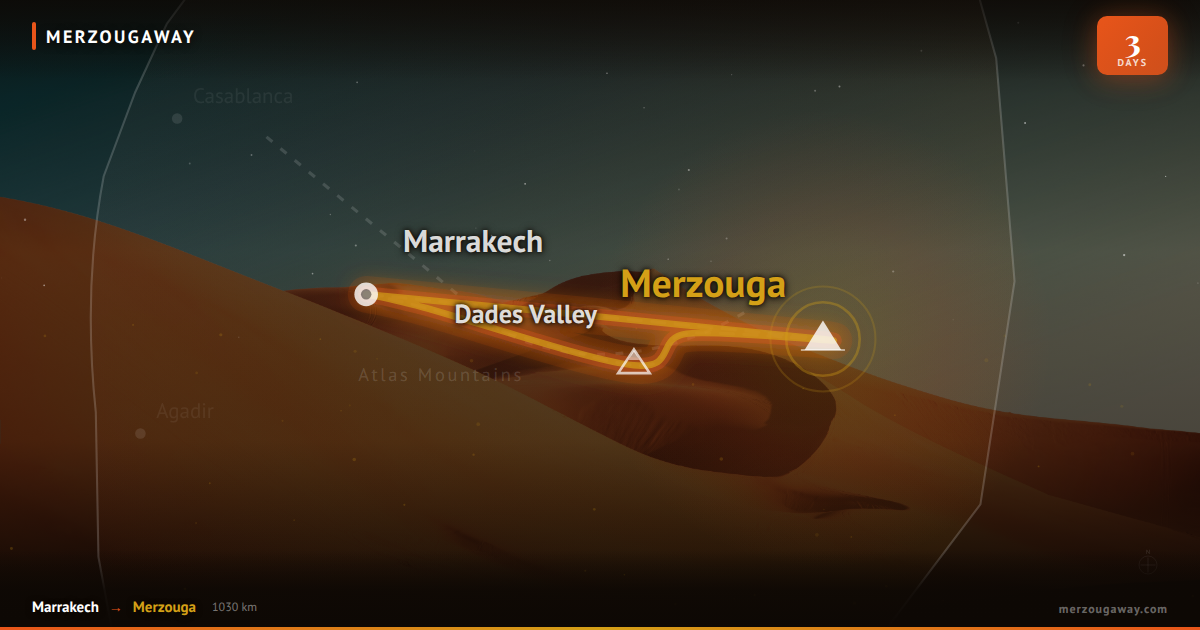
3-Day Marrakech to Merzouga Sahara Desert Astrophotography & Stargazing Tour
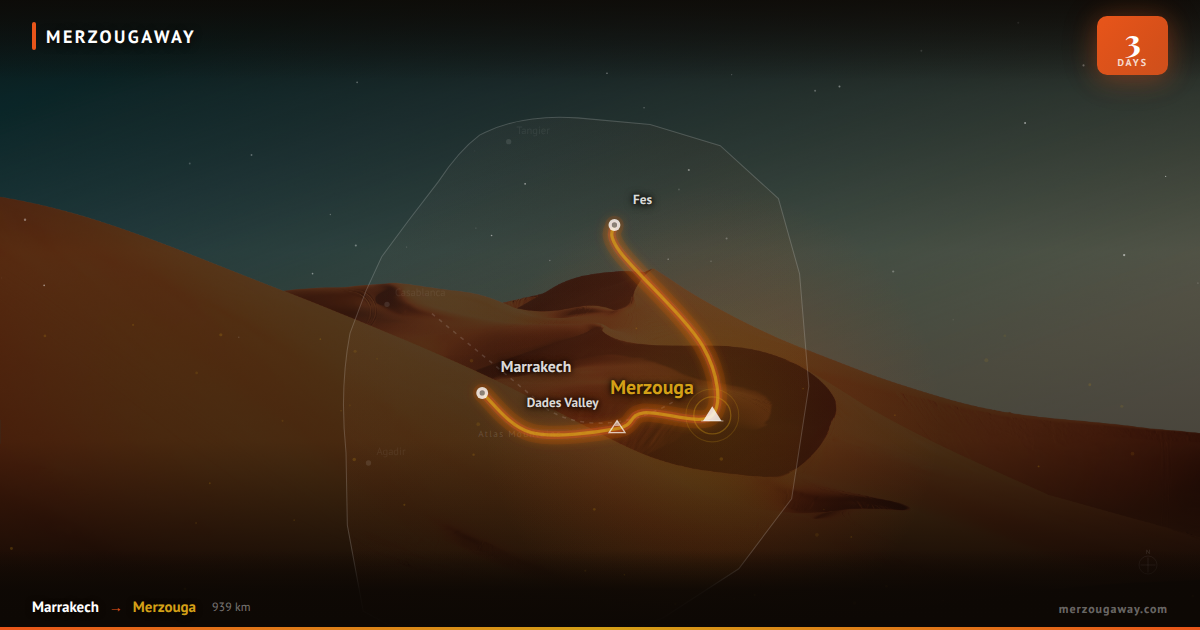
3-Day Marrakech to Merzouga to Fes One-Way Desert Tour
More Activities You'll Love
Explore more things to do in Morocco
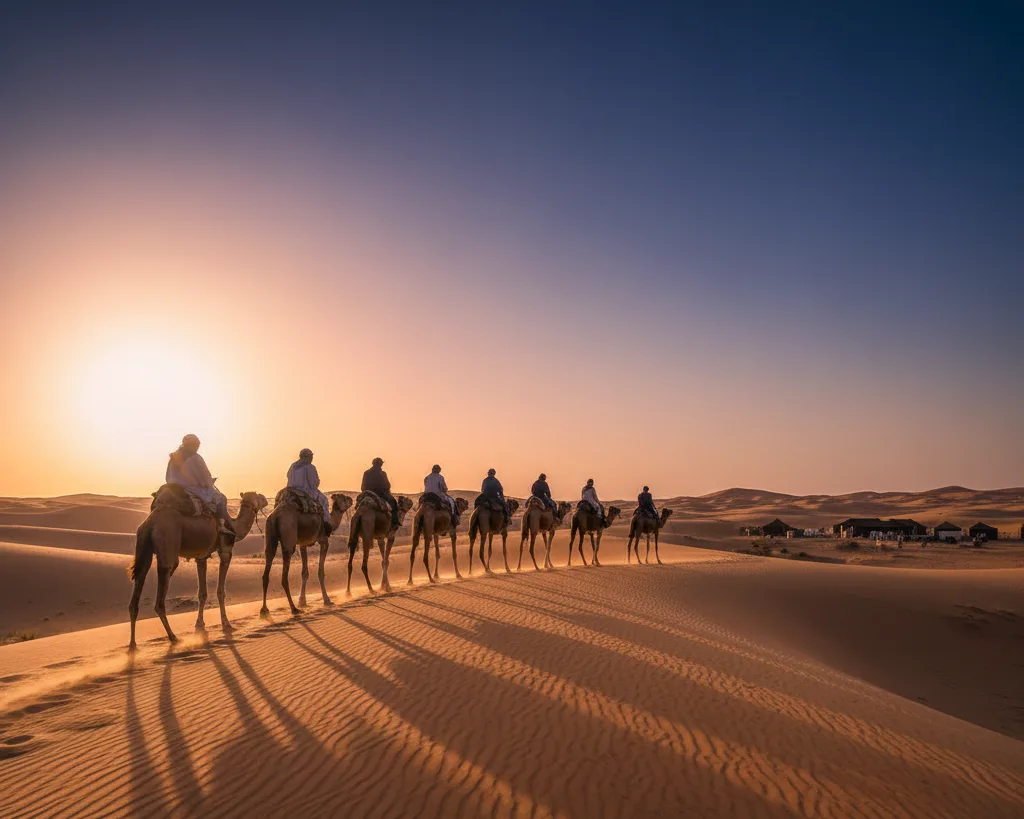
Camel Ride in the Sahara Desert
Experience the timeless magic of the Sahara on camelback. Watch the sun set over Erg Chebbi's golden dunes on a guided camel trek.
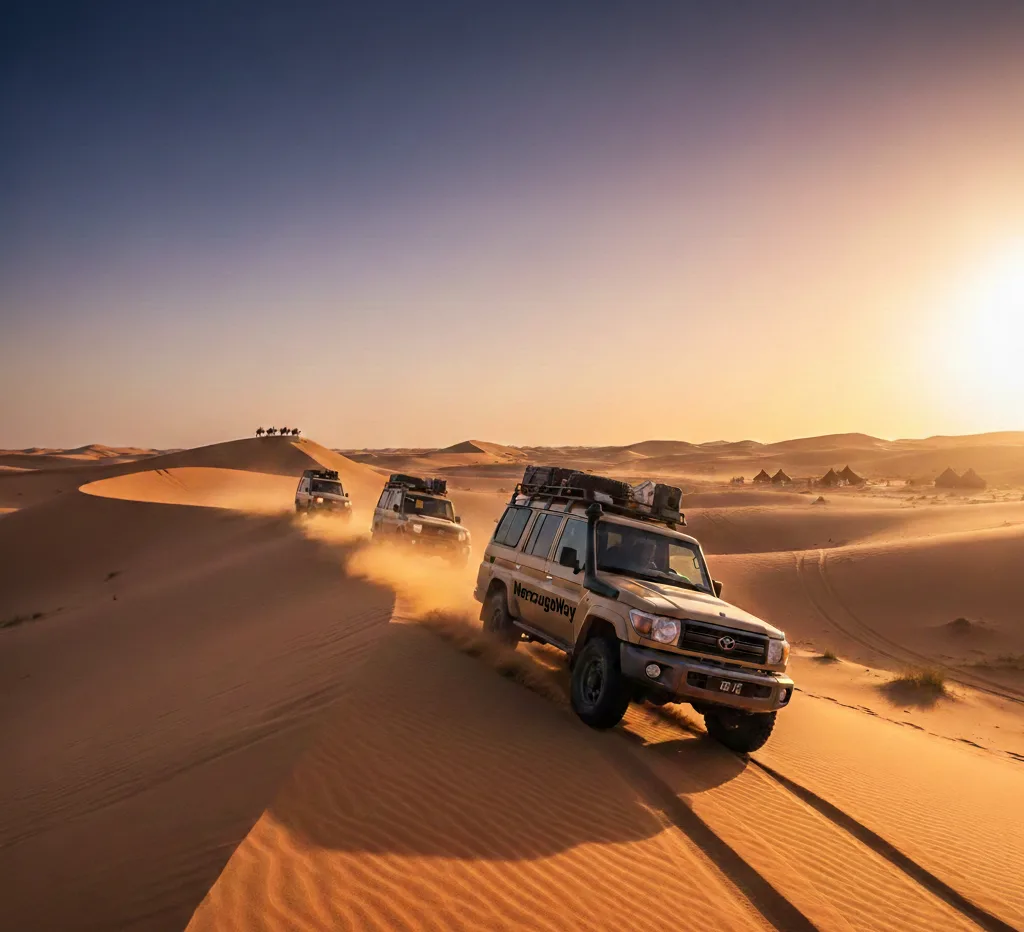
4x4 Dunes Tour in Erg Chebbi
Conquer the Erg Chebbi dunes in a powerful 4x4. An off-road adventure that takes you deep into the Sahara's most dramatic landscapes.
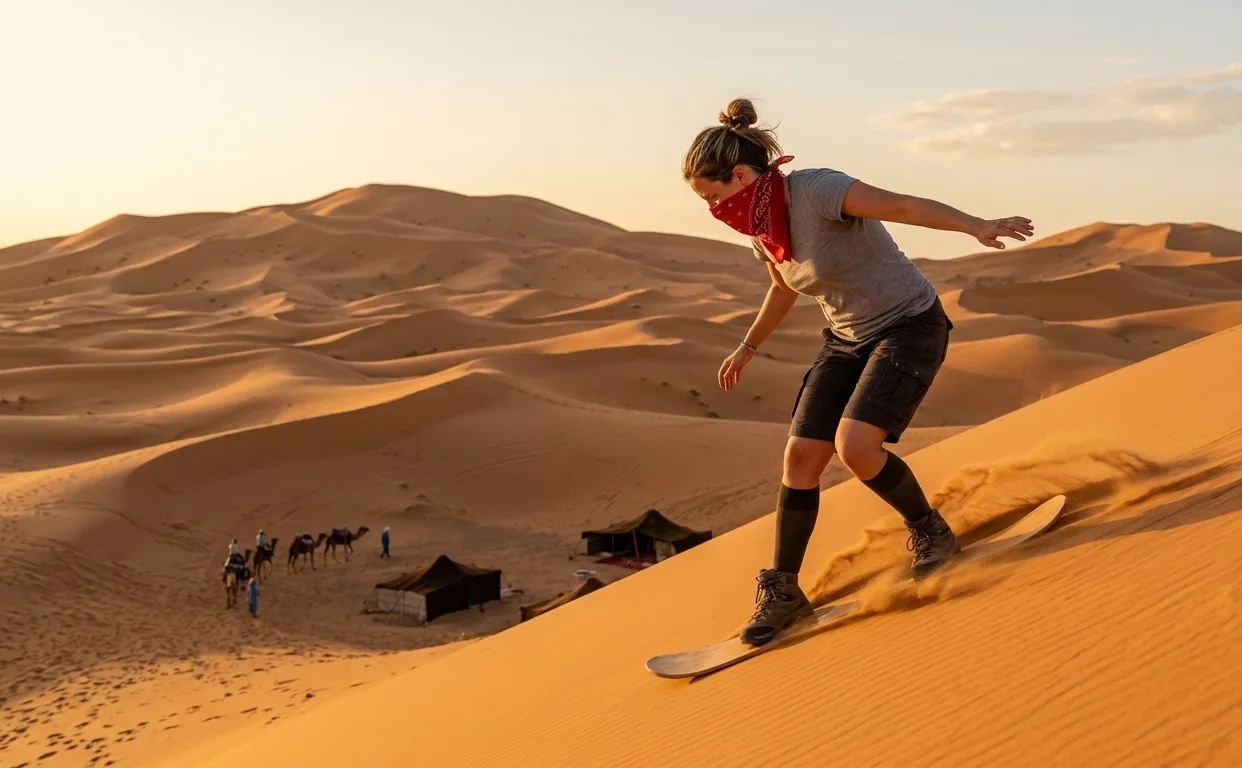
Sandboarding on the Erg Chebbi Dunes
Surf the Sahara's golden dunes on a sandboard. No snow required — just a steep dune and a sense of adventure.