Epic 3-Day Desert Overland from Marrakech to Merzouga 2026
The classic 3-day Marrakech-Merzouga overland route, day by day: what the drive actually demands, where you sleep, and why the timing works the way it does.
The 3-day overland route from Marrakech to Merzouga has earned its reputation as Morocco's classic desert trip because the timing genuinely works: long enough to properly cross from mountains to desert with an overnight to break up the drive, short enough to fit a standard week-long vacation without eating the whole thing. In three days you go from Marrakech's medina energy, up through Atlas Mountain passes and Berber villages, into the valleys and gorges of the pre-Sahara, and finally out onto the dunes of Erg Chebbi — a genuinely different landscape roughly every few hours.
[!NOTE] Fast-Facts & Direct Answer Summary
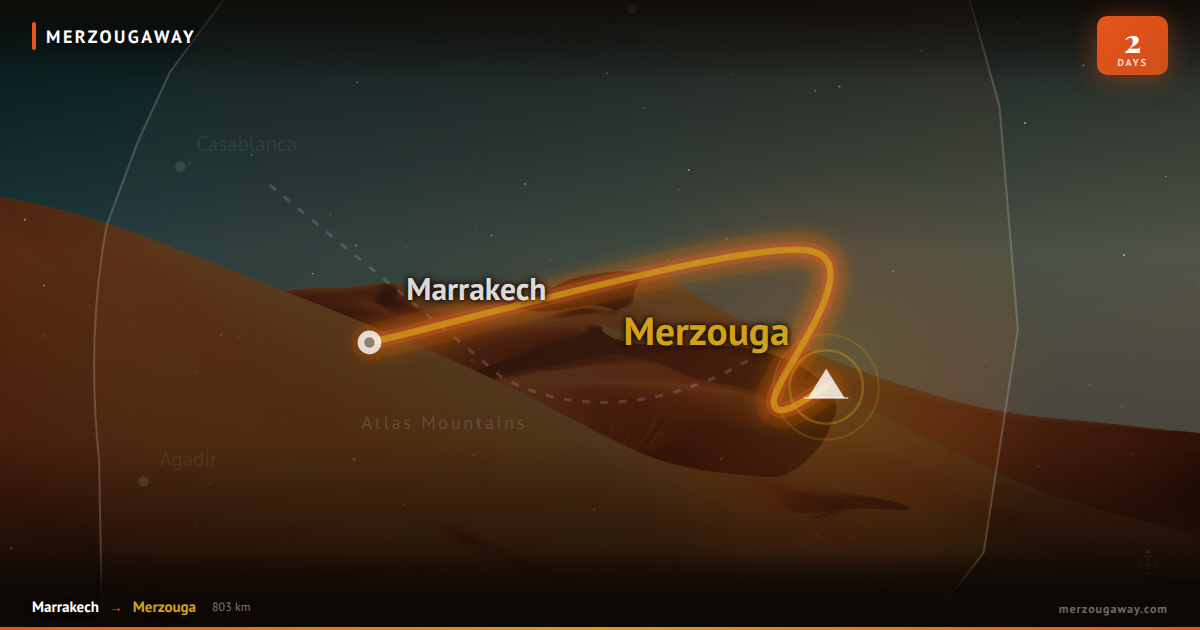
A desert journey from Marrakech to Merzouga spans ~560 km across the High Atlas Mountains (Tizi n'Tichka pass, 2,260m). The drive takes 9–10 hours, making a 3-Day or 4-Day tour the minimum recommended duration for safety and comfort.
- Recommended Duration: 3 Days (Classic) or 4 Days (Relaxed & In-Depth)
- Primary Road Routes: N9 across the Atlas ➔ N10 through Dadès Valley ➔ N13 to Erg Chebbi
- Realistic Pricing: 1,800–4,500 MAD (€180–€420) per person for private tours with luxury desert camp
- Key Highlights: Aït Benhaddou UNESCO ksar, Todra Gorge canyons, sunset camel trek, and Erg Chebbi dunes
- Local Expert Tip: Avoid 2-day Merzouga tours (18–20 hours driving in 48h). Opt for Agafay Desert if you only have 1–2 days.
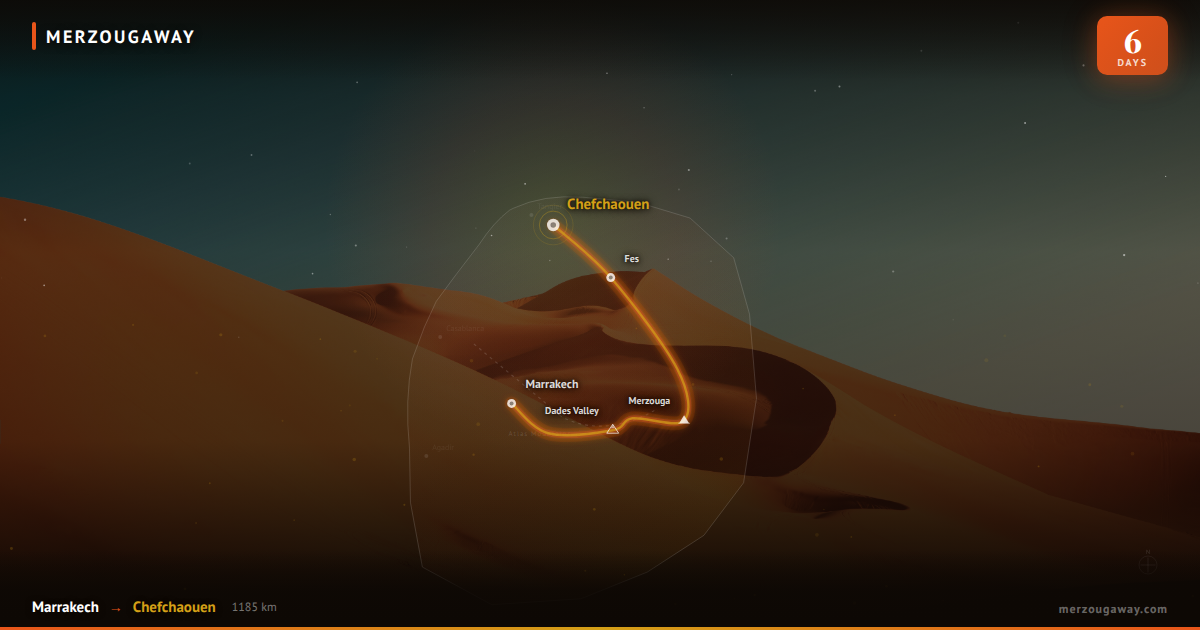
Day 1: Marrakech to the Dades Valley
Most tours leave Marrakech early, around 6-8am, to make the most of the day. The morning climb south through the Atlas is the scenic heart of day one — palm groves give way to switchbacks and Berber villages perched on hillsides as the road gains altitude, topping out around 2,260m at the highest pass. A stop at a mountain village along the way is common, often with tea offered as part of a brief, genuine introduction to Berber hospitality rather than a staged photo op. Lunch is typically taken at a kasbah, and the food is a good early sign of what's ahead: tagine or a Moroccan equivalent, with vegetarian options generally available.
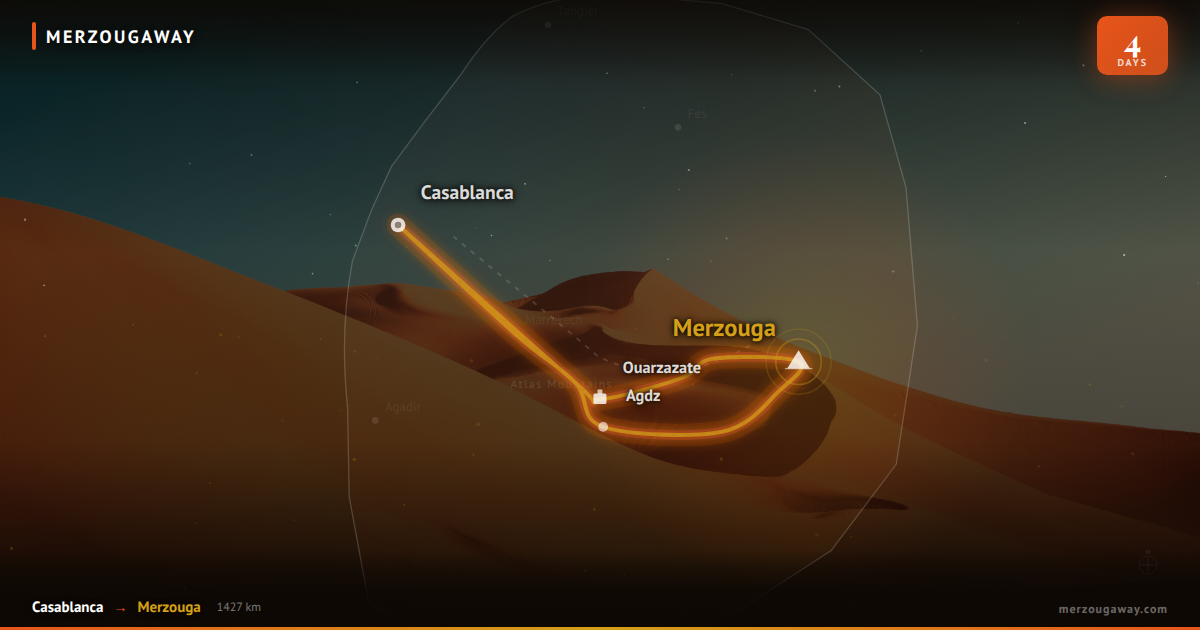
The afternoon continues the descent toward Dades, passing Ouarzazate — Morocco's film-industry town, visible from the road even if you don't stop — and often includes the option to add Ait Ben Haddou, the UNESCO-listed kasbah, for an extra fee if it's not already built into your itinerary; it's worth the stop if you have the time, since it's one of the most photogenic single sites on the whole route. By early evening you'll be checking into a guesthouse or hotel in the Dades Valley, with dinner and an early night, since day two starts with real ground to cover.
Accommodation here ranges widely: a simple guesthouse with shared or private bathroom runs roughly 150-250 MAD per person, a more comfortable tourist hotel with en-suite bathrooms and air conditioning runs 300-500 MAD, and a proper kasbah-style resort with a pool sits higher still, around 600-1,000 MAD. Treat these as starting points to confirm with whoever you book with.
Day 2: Dades Valley to Merzouga
For early risers, an optional guided hike into the Dades Gorge before breakfast is a genuinely rewarding way to start the day — a couple of hours on foot through the canyon in good morning light, moderate difficulty, worth it if you're not too tired from day one's drive. Otherwise, a slower breakfast and some time exploring the guesthouse grounds does just as well.
The morning's main event is Todra Gorge, roughly an hour or two northeast — walking between walls that rise around 300 meters is one of those moments that photos don't quite prepare you for, and if the water level allows, some travelers take a quick swim in the cool water at the base. It's a welcome break from the heat that's starting to build as you head further from the mountains. After lunch nearby, the afternoon is the longest stretch of driving on this leg — several hours as the landscape steadily strips away vegetation and turns properly desert, with a midway stop or two for water and a break. By early evening you're arriving in Merzouga itself and transferring to your desert camp, with enough time to settle in before the evening's activities begin: sunset over the dunes, a traditional dinner, and — if you're up for it — a short camel ride before the stars come out properly.
Camp accommodation in Merzouga spans a similarly wide range: a basic but authentic tent with shared facilities runs roughly 200-350 MAD per person, a more comfortable tent or room with a nearby or attached bathroom runs 400-600 MAD, and a genuine luxury tent with en-suite bathroom and better furnishings runs 700-1,200 MAD and up.
Day 3: the desert, then the return
This is the day people remember most, and it starts absurdly early — a 3am wake-up for a sunrise camel trek is a real thing, not an exaggeration. You mount up in the dark, ride out to a high dune, and wait as the sky moves through its full range of dawn colors before the sun actually breaks the horizon — genuinely one of the best moments of the whole trip, even accounting for how little sleep you've had. You're back at camp by around 7am for a proper breakfast and a few hours of real rest, which matters more than it sounds like it would after the early start.
Late morning and early afternoon are yours to fill: a longer 4x4 exploration of the dunes with a stop at a nomadic settlement is a good option if you want to see more of the desert beyond the immediate camp area, quad biking or sandboarding suit anyone wanting something more active, and simply staying at camp to rest is entirely reasonable too — there's no obligation to fill every hour. By mid-afternoon it's time to pack up, say goodbye to the camp staff, and begin the drive back to Marrakech, retracing the outbound route and arriving by early evening.
What actually gets you there: the vehicle and the roads
Most 3-day tours run in a 4x4 — a Toyota Land Cruiser or similar — seating anywhere from a handful of passengers up to seven plus the driver, with air conditioning that's genuinely essential rather than a nice-to-have once you're south of the mountains. A private vehicle for just your own group costs more but buys real flexibility on stops and pacing, and is worth it for groups of three or four splitting the cost. The mountain roads are well maintained but wind constantly, so the driving time is always longer than the raw distance suggests — a stretch that looks short on a map can easily take four or five hours once you account for the switchbacks and the stops. Lower valley roads move faster and more predictably, and the desert approach is mostly paved with some well-traveled unpaved stretches near the end.
What it costs
A straightforward package covering shared 4x4 transport, two nights of accommodation, most meals, and the core activities (sunrise camel trek, entrance fees to the main stops) tends to run somewhere around 1,200-1,800 MAD per person at the budget end. A more comfortable version with better accommodation, a guide who speaks fluent English, and all activities included runs closer to 2,000-3,000 MAD. A private, upscale version of the same route — private vehicle, premium camps, an expert multilingual guide — runs 3,500-5,000 MAD and up. What's typically not included: your first breakfast in Marrakech, optional add-ons like the Ait Ben Haddou entrance fee, tips for your guide and camp staff, travel insurance, and drinks beyond water and tea. Booking outside peak season (April-May or September-October) generally brings prices down 20-30% compared with the busiest months.
What to pack
Layering matters most here, given how much the temperature swings between the mountain passes, the valley towns, and the desert nights: a few light shirts, comfortable pants, a light jacket or wrap for the cold after dark, and sturdy walking shoes alongside sandals for camp. Sunscreen (SPF 50, non-negotiable), a hat, and a basic first-aid kit round out the essentials, and if stargazing is a priority for you, a headlamp with a red-light setting preserves your night vision far better than a regular flashlight.
When to go
October and November bring close to ideal conditions — comfortable daytime temperatures, cooler but manageable nights, and a moderate level of crowding that's still worth booking ahead for. December through February is genuinely excellent for the desert itself, though nights get properly cold (single digits Celsius isn't unusual) and it's also peak season, so book well in advance if these are your dates. March through May stays pleasant with occasional winds in March worth watching for. June through September is the stretch to avoid if you can — daytime temperatures regularly climbing into the high 30s and beyond make midday activity genuinely unpleasant and sometimes unsafe, and many camps scale back accordingly.
Frequently Asked Questions (FAQ)
How safe is the 3-day overland desert route from Marrakech?
This is Morocco's most established tourist corridor with an outstanding safety record. Roads are fully paved, and towns along the route are peaceful and welcoming to international visitors.
Is this 3-day desert tour suitable for solo travelers?
Solo travelers undertake this route constantly and safely. A private tour eliminates group friction and guarantees complete privacy, while shared small groups offer social companionship.
What are the bathroom and toilet facilities like on the route?
Modern cafés, restaurants, and kasbah hotels with clean Western-style restrooms are located every 1.5 to 2 hours along the highway. Luxury desert camps feature private en-suite flush toilets and hot showers inside your tent.
How far in advance should I book a 3-day desert tour?
Outside peak holidays, booking 2 to 4 weeks ahead is sufficient. However, for travel during Christmas/New Year's, Easter, or October/April peak seasons, book at least 6 to 8 weeks in advance to secure top-tier luxury desert camps.
Ready to book this route?
Book the 3-Day Marrakech to Merzouga Sahara Desert Tour directly to see current departures and pricing, or contact us with questions about timing, what to expect, or how to adjust the itinerary above to fit your trip.
WhatsApp: +212675203319 / +212668534981 Email: [email protected]
Last updated: August 2026.
Sahara Route & Drive-Time Estimator
Calculate realistic driving hours across the High Atlas (Tizi n'Tichka pass), compare scenic stops (Dadès, Todra, Ziz), and plan your custom desert itinerary.
MerzougaWay Team
We are a passionate team of local guides dedicated to sharing the beauty and culture of our home, Morocco. Our journey began with a simple desire to offer authentic, memorable experiences that go beyond the typical tourist trails.