How To Plan A Trip To Merzouga Desert: The Ultimate 2026 Guide
A realistic, step-by-step guide to planning a Merzouga trip — when to go, how to actually get there (there's no airport in Merzouga itself), how many days you need, and what it costs.
Merzouga, at the edge of the Erg Chebbi dunes, is the destination most people picture when they imagine the Sahara in Morocco — but it's also a place that's easy to under-plan, mostly because of one detail that catches travelers off guard: there's no airport in Merzouga itself, and no direct train either. Getting the logistics right matters more here than for a typical city stop, so this guide walks through the decisions in the order you'll actually need to make them.
[!NOTE] Fast-Facts & Direct Answer Summary
A realistic, step-by-step guide to planning a Merzouga trip — when to go, how to actually get there (there's no airport in Merzouga itself), how many days you need, and what it costs.
- Destination Focus: Authentic Moroccan culture, scenic routes, and local travel insights
- Currency & Payments: Moroccan Dirham (MAD; ~10 MAD ≈ €1 / $1.08 USD). Cash is essential outside major hotels
- Best Travel Window: October through April offers ideal temperate weather across Morocco and the desert
- Local Hospitality: Berber culture is renowned for warm hospitality, mint tea welcoming rituals, and rich musical heritage.
When to go
Spring (March-May) and autumn (September-November) are the easiest seasons, with daytime temperatures in the comfortable 20-30°C range, cooler nights, and — in spring especially — a chance of desert wildflowers after rain. Summer (June-August) is a different proposition entirely: daytime highs regularly reach 45°C, which makes midday activity genuinely unpleasant, though camel treks and camp activities simply shift to early morning and evening, and the clear summer skies are excellent for stargazing if you can handle the heat. Winter (December-February) brings pleasant days but nights that drop close to freezing, cold enough that a proper desert camp with real blankets and heating (not just a tent) matters a lot more than it would in shoulder season.
How to actually get there
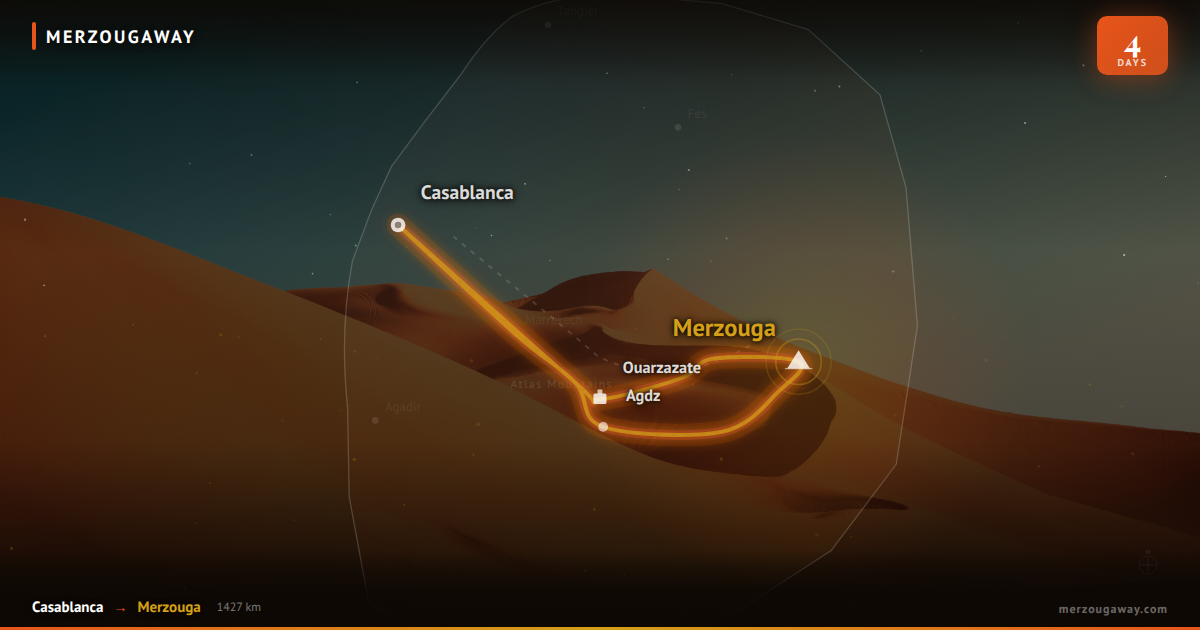
This is the part worth getting right before anything else. Merzouga has no airport of its own — the nearest one is Errachidia (ERH), roughly a 2-hour drive away, with Fes and Ouarzazate as alternative airports a good deal further out. There's also no direct rail line to Merzouga; the train network's southern reach ends well short of the desert, so any rail journey still ends with a road transfer for the final stretch. In practice, that means everyone reaches Merzouga by road, one way or another.
The two realistic approaches are flying into Marrakech, Fes, or Errachidia and arranging a private transfer or multi-day tour from there, or driving yourself if you're comfortable with Moroccan roads (a 4x4 is a sensible choice, though not strictly required outside the dunes themselves). From Marrakech, the drive is 9-10 hours over the dramatic but slow Tizi n'Tichka pass — genuinely too long to do as a same-day round trip, which is why virtually every Marrakech-based Merzouga trip is structured as an overnight at minimum, usually 3 days and 2 nights. From Fes, it's a similarly long 8-9 hour drive through the Middle Atlas. Coming from Ouarzazate, if you're already in southern Morocco, cuts that down to a much more manageable 5-6 hours. Most travelers don't self-drive this route on a first visit — hiring a private driver-guide removes the stress of unfamiliar mountain roads and means someone else is handling navigation and stops while you look at the scenery.
How many days you actually need
Two days and one night is the minimum that makes sense — enough time for a sunset camel trek, one night at camp, and a sunrise before heading back, but it's a tight trip with a lot of driving relative to time spent in the desert. Three to four days is the sweep spot for most travelers, giving you a proper night in the dunes plus time for a 4x4 excursion, a Khamlia village visit for Gnawa music, or simply a slower pace without feeling rushed. Beyond that, five or more days starts to make sense mainly if you're combining Merzouga with a longer circuit — continuing on to Fes, adding stops in the Dades or Todra gorges, or spending extra nights in the desert itself for a deeper, quieter experience.
Choosing where to stay
In Merzouga itself, the choice is really about how much of your stay happens in a desert camp versus a hotel or guesthouse in the village. Camps range from basic shared-facility setups to private luxury tents with en-suite bathrooms and proper heating for winter nights — as a rough guide, expect somewhere in the €30-100 per night range for a comfortable private tent, more for a genuinely high-end camp with extras like heated floors or a private pool area, and less for a very basic shared setup. Village hotels and guesthouses are a sensible add-on if you want a proper shower and a real bed before or after a night in the dunes, and many multi-day tours combine both — a night at camp, a night in a guesthouse.
What there actually is to do
The sunset or sunrise camel trek into the dunes is the activity almost everyone does, typically an hour or two round trip and priced modestly per person — it's the single most reliable "this was worth the trip" moment for most visitors. Beyond that, a half-day or full-day 4x4 excursion is the best way to see more of the surrounding desert without walking it — visiting a nomadic family, the volcanic-looking Khamlia area, or nearby oases. Khamlia village itself is worth the stop for its Gnawa music, a hypnotic, trance-rooted tradition performed by descendants of sub-Saharan communities who settled in the area generations ago. Sandboarding and quad biking are the more physical add-ons if you want something active on top of the camel trek, and stargazing needs no separate booking at all — Erg Chebbi's distance from any real light pollution means the night sky is worth simply stepping outside camp for, any night of the year.
Roughly what it costs
Budget varies enormously by comfort level, but as a general anchor: a private multi-day tour with a driver-guide, desert camp accommodation, camel trek, and meals at camp typically runs from somewhere in the low hundreds of euros per person for a 2-day trip, scaling up with more nights and a more luxurious camp. Independent budget travel — public transport, basic guesthouses, self-arranged activities — can bring costs down substantially, but loses the door-to-door convenience and local knowledge a guide provides, which matters more on this route than on an easy city stay given how remote the final stretch is. Whichever route you take, keep a stash of small-denomination dirhams on hand for tips, incidentals, and small activity add-ons that often aren't included in a package price.
Packing and health basics
Desert packing is really about managing a bigger temperature swing than the daytime heat alone suggests: light, breathable layers for the day, something genuinely warm for camp evenings (temperatures drop sharply after dark year-round), a scarf or shesh for sun and blown sand, sturdy closed shoes, and a headlamp, since camps often have limited lighting after dinner. High-SPF sunscreen, a refillable water bottle, and a basic first-aid kit round out the essentials — desert air is dry enough that a good moisturizer and lip balm earn their space in the bag too. Stick to bottled or purified water, pace your sun exposure, and bring any regular medication with you rather than assuming you'll find it locally, since Merzouga is a small town with limited pharmacy stock.
Emergency numbers worth having
- Police: 190
- Ambulance: 150
- Tourist Police: +212 5355-73160
Save your embassy or consulate's local contact before you travel — it's a five-minute task that's genuinely useful if anything goes wrong far from a major city.
Putting it together
The version of this trip most travelers end up happiest with is a private 3-day, 2-night tour from Marrakech or Fes: the mountain or Middle Atlas crossing on day one, a full day and night in Merzouga with the camel trek and camp on day two, and a return (or onward continuation) on day three. See our 3-day Marrakech to Merzouga desert tour for exactly how that itinerary runs, or get in touch and we'll help you build a custom version around your own dates and starting city.
Frequently Asked Questions (FAQ)
How many days do you need for a trip to Merzouga?
A minimum of 3 days and 2 nights is required from Marrakech or 2 days and 1 night from Fes. If time allows, a 4 or 5-day itinerary allows you to spend two full nights in the dunes and explore ancient fossil beds and Gnawa culture without feeling rushed.
What is the nearest commercial airport to Merzouga?
The nearest airport is Moulay Ali Cherif Airport in Errachidia (ERH), located 130 km (about a 1.5 to 2-hour drive) north of Merzouga. Royal Air Maroc operates regular domestic flights connecting Casablanca (CMN) directly to Errachidia.
What should I pack for an overnight stay in the Sahara Desert?
Pack lightweight, breathable layers for daytime sun, a warm fleece or jacket for chilly desert nights, sturdy closed shoes or sneakers, high-SPF sunscreen, sunglasses, and a cotton scarf (cheche) for wind and sand protection.
Is Wi-Fi and mobile data available in Erg Chebbi desert camps?
Most luxury camps provide solar-powered Wi-Fi in common dining areas, though speeds can be modest. Moroccan 4G mobile networks (Maroc Telecom and Orange) provide surprisingly strong cellular reception along the edge of the Erg Chebbi dunes.
Contact Us
Last updated: July 2026.
Sahara Route & Drive-Time Estimator
Calculate realistic driving hours across the High Atlas (Tizi n'Tichka pass), compare scenic stops (Dadès, Todra, Ziz), and plan your custom desert itinerary.
MerzougaWay Team
We are a passionate team of local guides dedicated to sharing the beauty and culture of our home, Morocco. Our journey began with a simple desire to offer authentic, memorable experiences that go beyond the typical tourist trails.