Is It Safe to Drive from Marrakech to Merzouga? Complete Safety Guide
An honest safety read on the Marrakech-Merzouga drive: genuinely low crime risk, but real mountain-road and fatigue factors worth planning around, whether you self-drive or hire a private driver.
The route itself is safe in the way that matters most to most travelers — crime along this corridor is genuinely low, it's a heavily used route with a well-established tourism infrastructure, and thousands of people complete it every season without incident. The more honest safety conversation isn't about danger from other people; it's about mountain roads, fatigue, and unfamiliar driving conditions if you're behind the wheel yourself.
[!NOTE] Fast-Facts & Direct Answer Summary
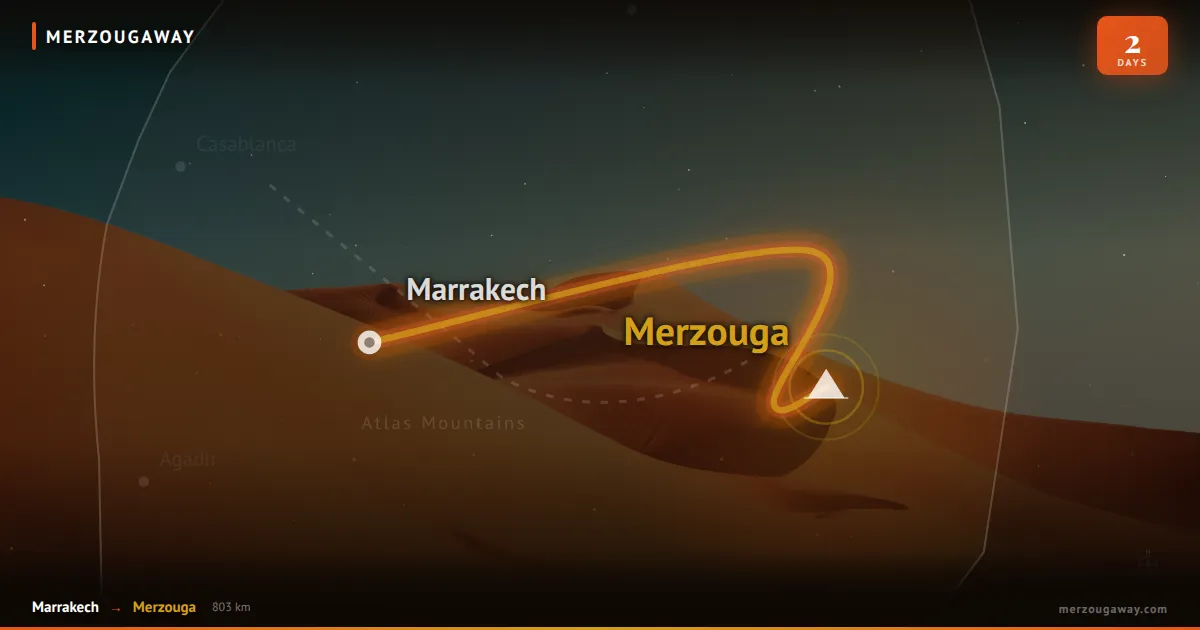
A desert journey from Marrakech to Merzouga spans ~560 km across the High Atlas Mountains (Tizi n'Tichka pass, 2,260m). The drive takes 9–10 hours, making a 3-Day or 4-Day tour the minimum recommended duration for safety and comfort.
- Recommended Duration: 3 Days (Classic) or 4 Days (Relaxed & In-Depth)
- Primary Road Routes: N9 across the Atlas ➔ N10 through Dadès Valley ➔ N13 to Erg Chebbi
- Realistic Pricing: 1,800–4,500 MAD (€180–€420) per person for private tours with luxury desert camp
- Key Highlights: Aït Benhaddou UNESCO ksar, Todra Gorge canyons, sunset camel trek, and Erg Chebbi dunes
- Local Expert Tip: Avoid 2-day Merzouga tours (18–20 hours driving in 48h). Opt for Agafay Desert if you only have 1–2 days.
The road itself
The first stretch out of Marrakech, the N9 toward Ouarzazate, climbs over the Tizi n'Tichka pass at 2,260 meters — well-maintained, clearly marked, but genuinely challenging: narrow in places, full of hairpin turns, and occasionally fogged in depending on season and time of day. Fuel stations thin out on this stretch, so top up before you climb rather than assuming you'll find one along the way. South of Ouarzazate, the road toward Erfoud and Merzouga straightens out considerably but runs through much more remote country, with long gaps between towns, no street lighting once you're past the last settlement, and the occasional loose gravel or sand drift near the desert edge.
Night driving on either stretch is genuinely worth avoiding — not because of any particular danger, but because unlit mountain curves and desert road edges are much harder to read in the dark, and professional tour drivers on this route uniformly plan to be off the road by evening rather than push through after dark.
Self-driving versus hiring a driver
Renting a car and doing this yourself is entirely possible and plenty of travelers do it, but it's worth being honest about what it actually asks of you: 9-10 hours behind the wheel on unfamiliar mountain roads, likely on one of your first days in the country, navigating in a language you may not read well, and managing fatigue on a drive that's considerably longer than it looks on a map. A private driver removes all of that — someone who knows the Tichka's curves, the fuel stops, and the pace to keep, while you actually get to look at the scenery instead of the road. It's the reason most first-time visitors hire a driver rather than self-drive this particular route, even if they're otherwise comfortable driving abroad.
What driving culture on this route is actually like
Moroccan driving habits differ from what many visitors are used to — more horn use as routine communication rather than aggression, trucks that sometimes hug the wrong side on a climb, motorcycles weaving between lanes in town. None of this is unusually dangerous once you expect it; professional tour drivers are used to it and drive defensively around it, and the road itself carries steady tourist and commercial traffic rather than feeling isolated or risky.
Practical safety habits, whichever way you go
Book with an established operator if you're hiring a driver, and don't hesitate to ask about the vehicle's condition before setting off — spare tire, working lights, a basic emergency kit are standard and reasonable to confirm. Plan for daylight-only driving on both legs, keep valuables with you rather than only in the trunk, and if self-driving, let someone know your rough itinerary and expected arrival. If a mechanical problem comes up, tour operators keep contacts for local assistance and can arrange a replacement vehicle — genuinely rare on well-maintained tour vehicles, but worth knowing is handled rather than something you'd be stranded over.
Solo travelers, including solo women, complete this route regularly and without particular incident beyond the ordinary travel precautions that apply anywhere — a reputable driver or tour operator and a bit of common sense cover the real risk here.
Worth saving in your phone before you set off: 112 works as a general emergency number from any mobile, 177 reaches the Gendarmerie Royale, who cover rural roads and highways like this one (rather than the urban police line, 19), and 150 reaches SAMU for a medical emergency. Coverage is patchy on the remote stretch south of Ouarzazate, so it's worth telling whoever's expecting you roughly when you'll have signal again.
The honest bottom line
This is a safe route by any reasonable measure, but "safe" here means low crime risk and solid infrastructure, not "effortless." The real considerations are the mountain road itself and how you want to spend 9-10 hours covering it — with a driver who knows every curve, or behind the wheel yourself as part of the adventure.
Comprehensive Road Quality and Hazard Analysis Matrix
Embarking on a self-drive road trip from Marrakech across the High Atlas mountains to the Sahara dunes of Merzouga is one of the world's most spectacular overland journeys. Covering approximately 560 kilometers along the N9, N10, and N13 national highways, the route traverses four distinct geographical zones: the Haouz agricultural plains, the towering alpine passes of the High Atlas, the arid pre-Saharan "Valley of a Thousand Kasbahs," and the desert sand dunes of Erg Chebbi.
The following comprehensive safety and infrastructure matrix breaks down each specific driving sector:
| Highway Sector & Route | Distance & Drive Time | Asphalt Quality & Lane Width | Mountain Hazard Level | Police Checkpoint Density | Fuel & Repair Services | | :--- | :--- | :--- | :--- | :--- | :--- | | Marrakech to Taddert (N9 North Climb) | 85 km / 1.5 to 2.0 hrs | Excellent dual-lane asphalt; wide paved shoulders | Low to Moderate; heavy agricultural & moped traffic | High (Ait Ourir & Toufliht checkpoints) | Frequent (Afriquia, Shell, Total stations every 15 km) | | Taddert to Tizi n'Tichka Pass (N9 Summit) | 35 km / 1.0 to 1.5 hrs | Modern widened highway (2,260m elevation); sweeping switchbacks | High; tight blind curves, heavy freight trucks, winter ice | High (Pass summit gendarmerie post) | Limited; local repair workshops (vulcanisateurs) in Taddert | | Tizi n'Tichka to Ouarzazate (N9 South Descent) | 80 km / 1.5 hrs | Wide modern asphalt; smooth surface | Moderate; steep downhill gradients; watch brake fade | Moderate (Amerzgane police checkpoint) | Good (Fuel stations at Amerzgane and Ouarzazate entry) | | Ouarzazate to Tinghir / Todra (N10 Highway) | 170 km / 2.5 hrs | Flat, fast 2-lane national highway; long straightaways | Low; crosswinds, school children crossing in villages | Moderate (Skoura, Kelaat M'Gouna, Boumalne checkpoints) | Excellent (Modern fuel plazas with clean cafes every 30 km) | | Tinghir to Erfoud via Tinjdad (N10 & R702) | 145 km / 2.0 hrs | Smooth asphalt; flat desert terrain | Low; sudden road drifts with blowing sand | Low to Moderate (Tinjdad & Erfoud bypass checkpoints) | Plentiful in major oasis towns; sparse on open desert plains | | Erfoud to Merzouga Dunes (N13 Highway) | 55 km / 45 mins | Paved 2-lane road all the way to desert hotels | Low to Moderate; camel crossings, shifting sand drifts | High (Rissani junction & Merzouga village entry) | Reliable fuel in Rissani and Merzouga village |
The Tizi n'Tichka Pass: Alpine Navigation and Winter Realities
The N9 highway crossing the Tizi n'Tichka Pass (2,260 meters / 7,415 feet) was historically notorious for narrow unpaved precipices and rockfalls. Over the past decade, the Moroccan Ministry of Equipment and Transport executed a monumental infrastructure overhaul, widening the road to three lanes on steep ascents, installing concrete safety crash barriers, and laying smooth all-weather asphalt.
However, alpine driving rules remain paramount:
- Brake Management on Steep Descents: Driving downhill from the summit toward Ouarzazate involves continuous steep descending grades over 40 kilometers. Never ride your vehicle's brakes continuously in neutral or high gear. Continuous friction causes brake fluid boiling and catastrophic brake pad glaze (brake fade). Instead, downshift your transmission into 2nd or 3rd gear (or use manual mode on an automatic gearbox) to let engine compression hold your speed safely around hairpin curves.
- Overtaking Heavy Trucks: Heavily loaded vegetable, mineral, and phosphate trucks climb the pass at 15 to 25 km/h, belching diesel exhaust. Exercise supreme patience. Never cross double solid white lines on blind mountain curves. Moroccan truck drivers are generally courteous and will signal with their right turn indicator when the forward road is clear for you to overtake safely.
- Winter Snow and Black Ice (December to February): While Morocco is associated with desert sunshine, winter temperatures at 2,260 meters frequently plummet below freezing. Freezing rain or overnight snow can create invisible black ice on shaded northern switchbacks. If severe snowstorms occur, the Royal Gendarmerie will halt all traffic at Toufliht until government snowplows clear and grit the tarmac. If self-driving in mid-winter, confirm mountain weather conditions with your car rental agency or riad host before departure.
Royal Gendarmerie and Police Checkpoint Etiquette
Police checkpoints in Morocco are ubiquitous, professional, and established primarily to ensure national security, detect smuggling, and enforce road safety laws:
- Checkpoint Structure: On open highways between towns, checkpoints are manned by the Gendarmerie Royale (dressed in grey-green military uniforms). Within municipal city limits (Marrakech, Ouarzazate, Tinghir, Erfoud), checkpoints are manned by the Sûreté Nationale (dressed in dark blue police uniforms).
- Mandatory Complete Stop: When approaching a checkpoint, you will observe red-and-white signs reading "Halte Police" or "Halte Gendarmerie" placed in the roadway alongside tire spike strips. You must bring your vehicle to a complete, dead stop at the sign line, even if the road appears entirely clear.
- Wait for Hand Signal: Do not drive past the sign until an officer makes a clear verbal greeting or beckons you forward with a wave of the hand. Creeping forward without authorization is a punishable offense that immediately irritates the officers.
- Document Presentation: Roll down your driver-side window, offer a polite "Salam Alaykum" or "Bonjour Monsieur", and have your driving license, vehicle registration booklet (Carte Grise), and rental agreement insurance contract ready. Officers are almost invariably courteous toward foreign tourists and will frequently review your documents, ask where you are visiting from, smile, and say "Bienvenue au Maroc!"
- Speed Limits and Automated Radars: Morocco strictly enforces speed limits using handheld laser radar guns and automated roadside speed cameras. Speed limits are strictly 60 km/h when entering any populated village or town perimeter, 80 to 100 km/h on open rural highways, and 120 km/h on express motorways. Exceeding the speed limit by even 7 km/h will result in being pulled over. Standard official fines range from 150 MAD to 400 MAD, payable immediately in cash directly to the officer in exchange for an official signed carbon-copy receipt (Quittance de Paiement).
Night Driving Realities: Why You Must Never Drive After Dark
If seasoned Moroccan tour operators have one unbreakable safety rule, it is this: never drive outside urban centers after dusk.
While daytime driving along the N9 and N10 is safe and scenic, driving these rural routes between 19:00 and 06:00 introduces severe hazards:
- Unlit Agricultural and Commercial Traffic: Hundreds of rural mopeds, donkey carts, horse carriages, and vintage agricultural tractors travel along highway shoulders without working headlights, taillights, or retroreflective markers, rendering them completely invisible until your headlights illuminate them from 15 meters away.
- Free-Roaming Livestock and Desert Camels: In the desert sectors between Tinjdad, Erfoud, and Merzouga, herds of dromedary camels wander freely across the highway. Because camel fur absorbs automotive headlight beams and their tall legs elevate their heavy bodies directly at windshield level, hitting a camel at 80 km/h causes catastrophic passenger cabin intrusion.
- Pedestrians on Unlit Road Margins: Rural Moroccan villagers, school children, and elders dressed in traditional dark hooded wool djellabas walk along unpaved highway shoulders without street lighting or reflective gear.
- Blinding High Beams: Oncoming rural trucks, buses, and grand taxis frequently drive with aftermarket high-intensity LED light bars and fail to dim their high beams, momentarily blinding oncoming drivers on unlit two-lane mountain passes. Plan your travel itinerary so you arrive at your destination hotel or desert camp at least one hour before sunset.
Emergency Procedures, Breakdown Protocol, and Fuel Management
- Tire Punctures and Vulcanisateurs: Rough desert gravel and mountain stones occasionally cause tire punctures. Fortunately, Morocco features a ubiquitous network of roadside tire repair shops known as Vulcanisateurs (look for stacks of old tires displayed outside small roadside garages in every village). A vulcanisateur will jack up your car, locate the puncture in a water basin, install a vulcanized rubber plug, and re-inflate your tire for 30 to 50 MAD (~$3 to $5 USD) in under 15 minutes.
- Fuel Planning Strategy: Modern fuel stations (Afriquia, Shell, Total, Winxo) with clean restrooms and espresso bars are plentiful along the N9 and N10. However, once you pass Erfoud on the approach to Merzouga, stations become sparse. The Golden Rule: Never allow your fuel tank to drop below one-quarter capacity. Always top off your fuel tank in Tinghir, Tinjdad, or Erfoud before heading into the desert. All fuel stations accept cash; while major brand stations in towns accept Visa/MasterCard, terminals occasionally lose network connection, so carry at least 500 MAD in cash for emergency refueling.
Frequently Asked Questions (FAQ)
Is it safe to drive yourself from Marrakech to Merzouga?
Yes, southern Morocco is very safe with well-maintained, paved national highways (N9, N10, and N13). Thousands of international tourists self-drive this route annually without incident.
What are the main hazards on the road from Marrakech to Merzouga?
Key hazards include sharp switchback curves on the Tizi n'Tichka mountain pass, slow-moving heavy trucks, occasional wandering livestock or donkeys, and local vehicles passing unexpectedly. Always avoid driving after dark.
How do police checkpoints work in Morocco?
Routine Gendarmerie checkpoints are stationed outside major towns. Always slow down to a crawl at the "Halte Police" sign. Gendarmes are courteous to tourists; have your passport, driving license, and car rental paperwork ready. Obey all posted speed limits.
Do you need a 4x4 to drive to Merzouga?
No. Highway N9, N10, and N13 are 100% paved tarmac all the way to Merzouga village. A standard 2WD compact car handles the entire road comfortably. A 4x4 is only required if venturing directly into off-road desert sand dunes.
Want a driver who's done this route more times than either of us can count?
WhatsApp: +212675203319 / +212668534981 Email: [email protected]
Last updated: August 2026.
Sahara Route & Drive-Time Estimator
Calculate realistic driving hours across the High Atlas (Tizi n'Tichka pass), compare scenic stops (Dadès, Todra, Ziz), and plan your custom desert itinerary.
MerzougaWay Team
We are a passionate team of local guides dedicated to sharing the beauty and culture of our home, Morocco. Our journey began with a simple desire to offer authentic, memorable experiences that go beyond the typical tourist trails.