Marrakech to Erg Chebbi Desert Tour: Ultimate Sahara Experience
A journey from Marrakech to the Erg Chebbi dunes takes you over the High Atlas, through UNESCO kasbahs and desert gorges, and ends with a night under the stars in the Sahara. Here's what the classic 4-day route actually looks like.
[!NOTE] Fast-Facts & Direct Answer Summary
A journey from Marrakech to the Erg Chebbi dunes takes you over the High Atlas, through UNESCO kasbahs and desert gorges, and ends with a night under the stars in the Sahara. Here's what the classic 4-day route actually looks like.
- Destination Focus: Authentic Moroccan culture, scenic routes, and local travel insights
- Currency & Payments: Moroccan Dirham (MAD; ~10 MAD ≈ €1 / $1.08 USD). Cash is essential outside major hotels
- Best Travel Window: October through April offers ideal temperate weather across Morocco and the desert
- Local Hospitality: Berber culture is renowned for warm hospitality, mint tea welcoming rituals, and rich musical heritage.
Overview
Erg Chebbi is the Sahara most people picture when they imagine Morocco's desert: dunes rising up to 150 meters, shifting from pale gold to burning red at sunset, with nothing but sand to the horizon. Getting there from Marrakech is a real journey rather than a quick transfer — roughly 560 km one-way, crossing the High Atlas Mountains and a string of kasbahs, gorges, and oasis towns along the way. The classic version of this trip runs 4 days and 3 nights, which gives you enough time to actually enjoy the places between the two cities rather than just passing through them.
Day 1: Marrakech to the Dades Valley
The drive south begins with the Tizi n'Tichka pass, the highest paved mountain road in North Africa at 2,260 meters, winding through Berber villages of stacked stone and terraced almond groves before dropping toward the pre-Saharan plateau. Midday brings you to Ait Ben Haddou, the UNESCO-listed fortified village whose red-clay towers have appeared in Gladiator, Game of Thrones, and Lawrence of Arabia — worth an hour or more to walk through and climb to the hilltop granary for the view back over the valley. From there the route continues to Ouarzazate, Morocco's film-industry hub, with a stop at the Taourirt Kasbah, before heading east along the Road of a Thousand Kasbahs through the Skoura palm oasis and the Valley of Roses. The day ends in the Dades Valley, where a traditional guesthouse sits beneath cliffs that glow amber in the evening light.
Day 2: Dades Valley to Erg Chebbi
The morning starts with the Dades Gorge itself and its "Monkey Fingers" rock formations, wind-eroded limestone pillars visible on a short walk from the guesthouse. From there it's on to Todra Gorge, where the canyon narrows dramatically and sheer walls rise on either side of the road — a quick stop, but a striking one. The route continues through palm groves and small Berber towns toward Erfoud, known for its fossil workshops, before the desert itself finally appears: a wall of dunes rising abruptly from the flat plateau. Camels are waiting in the late afternoon for the sunset trek into the Erg Chebbi dunes, ending at a desert camp where dinner, music around the fire, and a night under an extraordinarily dense sky of stars close out the day.
Day 3: Erg Chebbi to Ouarzazate
Sunrise over the dunes is worth setting an early alarm for — the way the light shifts from indigo to gold across the sand is one of the moments most travelers remember longest from the whole trip. After breakfast and a camel ride back to Merzouga village, the return journey heads through Rissani, the old caravan town whose souks and market stalls feel far less staged for tourists than most stops on this route. The road then crosses back through the Anti-Atlas foothills, arriving in Ouarzazate for the night.
Day 4: Ouarzazate to Marrakech
The final day is lighter — an optional stop at the Atlas Film Studios if you haven't already seen it, then the return crossing over the High Atlas, with the same Tizi n'Tichka road offering a completely different view heading north than it did heading south. Stops for photos and tea at roadside Berber cooperatives break up the drive, and most groups arrive back in Marrakech by late afternoon.
What's typically included
| | | |---|---| | Transport | Private air-conditioned 4x4 or minibus | | Guide | English/French/Spanish-speaking driver-guide | | Accommodation | 3 nights (Dades Valley, desert camp, Ouarzazate) | | Meals | Breakfasts daily, dinners on the desert and gorge nights | | Activities | Sunset and sunrise camel trek, sandboarding | | Group size | Private (typically 2-6 people) | | Best months | September to May |
Lunches are generally not included, since most groups prefer to choose their own stop along the way, and entrance fees to specific monuments are usually separate as well.
What to bring
Comfortable walking shoes for uneven ground at the kasbahs and gorges, warm layers for genuinely cold desert nights, sun protection for the daytime heat, and a camera are the essentials. A lightweight headscarf or buff is worth having for dust and wind in the dune area, and a small flashlight helps for getting around the desert camp after dark.
Why this route works
The appeal of the 4-day version over a rushed 2-day round trip is simply time: daily driving stays around 6-7 hours rather than 9-10, there's a full morning to actually be in the desert rather than leaving right after sunrise, and stops like Rissani's souks and the Dades Gorge get a proper visit instead of a photo-stop from the car window. It's a private tour throughout, so guides, drivers, and the pace of each day adapt to your group rather than a fixed coach schedule.
Frequently Asked Questions (FAQ)
What is the exact distance from Marrakech to Erg Chebbi?
The driving distance from Marrakech to the Erg Chebbi sand dunes in Merzouga is approximately 560 km (348 miles) one way, traversing the High Atlas Mountains via Route N9 and Route N10.
Why are Erg Chebbi dunes famous worldwide?
Erg Chebbi is renowned for having Morocco's highest and most majestic sand dunes, rising up to 150 meters (nearly 500 feet). The fine orange-golden sand changes color dramatically from deep ochre at sunrise to fiery red at sunset.
How do we reach the desert camp from Merzouga village?
You can reach the camp either by a 1 to 1.5-hour sunset camel ride across the dunes, or via a direct 15-minute 4x4 ride across the desert sands for those who prefer not to ride camels.
What should I do if I get motion sick on winding mountain roads?
The Tizi n'Tichka pass features winding curves for about 2 hours. Take motion sickness medication before departing Marrakech, sit in the front passenger seat of your private 4x4, and ask your driver to pause for fresh air at scenic mountain overlooks.
Booking Information
Ready to experience the magic of Erg Chebbi? Contact us to book your desert adventure:
- WhatsApp: +212675203319 / +212668534981
- Email: [email protected]
Or book the 4-Day Marrakech to Merzouga Desert Tour directly — it follows this same Erg Chebbi route with set departures and pricing from €420.
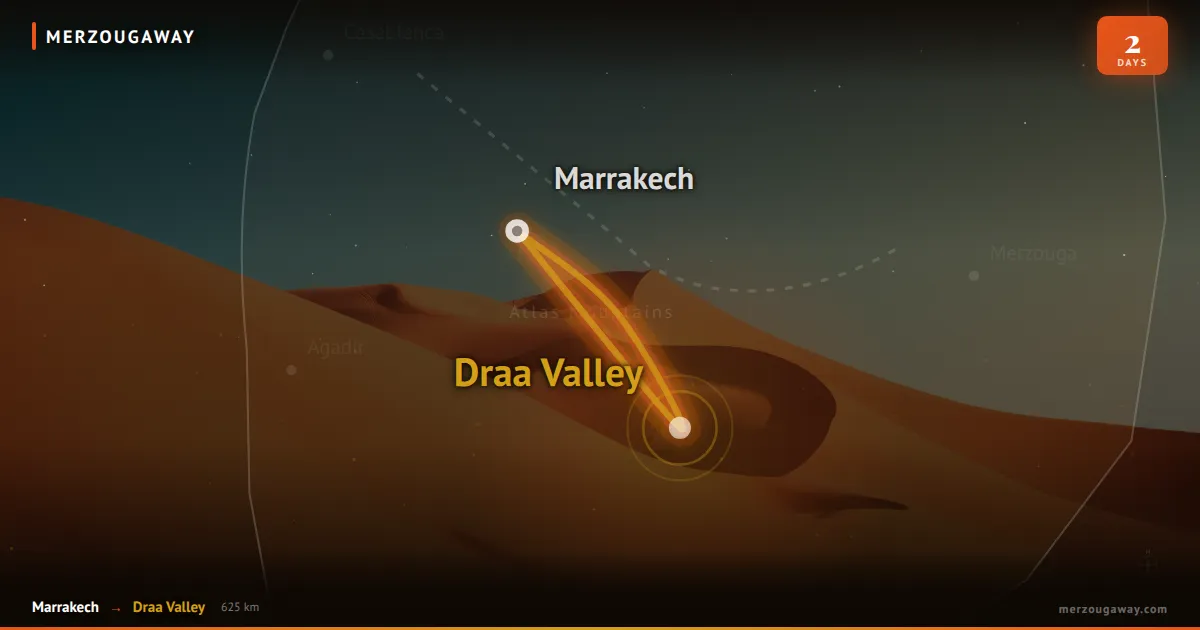
This itinerary can be customized to your group's pace and interests — shorter 2- and 3-day versions of the same route are also available if your schedule is tighter.
Sahara Route & Drive-Time Estimator
Calculate realistic driving hours across the High Atlas (Tizi n'Tichka pass), compare scenic stops (Dadès, Todra, Ziz), and plan your custom desert itinerary.

MerzougaWay Team
We are a passionate team of local guides dedicated to sharing the beauty and culture of our home, Morocco. Our journey began with a simple desire to offer authentic, memorable experiences that go beyond the typical tourist trails.