Marrakech to Merzouga Desert Camp: Luxury & Budget Options 2026
What a Sahara desert camp near Merzouga actually looks like across budget, standard, and luxury tiers — tents, bathrooms, meals, and how to pick the right one for a multi-day trip from Marrakech.
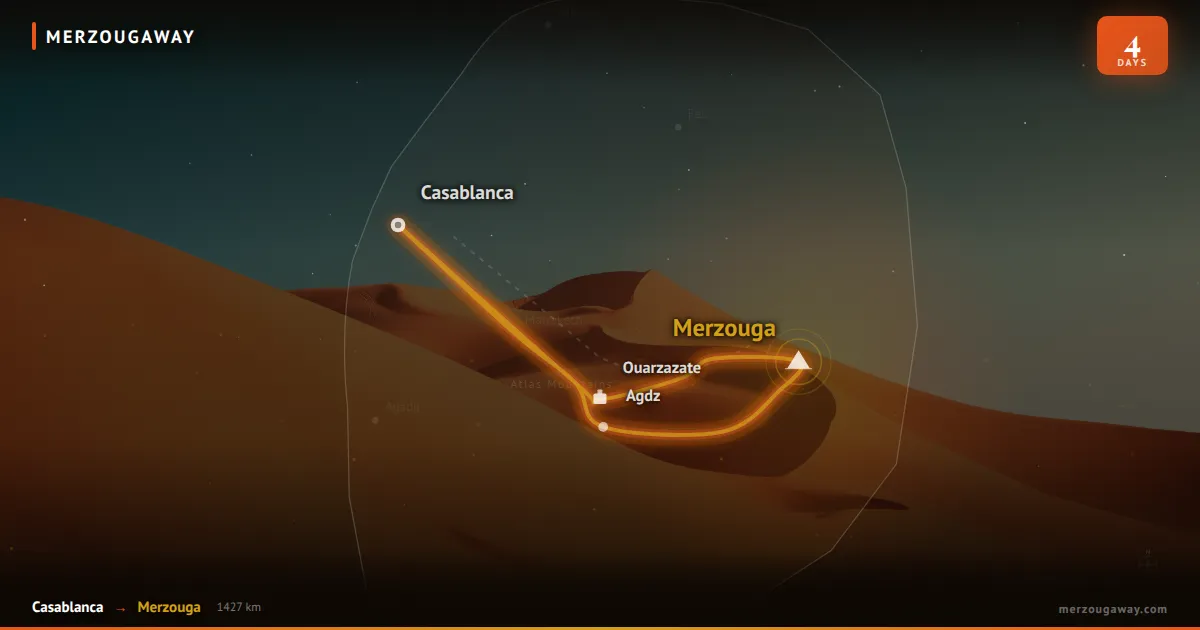
A night under Sahara stars is the moment most people remember longest from a Morocco trip, and it happens in a desert camp near Merzouga — a cluster of Berber-style tents pitched among the dunes of Erg Chebbi. Worth clearing up first: you don't drive from Marrakech to a desert camp in a single day. Merzouga sits roughly 560 km and 9-10 hours from Marrakech by road, crossing the High Atlas via the Tizi n'Tichka pass, so the camp night is really the destination of a 2- to 4-day private tour rather than something you bolt onto a Marrakech city stay. Once you're in Merzouga itself, though, camps also run as standalone one-night add-ons, no multi-day commitment required.
[!NOTE] Fast-Facts & Direct Answer Summary
A desert journey from Marrakech to Merzouga spans ~560 km across the High Atlas Mountains (Tizi n'Tichka pass, 2,260m). The drive takes 9–10 hours, making a 3-Day or 4-Day tour the minimum recommended duration for safety and comfort.
- Recommended Duration: 3 Days (Classic) or 4 Days (Relaxed & In-Depth)
- Primary Road Routes: N9 across the Atlas ➔ N10 through Dadès Valley ➔ N13 to Erg Chebbi
- Realistic Pricing: 1,800–4,500 MAD (€180–€420) per person for private tours with luxury desert camp
- Key Highlights: Aït Benhaddou UNESCO ksar, Todra Gorge canyons, sunset camel trek, and Erg Chebbi dunes
- Local Expert Tip: Avoid 2-day Merzouga tours (18–20 hours driving in 48h). Opt for Agafay Desert if you only have 1–2 days.
What actually separates one camp from another
The word "desert camp" covers a wide range, and the difference between tiers comes down to three things: the tent, the bathroom, and how many other guests you're sharing the dunes with. At the simple end, budget camps put you in basic fabric tents with shared mattresses and communal bathroom blocks — this is the backpacker tier, social and authentic, but with no privacy and fairly basic hot water. Step up to a standard camp and the tents become proper canvas structures with real beds, decent linens, and either private or semi-private bathrooms with reliable hot showers; this is where most family and couple travelers land, since it balances comfort against cost without tipping into luxury pricing.
At the top end — which is what we run on our own tours — a private luxury tent means an en-suite bathroom with a flushing toilet and a genuinely hot shower, a real mattress with fresh linen, gas heating for the cold months (October to March), and a camp capped at 10-12 tents total so it never feels crowded. The gap between "standard" and "luxury" in the Sahara isn't cosmetic the way it might be at a city hotel — a private bathroom in your own tent means not walking across cold sand in the middle of the night, which matters more than it sounds like it would. As a rough sense of the market: budget tents run at the low end of a hundred-odd dirhams a night, standard camps sit in the low hundreds, and private luxury tents with en-suite facilities go for several hundred dirhams and up — treat any number you see quoted online as a starting point to confirm with whoever's actually running the camp, since pricing shifts with season and group size.
What a night at camp actually involves
The rhythm is fairly consistent across camps, luxury or not. You arrive by camel or 4x4 in the late afternoon, timed so the ride into the dunes lands you on a high ridge right as the sun drops — the sand shifts from gold to deep red to purple in the space of twenty minutes, and it's genuinely the moment most people photograph more than anything else on the trip. Dinner follows under the stars, typically a tagine or couscous with soup and bread to start, then Berber drumming and music around a fire once the plates are cleared. After the music winds down is when the sky does its real work: with essentially zero light pollution for hundreds of kilometers, the Milky Way is visible as a distinct band overhead on any clear night, which is most nights. Sunrise the next morning is a slower, quieter version of the same spectacle, best watched from the top of a nearby dune before breakfast and the ride back.
Temperatures swing hard between day and night out here — expect real heat during the day even outside summer, and a genuine, sometimes near-freezing drop after dark in winter. Camps issue blankets and, at the better ones, gas heaters, but bringing a warm layer of your own for the hour around the campfire is worth doing regardless of season. Sun protection matters just as much: the desert sun burns fast, so sunscreen, a hat, and steady water intake through the day aren't optional extras.
Choosing based on who's traveling
Couples and honeymooners generally get the most out of a luxury tent specifically because of the privacy — a private dinner setup and a proper en-suite bathroom go a long way toward making a proposal or anniversary night feel special rather than merely comfortable. Families with children do well at a standard camp: the camel ride is gentle enough for kids from about five up, younger children ride with a parent, and the shared camp atmosphere tends to be genuinely fun rather than something to manage around. Solo travelers and photographers tend to prefer whichever tier gives them the most flexibility around sunrise and sunset timing — ask directly whether the camp allows an early solo walk to the dunes before the group wakes, since not all of them do. None of this is really a safety question by tier; professional guides and organized camps make an overnight in the dunes straightforward regardless of budget level, including for solo women travelers, who make up a real share of desert camp guests.
Booking it properly
The most reliable way to book a desert camp is as part of a private multi-day tour that already includes it — that way the accommodation, meals, and camel trek are locked in together rather than something you have to separately verify once you're in Merzouga. If you're already in the Merzouga area and just want the overnight-in-the-dunes experience without a longer road trip, a standalone one-night camp stay covering the sunset trek, dinner, music, and sunrise is a genuinely good way to get the full experience in under 24 hours — see our Merzouga overnight desert camp experience for exactly how that works. Whichever route you take, confirm the specifics before paying: exact camp location, tent type, whether the bathroom is private or shared, what meals are included, and the cancellation policy. A camp that can't answer those clearly is a camp worth booking somewhere else instead.
Frequently Asked Questions (FAQ)
What is the real difference between a standard and luxury desert camp in Merzouga?
A luxury camp tent features a private en-suite bathroom with a flushing toilet, hot water shower, electric lighting, and winter heating. Standard camps feature shared communal bathrooms located outside the tents.
Is a desert camp comfortable enough to sleep well in?
Yes. Quality camps feature real spring mattresses, raised bed frames, clean cotton sheets, and heavy wool blankets. In luxury camps, heating keeps tents warm even when desert nights dip to 4°C.
Can young children manage the camel ride and desert camp overnight?
Yes. Children aged five and older easily manage their own camel, while younger children ride safely with a parent. The open dunes, campfires, and drumming make it an unforgettable experience for families.
Do I need to book a multi-day tour to stay at a Merzouga desert camp?
No. If you are self-driving to Merzouga or arriving by bus/taxi, you can book a standalone 1-night desert camp experience covering the sunset camel trek, dinner, luxury tent, and breakfast.
Contact Us
Have questions about which camp tier is right for your trip? Reach out and we'll help you plan the desert night that fits your budget and travel style.
- WhatsApp: +212 675 203 319 / +212 668 534 981
- Email: [email protected]
Last updated: July 2026.
Sahara Route & Drive-Time Estimator
Calculate realistic driving hours across the High Atlas (Tizi n'Tichka pass), compare scenic stops (Dadès, Todra, Ziz), and plan your custom desert itinerary.
MerzougaWay Team
We are a passionate team of local guides dedicated to sharing the beauty and culture of our home, Morocco. Our journey began with a simple desire to offer authentic, memorable experiences that go beyond the typical tourist trails.