Marrakech to Merzouga to Fes: What This Journey Actually Looks Like
A day-by-day look at the Marrakech-Merzouga-Fes desert route — the landscapes, the stops, and what makes traveling it in one direction better than a round trip.
Marrakech and Fes are Morocco's two great imperial cities, and the Sahara sits almost exactly between them. Traveling the route in one direction — starting in Marrakech, crossing the desert at Merzouga, and finishing in Fes — turns what could be an out-and-back errand into a genuine journey through the most varied landscapes Morocco has to offer, without doubling back over roads you've already seen.
[!NOTE] Fast-Facts & Direct Answer Summary
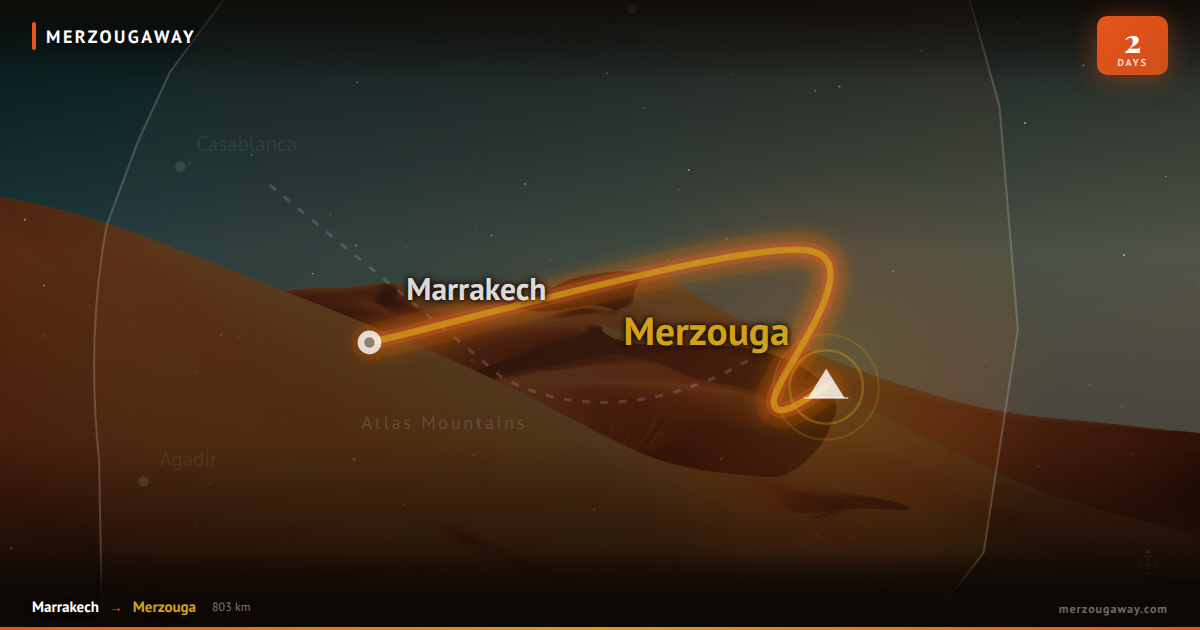
A desert journey from Marrakech to Merzouga spans ~560 km across the High Atlas Mountains (Tizi n'Tichka pass, 2,260m). The drive takes 9–10 hours, making a 3-Day or 4-Day tour the minimum recommended duration for safety and comfort.
- Recommended Duration: 3 Days (Classic) or 4 Days (Relaxed & In-Depth)
- Primary Road Routes: N9 across the Atlas ➔ N10 through Dadès Valley ➔ N13 to Erg Chebbi
- Realistic Pricing: 1,800–4,500 MAD (€180–€420) per person for private tours with luxury desert camp
- Key Highlights: Aït Benhaddou UNESCO ksar, Todra Gorge canyons, sunset camel trek, and Erg Chebbi dunes
- Local Expert Tip: Avoid 2-day Merzouga tours (18–20 hours driving in 48h). Opt for Agafay Desert if you only have 1–2 days.
The shape of the trip
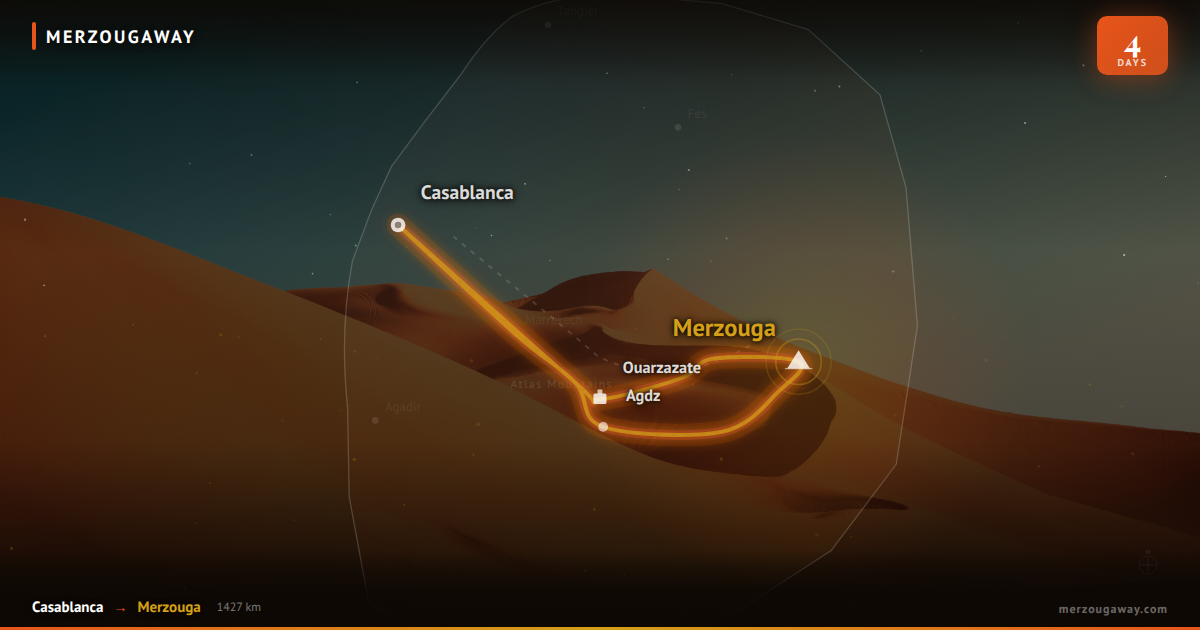
Most versions of this route run 3 to 4 days, and the landscape does almost all the work of making it feel like a real journey rather than a long drive. You leave the ochre walls and packed souks of Marrakech, climb into the High Atlas Mountains, drop into the red-rock kasbah country around Ouarzazate, cross the Dades and Todgha gorges, and arrive at the Erg Chebbi dunes near Merzouga — genuinely one of the most striking dune fields in the Sahara. From there the route turns north through the Ziz Valley's palm groves and the Middle Atlas's cedar forests, ending in Fes, home to the world's oldest continuously operating university and one of the largest car-free medinas anywhere.
Marrakech to the mountains
The first stretch out of Marrakech climbs the Tizi n'Tichka pass, the main road over the High Atlas, with switchbacks and mountain views that are as much a highlight as anything at the end of the day. Most itineraries stop at Aït Benhaddou, a UNESCO World Heritage ksar of red earthen architecture that's been used as a filming location for years — it's touristed for good reason, and worth the stop even knowing that. From there the route continues through Ouarzazate, sometimes called the gateway to the desert for its film studios and its position at the edge of the pre-Saharan landscape.
Into the desert
The second stretch is where the country changes fastest: from the gorges and river valleys around Dades and Todgha, through Erfoud's palm groves, and finally into the open dune sea of Erg Chebbi. A sunset camel trek into the dunes and a night at a desert camp is the centerpiece of this leg — the silence after dark, with no light pollution for miles, is the kind of thing photos don't really capture. Sunrise the next morning, watching the light change color across the dunes, is worth setting an alarm for even after a short night's sleep.
Merzouga to Fes
The final stretch is a genuine shift in character: north through the Ziz Valley's palm groves, into the cedar forests of the Middle Atlas (keep an eye out for Barbary macaques along this stretch), often via Ifrane — a town built in a distinctly alpine style that looks out of place in Morocco until you learn its history. The route ends in Fes, whose medina is dense and layered enough that even a short visit rewards having a guide who knows it, rather than trying to navigate the Blue Gate and the tanneries cold.
Why this direction, and why one-way
Doing the trip Marrakech-to-Fes rather than a Marrakech round trip means every day covers new ground instead of retracing the previous day's road — a meaningful difference on a route this long. It also suits an "open-jaw" flight plan well, flying into Marrakech and out of Fes (or vice versa), which avoids an unnecessary domestic backtrack. We cover the practical side of planning this — luggage logistics, drop-off details in Fes, and how pricing works — in our companion guide to booking a one-way Marrakech to Merzouga tour with Fes drop-off.
When to go
Spring (March-May) and autumn (September-November) offer the most comfortable temperatures for both the mountain crossing and the desert nights. Summer pushes desert daytime temperatures well above 40°C, though the trip is still doable with air-conditioned transport and sensible hydration. Winter brings cold desert nights and occasional snow on the Tizi n'Tichka pass, worth planning around with warm layers if you're traveling December through February.
What to pack
Lightweight, breathable clothing for the daytime heat, warm layers for the desert night regardless of season, comfortable walking shoes for uneven ground at the kasbahs and dunes, sun protection, and a headlamp for moving around the camp after dark.
Frequently Asked Questions (FAQ)
Why is the Marrakech to Fes via Merzouga desert tour called the "Golden Triangle"?
This route is Morocco's premier overland crossing because it links the country's two greatest imperial capitals without backtracking. You travel from Marrakech over the High Atlas to Erg Chebbi, and then cross the Middle Atlas and cedar forests to arrive in Fes, experiencing Morocco's complete geographical diversity.
How many days are needed for the Marrakech to Fes desert route?
3 days / 2 nights is the minimum standard crossing (Night 1: Dades Valley; Night 2: Merzouga luxury camp). A 4-day itinerary adds a second night in the dunes or an overnight in the Middle Atlas (Midelt), providing an unhurried, comfortable pace.
What do you see on the drive between Merzouga and Fes on the final day?
The final leg (470 km / 7.5 hours) traverses the spectacular Ziz Valley Gorge with millions of date palms, crosses the High and Middle Atlas ranges via Midelt, passes through the ancient Azrou cedar forest to observe wild Barbary macaques, and stops in alpine Ifrane ("Little Switzerland") before descending into Fes.
Can luggage be transported between Marrakech and Fes on this tour?
Yes! Your luggage travels securely with you inside the private 4x4 or Mercedes van throughout the entire journey and is delivered directly to your riad in Fes at the end of the tour.
Can this tour be done in reverse from Fes to Marrakech?
Yes. MerzougaWay operates this crossing daily in both directions (Fes to Marrakech or Marrakech to Fes) with identical high-standard inclusions, luxury camps, and scenic stops.
Book this route
We run this itinerary as a private tour — your pace, your stops, no shared schedule to work around. Contact us to build the version of this route that fits your dates and interests.
Contact us:
- Email: [email protected]
- WhatsApp: +212675203319 / +212668534981
See our 3-day Marrakech to Merzouga to Fes one-way tour for a full itinerary.
Sahara Route & Drive-Time Estimator
Calculate realistic driving hours across the High Atlas (Tizi n'Tichka pass), compare scenic stops (Dadès, Todra, Ziz), and plan your custom desert itinerary.

MerzougaWay Team
We are a passionate team of local guides dedicated to sharing the beauty and culture of our home, Morocco. Our journey began with a simple desire to offer authentic, memorable experiences that go beyond the typical tourist trails.