Coastal to Sahara: The Ultimate 5-Day Essaouira to Merzouga Desert Tour (2026)
The definitive 5-day Essaouira to Merzouga desert tour route for 2026. Discover the Atlantic coast, High Atlas Tizi n'Tichka pass, Aït Benhaddou, Dades Gorges, and Erg Chebbi luxury glamping.
The overland journey from the breezy Atlantic fishing ramparts of Essaouira to the soaring 150-meter-high golden sand dunes of Erg Chebbi in Merzouga is one of the most geographically diverse and visually stunning road trips on earth.
In a single 5-day journey spanning roughly 1,350 kilometers (840 miles), you will transition from misty coastal trade winds and ancient Portuguese sea fortresses, cross the rugged 2,260-meter alpine peaks of the High Atlas Mountains, wander through 1,000-year-old mud-brick Kasbahs, wind through 300-meter-deep limestone canyons, and sleep under a billion stars in a 5-star luxury Sahara desert camp.
In this comprehensive 2026 expedition guide, our local team at MerzougaWay provides the complete day-by-day 5-day Essaouira to Merzouga itinerary, including driving distances, road conditions, secret cultural stops, boutique hotel recommendations, and logistics.
⚡ Quick Summary: The 5-Day Coast to Desert Route at a Glance
[!NOTE] At a Glance — 5-Day Coast to Sahara Highlights
- Total Distance: Roughly 1,350 km (840 miles) over 5 days (Comfortable 3.5 to 5 hours of driving per day broken up by scenic landmarks).
- Day 1: Atlantic Coast (Essaouira) ➔ Chichaoua ➔ High Atlas Tizi n'Tichka (2,260m) ➔ UNESCO Kasbah Aït Benhaddou ➔ Ouarzazate.
- Day 2: Ouarzazate ➔ Skoura Oasis (Kasbah Amridil) ➔ Valley of the Roses ➔ Dades Gorge Canyon.
- Day 3: Dades Valley ➔ Todra 300m Gorges ➔ Erfoud Fossil Marble ➔ Erg Chebbi (Merzouga 5-Star Luxury Camp).
- Day 4: Erg Chebbi Sunrise ➔ Khamlia Gnawa Village ➔ Alnif & N'Kob (45 Kasbahs) ➔ Draa Valley Oasis ➔ Agdz.
- Day 5: Agdz ➔ Anti-Atlas Mountains ➔ Kasbah Telouet ➔ Marrakech (End of Tour).
- Best Vehicle: Private air-conditioned Toyota Land Cruiser Prado 4x4 or Mercedes V-Class VIP Van.
┌─────────────────────────────────────────────────────────────────────────────────────────────────┐
│                     5-DAY ESSAOUIRA TO MERZOUGA ROUTE MATRIX                                    │
├─────────┬─────────────────────────────┬────────────┬──────────────┬─────────────────────────────┤
│ DAY     │ ROUTE SEGMENT               │ DISTANCE   │ DRIVE TIME   │ OVERNIGHT STOP              │
├─────────┼─────────────────────────────┼────────────┼──────────────┼─────────────────────────────┤
│ Day 1   │ Essaouira ➔ Aït Benhaddou   │ 380 km     │ 6.0 Hours    │ Boutique Ksar in Ouarzazate │
│ Day 2   │ Ouarzazate ➔ Dades Gorges   │ 160 km     │ 3.0 Hours    │ Cliffside Boutique Hotel    │
│ Day 3   │ Dades ➔ Todra ➔ Merzouga    │ 270 km     │ 4.5 Hours    │ 5-Star Erg Chebbi Glamping  │
│ Day 4   │ Merzouga ➔ Draa Valley/Agdz │ 280 km     │ 4.5 Hours    │ Restored Kasbah in Agdz     │
│ Day 5   │ Agdz ➔ Telouet ➔ Marrakech  │ 260 km     │ 4.5 Hours    │ Marrakech Boutique Riad     │
└─────────┴─────────────────────────────┴────────────┴──────────────┴─────────────────────────────┘
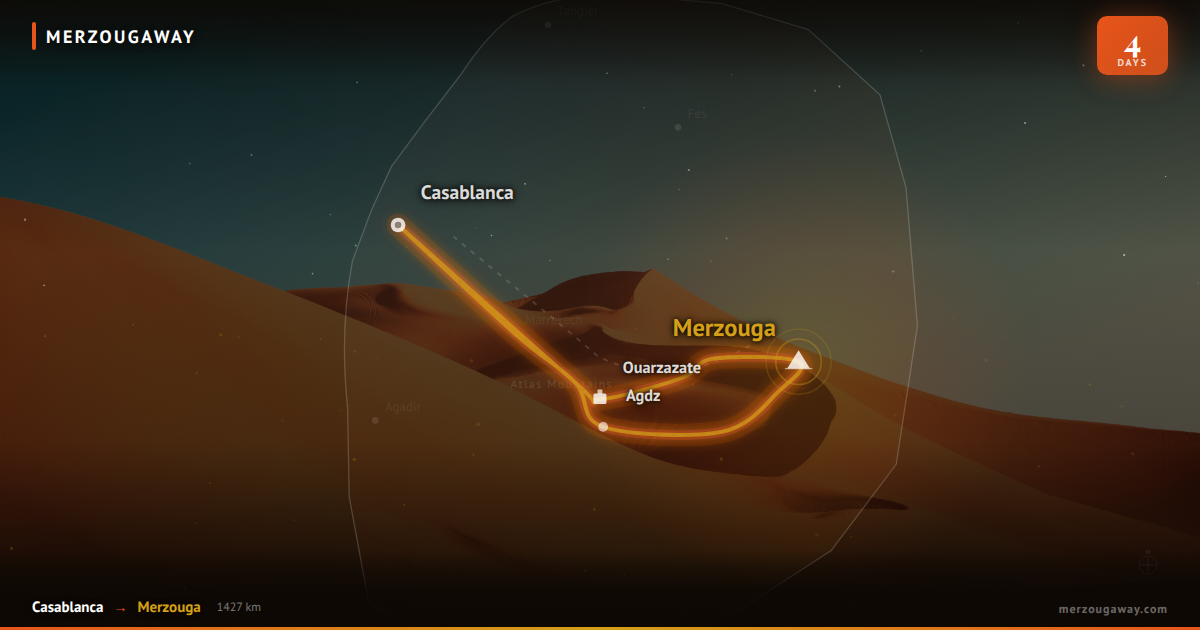
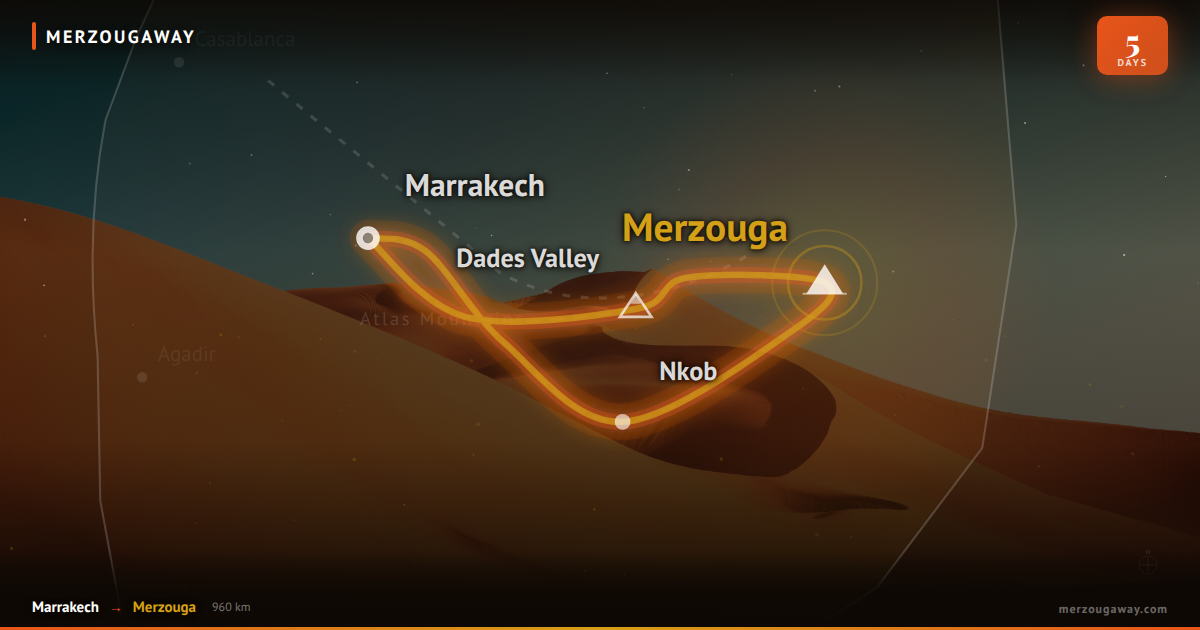
Visual Route Map: Atlantic Coast to Sahara Dunes
    [ESSAOUIRA] (Atlantic Ocean Breezes & Ramparts)
         │
         ▼ (Highway R207 / 2.0h)
    [Chichaoua Plains]
         │
         ▼ (Bypass Marrakech ➔ Highway N9)
    ▲▲▲ HIGH ATLAS MOUNTAINS (Tizi n'Tichka Pass - 2,260m) ▲▲▲
         │
         ▼
    [KASBAH AÏT BENHADDOU] (UNESCO 11th-Century Clay Fortress)
         │
         ▼
    [OUARZAZATE] ➔ [SKOURA OASIS] ➔ [DADES GORGES] (Day 2)
                                          │
                                          ▼
    [TODRA GORGES] ➔ [ERFOUD] ➔ [ERG CHEBBI - MERZOUGA] (Day 3: Luxury Camp)
                                          │
                                          ▼ (South Route via N'Kob)
    [DRAA PALM VALLEY] ➔ [AGDZ KASBAHS] ➔ [MARRAKECH] (Days 4 & 5)
Part 1: Detailed Day-by-Day Expedition Itinerary
Day 1: Essaouira to Kasbah Aït Benhaddou & Ouarzazate (380 km / 6h)
- 07:30 AM Departure: Depart your Essaouira riad, driving east through the argan forests of the Haha region.
- 11:00 AM — Crossing the High Atlas Mountains: Ascend Highway N9 into the High Atlas, crossing the dramatic Tizi n'Tichka Pass (2,260m / 7,415 ft) with sweeping views of terraced Berber farming valleys.
- 02:30 PM — UNESCO Kasbah Aït Benhaddou: Cross the Ounila riverbed to explore the famous fortified earthen village (Ksar). Climb to the ancient granary (Agadir) atop the hill for golden-hour views of the desert plains where Gladiator, Game of Thrones, and The Mummy were filmed.
- Overnight: Boutique Kasbah hotel in Ouarzazate or Aït Benhaddou (Dinner included).
Day 2: Ouarzazate to Skoura, Rose Valley & Dades Gorges (160 km / 3h)
- 09:00 AM — Skoura Palm Oasis & Kasbah Amridil: Explore the 17th-century Kasbah Amridil, a living mud-brick fortress featured on the vintage Moroccan 50-Dirham banknote.
- 11:30 AM — Valley of the Roses (Kelaat M'Gouna): Drive through lush Damascus rose orchards where millions of fragrant pink petals are distilled into organic rosewater.
- 02:30 PM — The Dades Gorge Canyon Drive: Ascend into the dramatic Dades Gorge, driving the famous hairpin switchbacks of Tisdrine and admiring the towering natural rock formations known as the "Monkey Fingers" (Les Doigts de Singe).
- Overnight: Charming cliffside boutique hotel in the Dades Valley with terrace views over the canyon river.
Day 3: Dades to Todra Gorges, Erfoud & Erg Chebbi Luxury Camp (270 km / 4.5h)
- 09:00 AM — The Sheer Walls of Todra Gorge: Stroll along the crystalline Todra River between vertical 300-meter-high (nearly 1,000 ft) orange limestone cliffs.
- 01:00 PM — Fossil Workshops in Erfoud: Discover prehistoric marine ammonites and trilobites embedded in 350-million-year-old Saharan limestone slabs.
- 04:30 PM — Sunset Camel Trek into Erg Chebbi: Arrive at the edge of the golden sand dunes in Merzouga. Mount your camel for a 1-hour sunset trek across the knife-edge ridges of Erg Chebbi.
- The Desert Night: Arrive at MerzougaWay Luxury Camp. Settle into your private en-suite canvas tent with a hot shower, enjoy a gourmet 3-course Moroccan dinner, and gather around the roaring campfire for hypnotic live Gnawa and Berber drumming under a sky of a billion stars.
Day 4: Merzouga Sunrise, Khamlia Village & Draa Valley to Agdz (280 km / 4.5h)
- 06:00 AM — The Sahara Sunrise: Climb a 100-meter dune ridge to watch the sun ignite the desert in glowing amber and copper tones.
- 09:00 AM — Khamlia Gnawa Village: Visit the historic desert village of Khamlia, home to the descendants of sub-Saharan travelers, to experience authentic spiritual Gnawa trance music and iron castanets (Qraqeb).
- 01:30 PM — Village of 45 Kasbahs (N'Kob): Drive west along Highway R108 through the volcanic Jbel Saghro peaks to N'Kob for lunch.
- 04:30 PM — The Draa Valley Oasis: Enter the Draa Valley—Morocco's largest palm oasis containing over 2 million date palms. Arrive in the ancient caravan town of Agdz.
- Overnight: Restored 19th-century earthen Kasbah hotel in Agdz.
Day 5: Agdz via Kasbah Telouet & High Atlas to Marrakech (260 km / 4.5h)
- 09:00 AM — Kasbah Telouet (The Gloui Palace): Take the historic mountain road through the Ounila Valley to visit the abandoned palace of the "Lord of the Atlas" (Thami El Glaoui), featuring jaw-dropping Italian marble, carved stucco lace, and zellij tilework hidden behind crumbling exterior clay walls.
- 01:00 PM — Mountain Pass Lunch: Enjoy a traditional Berber tagine lunch overlooking alpine peaks.
- 04:30 PM — Arrival in Marrakech: Descend the High Atlas into Marrakech. Your private driver drops you directly at your riad or Marrakech Menara Airport (RAK).
Part 2: What to Pack for a Coast-to-Desert Expedition
Because you will experience both Atlantic maritime humidity (18°C–22°C) and dry Saharan heat/chill (4°C at night to 28°C by day), pack versatile layers:
- Light Windbreaker Jacket: For breezy Essaouira ramparts and evening Atlantic walks.
- Warm Packable Fleece / Down Jacket: Essential for chilly winter desert nights in Merzouga.
- 2-Meter Cotton Berber Scarf (Cheche): Protects against sun and blowing sand on camel treks.
- Trail Runners / Sneakers: For walking cobblestone medinas and climbing sand dunes.
- Polarized Sunglasses & SPF 50+ Sunscreen: High UV protection in the Sahara.
❓ Frequently Asked Questions (FAQ)
Can this tour start in Marrakech and end in Essaouira instead?
Yes! The 5-day route is 100% reversible. You can start in Marrakech, travel through the High Atlas to the Merzouga Desert, cross the Draa Valley, and finish your trip relaxing by the Atlantic ocean in Essaouira!
Is 5 days enough time for both Essaouira and the Sahara Desert?
Yes! 5 days is the ideal duration for this itinerary. Spreading the 1,350 km route across 5 days keeps daily driving to a comfortable 3.5 to 5 hours, leaving plenty of time each afternoon for sightseeing, camel trekking, and enjoying boutique riads.
What kind of vehicle is used for this tour?
Private tours with MerzougaWay use modern, air-conditioned Toyota Land Cruiser Prado TX 4x4s or spacious Mercedes-Benz V-Class VIP passenger vans, equipped with Wi-Fi, bottled mineral water, and driven by professional English-speaking Berber driver-guides.
Are all meals included on the 5-day tour?
All breakfasts and multi-course dinners (at boutique hotels and the luxury desert camp) are 100% included. Midday lunches are enjoyed at scenic local Berber restaurants along the route (averaging 80 to 140 MAD / ~€8–€14 per meal).
Can families with young children do this 5-day tour?
Yes! The 5-day route is very popular with families because the driving is broken up into manageable chunks, and children love the camel rides, fossil hunting in Erfoud, exploring ancient castle ramparts, and sandboarding on the dunes.
How do I book this private 5-day tour?
You can book directly with MerzougaWay via our website booking portal or by messaging our local team directly on WhatsApp with your travel dates and group size.
🇲🇦 Book Your Private 5-Day Coast to Sahara Tour with MerzougaWay
Ready to experience the ultimate Moroccan overland adventure from the Atlantic waves to the golden Sahara dunes? MerzougaWay designs bespoke private luxury expeditions tailored to your schedule.
- Explore All Tour Packages: All Morocco Desert Tour Packages
- Direct WhatsApp Consultation: +212 675 203 319 / +212 668 534 981
- Email Customer Support: [email protected]
Guide updated and verified for 2026 travel season.
Sahara Route & Drive-Time Estimator
Calculate realistic driving hours across the High Atlas (Tizi n'Tichka pass), compare scenic stops (Dadès, Todra, Ziz), and plan your custom desert itinerary.
MerzougaWay Team
We are a passionate team of local guides dedicated to sharing the beauty and culture of our home, Morocco. Our journey began with a simple desire to offer authentic, memorable experiences that go beyond the typical tourist trails.