Fes Day Trips: Ultimate Guide to Unforgettable Excursions 2026
The real day-trip options from Fes — Volubilis and Meknes, Chefchaouen, the Middle Atlas cedar forests, and the Rif waterfalls near Chefchaouen — with honest distances and what each is actually worth.
Fes sits close enough to several genuinely different landscapes — Roman ruins, a holy hilltop town, blue-washed mountain streets, cedar forest highlands — that it makes an unusually good base for day trips, without needing to change hotels every night. Here's what's actually reachable and what each one is worth.
[!NOTE] Fast-Facts & Direct Answer Summary
The real day-trip options from Fes — Volubilis and Meknes, Chefchaouen, the Middle Atlas cedar forests, and the Rif waterfalls near Chefchaouen — with honest distances and what each is actually worth.
- Destination Focus: Authentic Moroccan culture, scenic routes, and local travel insights
- Currency & Payments: Moroccan Dirham (MAD; ~10 MAD ≈ €1 / $1.08 USD). Cash is essential outside major hotels
- Best Travel Window: October through April offers ideal temperate weather across Morocco and the desert
- Local Hospitality: Berber culture is renowned for warm hospitality, mint tea welcoming rituals, and rich musical heritage.
Meknes, Volubilis, and Moulay Idriss
This is the classic Fes day trip and the one most worth doing if you only have time for one: Meknes, one of Morocco's four imperial cities, is about 1-1.5 hours from Fes, and its highlights — Moulay Ismail's mausoleum and the vast Heri es-Souani granaries — are worth a couple of hours on their own. From there it's a short hop to Volubilis, the best-preserved Roman ruin in Morocco and a genuine UNESCO World Heritage site, with mosaics still in place on the ground where they were laid two thousand years ago. Moulay Idriss, the hill town considered the holiest in Morocco and named for the country's founding dynasty, sits just a few minutes further and makes a natural third stop, with panoramic views over the surrounding countryside from the top of the town. Doing all three in one day is entirely realistic — most tours run 7-9 hours round trip from Fes.
Chefchaouen
The blue-washed medina of Chefchaouen is roughly 3.5-4 hours from Fes each way through the Rif Mountains, which makes it a genuinely long day — plan on 11-13 hours round trip if you're doing it in a single day rather than staying overnight. It's worth it for the photography and the mountain scenery alone, but be honest with yourself about whether a same-day round trip leaves enough time to actually enjoy the town, or whether an overnight stay would serve you better given how far it is.
Ifrane and the Middle Atlas
Ifrane, often called Morocco's "Little Switzerland" for its Alpine-style architecture, sits about an hour from Fes in the Middle Atlas — a genuinely different Morocco from the desert or coastal images most people expect, with cedar forests, cooler air, and a real chance of spotting Barbary macaques in the trees near Azrou. It's an easy half-day trip, good for a change of pace and scenery without a long drive, and works well even in summer when the highland air is noticeably cooler than Fes itself.
The Rif waterfalls near Chefchaouen
The Akchour waterfalls and the nearby natural rock arch known as God's Bridge sit in the Rif Mountains near Chefchaouen, not the Middle Atlas — a distinction that matters if you're trying to combine this with an Ifrane trip, since they're in opposite directions from Fes. Reaching them typically means combining the trip with Chefchaouen itself given the distance, with a hike in to the falls and swimming spots along the way. Worth it if you're already committing to the long Chefchaouen day and want to add a genuine hike to the mix.
Planning it well
High season (spring and autumn) books up faster, so a couple of days' advance notice helps; the quieter summer and winter months are more forgiving of last-minute planning. Whatever the season, start early — you'll beat both the heat and the crowds, and get better light for photos at each stop. Dress in layers, since temperatures can swing a fair amount between a Fes morning and a Middle Atlas afternoon, and keep something modest on hand for Moulay Idriss and other religious sites.
A private day trip gives you the flexibility to linger somewhere that catches your interest and skip past what doesn't, with pickup directly from your riad or hotel — it works well whether it's just you, a couple, or a family or group of friends traveling together, since the whole day is built around your pace rather than a fixed schedule.
Master Comparison Matrix: The Top Day Excursions from Fes
While the ancient medieval Medina of Fes (Fes el-Bali)—with its 9,000 car-free derbs, fragrant spice markets, and 1,000-year-old Chouara Tannery—can occupy travelers for days, the geographic position of Fes makes it the ultimate springboard for exploring Northern and Central Morocco. Within a 1 to 3-hour radius lie magnificent UNESCO Roman ruins, imperial royal capitals, mountain cedar forests teeming with wild primates, and the world-famous "Blue Pearl" of the Rif Mountains.
The following master comparison table evaluates the top five day-trip destinations departing from Fes:
| Destination & Excursion | Driving Distance & Transit Time | Optimal Mode of Transit | Key Attractions & Sights | Approximate Cost per Person (MAD / EUR) | Recommended Traveler Focus | | :--- | :--- | :--- | :--- | :--- | :--- | | Volubilis (Walili) & Moulay Idriss Zerhoun | 70 km / 1 hr 15 mins each way | Grand Taxi or Private Driver | In situ Roman mosaics, Basilica, holy pilgrimage hill town | 250 – 500 MAD (€25 – €50) | History lovers, archaeology enthusiasts, photographers | | Meknes (Imperial City) | 60 km / 35 to 45 mins | Direct ONCF train (departs hourly) | Bab El-Mansour, Heri es-Souani granaries, royal stables | 44 MAD round-trip train ticket (€4) | Independent culture seekers, budget rail travelers | | Chefchaouen (The Blue Pearl) | 200 km / 3.5 to 4.0 hrs each way | Private 4x4 / Minibus tour or CTM bus | Blue-washed medina, Spanish Mosque sunset, mountain crafts | 350 – 700 MAD (€35 – €70) | Instagram & visual photography, mountain artisan lovers | | Middle Atlas: Ifrane, Azrou & Bhalil | 80 km / 1.5 hrs each way | Private driver or shared Grand Taxi | French alpine architecture, Barbary macaques, troglodyte caves | 300 – 600 MAD (€30 – €60) | Nature enthusiasts, families, indigenous village culture | | Sefrou & Cascades d'el-Aggai | 30 km / 35 mins each way | Grand Taxi from Bab Jiaf station | Historic Jewish Mellah, olive oil presses, natural waterfalls | 30 – 100 MAD (€3 – €10) | Off-the-beaten-track explorers, Jewish heritage seekers |
Volubilis (Walili) and Moulay Idriss Zerhoun Deep Dive
Located an hour west of Fes across fertile agricultural plains planted with ancient olive groves, Volubilis (known in Arabic as Walili) is Morocco's most expansive and best-preserved Roman archaeological site, recognized as a UNESCO World Heritage site since 1997:
- Archaeological Highlights: Flourishing from the 3rd century BC through the Roman imperial era as the capital of Mauretania Tingitana, Volubilis exported wheat, wild beasts for gladiatorial arenas, and olive oil across the Roman Empire. Wander down the monumental paved Decumanus Maximus, admire the towering Triumphal Arch of Caracalla (constructed in 217 AD), inspect the legislative Basilica and Capitoline Temple, and marvel at extraordinary in situ polychrome floor mosaics depicting the Labors of Hercules, Diana Bathing, and Orpheus Charming the Animals.
- Logistics & Licensed Guides: Official entrance tickets cost 70 MAD (~$7 USD) per adult. While you can explore independently, hiring a licensed state guide stationed at the ticket pavilion (negotiable for 200 to 300 MAD for a 90-minute tour in English, French, or Spanish) brings the ancient ruins vividly to life with historical context. Visit early in the morning (opening at 08:30) or late afternoon, as the exposed ruins offer virtually zero shade during midday summer heat.
- Moulay Idriss Zerhoun: Just 5 kilometers from Volubilis, perched dramatic across two green hilltops, sits the sacred pilgrimage town of Moulay Idriss Zerhoun. Named after Moulay Idriss I (great-grandson of the Prophet Muhammad and founder of the Idrisid dynasty who brought Islam to Morocco in 789 AD), this picturesque whitewashed town was closed to non-Muslims until 1916. Stroll through the scenic market square, admire Morocco's only cylindrical minaret decorated with green zellij tiles, and sample the town's renowned spiced grilled kefta and round anise seed sweetbreads.
Meknes: The Grand Imperial Capital of Sultan Moulay Ismail
Often overshadowed by neighboring Fes, Meknes was transformed in the 17th century by the fierce Alaouite Sultan Moulay Ismail into a monumental imperial fortress city designed to rival the court of King Louis XIV at Versailles:
- Transit Simplicity: Reaching Meknes from Fes is effortless. Direct ONCF trains depart Fes-Ville railway station every hour, arriving at Meknes-Ville station in just 35 to 45 minutes. A one-way 2nd-class ticket costs 22 MAD (~$2.20 USD), while 1st-class costs 35 MAD. From the station, take a petit taxi (15 to 20 MAD) directly to Place el-Hedim.
- Key Monuments:
- Bab El-Mansour: Widely regarded as the grandest ceremonial gateway in North Africa, featuring towering marble columns looted from Roman Volubilis, intricate arabesque carvings, and glowing turquoise and cobalt ceramic zellij mosaics.
- Place el-Hedim: Meknes's more intimate counterpart to Marrakech's Jemaa el-Fna, lined with outdoor cafes serving fresh mint tea and local almond pastries.
- Heri es-Souani and the Royal Stables: A colossal vaulted architectural marvel built to store years of grain reserves for the royal army and house Moulay Ismail's legendary 12,000 royal cavalry horses, cooled by subterranean water channels feeding the adjacent 4-hectare Agdal Reservoir (Bassin de l'Agdal).
- Mausoleum of Moulay Ismail: A peaceful royal sanctuary showcasing serene courtyards with marble fountains, intricate carved cedarwood, and quiet contemplation chambers (respectful modest dress required; non-Muslims may enter the outer sanctuaries).
The Middle Atlas: Ifrane, Azrou Cedar Forest, and Bhalil
Escaping the summer heat or exploring winter snow in the Middle Atlas mountains offers a radical contrast to the medieval medina:
- Ifrane ("Little Switzerland"): Perched at 1,665 meters elevation, Ifrane was established by French colonial authorities in the 1920s as a hill station resort (station estivale). With its pitched red-tile alpine roofs, manicured botanical flowerbeds, European architecture, clean streets, and the famous stone lion sculpture carved during World War II, Ifrane feels strikingly alpine. It is also home to Al Akhawayn University, Morocco's prestigious English-language institution.
- Azrou Cedar Forest and Barbary Macaques: Continuing south into the high cedar forests of Azrou (surrounding the historic Cèdre Gouraud monument), travelers encounter troops of wild Barbary macaques (Macaca sylvanus), the only wild monkey species native to Europe and North Africa.
- Ethical Wildlife Warning: While roadside vendors sell peanuts to feed the monkeys, wildlife conservation authorities urge visitors not to feed wild macaques. Human snack foods cause dental disease, obesity, and aggressive habituation. Observe and photograph these magnificent primates from a respectful distance of 5 to 10 meters as they leap through the ancient Atlantic cedar canopy.
- Bhalil Troglodyte Cave Dwellings: Located just 30 km south of Fes near Sefrou, the hillside village of Bhalil is famous for its historic inhabited cave homes dating back centuries. Built into limestone cliffs, these subterranean dwellings maintain a constant year-round temperature of 18°C (64°F). Local Berber families frequently invite travelers in for mint tea, showcasing traditional handicraft production of silk djellaba buttons (sfifa), hand-knotted by village women along the village lanes.
Chefchaouen as a Day Trip: Realistic Expectations
Can you visit the famous "Blue Pearl" of Chefchaouen as a single-day excursion from Fes?
- The Driving Reality: Chefchaouen is situated 200 kilometers north of Fes in the rugged Rif Mountain range. The drive takes 3.5 to 4.0 hours each way along winding two-lane mountain roads (N13 and N2). That means a day trip requires 7 to 8 hours of total round-trip driving.
- The Trade-Off: If you hire a private driver or take a dedicated day tour departing Fes at 07:30 AM, you arrive in Chefchaouen around 11:30 AM, allowing 4 to 5 hours to explore the blue-washed Medina lanes, photograph famous flower-pot staircases along Rue Targui, hike up to the Spanish Mosque for a panoramic viewpoint, enjoy a goat cheese and tagine lunch on Plaza Uta el-Hammam, and depart at 16:30 PM to return to Fes by 20:30 PM.
- Our Expert Verdict: If Chefchaouen is a mandatory bucket-list dream and your Morocco itinerary has zero extra days, the day trip is entirely doable and rewarding. However, if your schedule permits, staying overnight in a Chefchaouen riad provides a far more magical experience, allowing you to explore the serene blue alleys in the early morning and golden dusk after the tour bus day-trippers have departed.
Frequently Asked Questions (FAQ)
What is the best day trip to take from Fes?
The Volubilis, Moulay Idriss, and Meknes circuit is the undisputed #1 day trip from Fes. It combines 2,000-year-old Roman mosaic ruins (Volubilis), Morocco's most sacred pilgrimage town (Moulay Idriss Zerhoun), and the grand 17th-century imperial gates and granaries of Meknes, all within a comfortable 1-hour drive.
Can you visit Chefchaouen as a day trip from Fes?
Yes, but expect a full 11- to 12-hour day. Chefchaouen is 200 km northwest through the winding Rif Mountains (3.5 to 4 hours driving each way). Departing Fes by 7:30 AM allows approximately 4 to 5 hours in the Blue City to explore the blue alleyways, shop for woven blankets, and have lunch at Plaza Uta el-Hammam before returning by 8:00 PM.
How far is Volubilis from Fes and how long does it take?
Volubilis (Walili) is 70 km west of Fes via Route N4. Driving takes approximately 1 hour and 15 minutes each way. Entrance tickets cost 70 MAD (€6.50), and hiring a licensed site archaeologist guide costs 150 to 200 MAD for a 1-hour guided walkthrough.
Where can you see wild monkeys (Barbary macaques) near Fes?
Barbary macaques live in the ancient cedar forests of the Middle Atlas Mountains near Azrou and Ifrane, located 75 km (1 hour and 15 minutes) south of Fes. The best viewing area is the Cèdre Gouraud Forest along Route N13.
Can you do a day trip from Fes to the Sahara Desert?
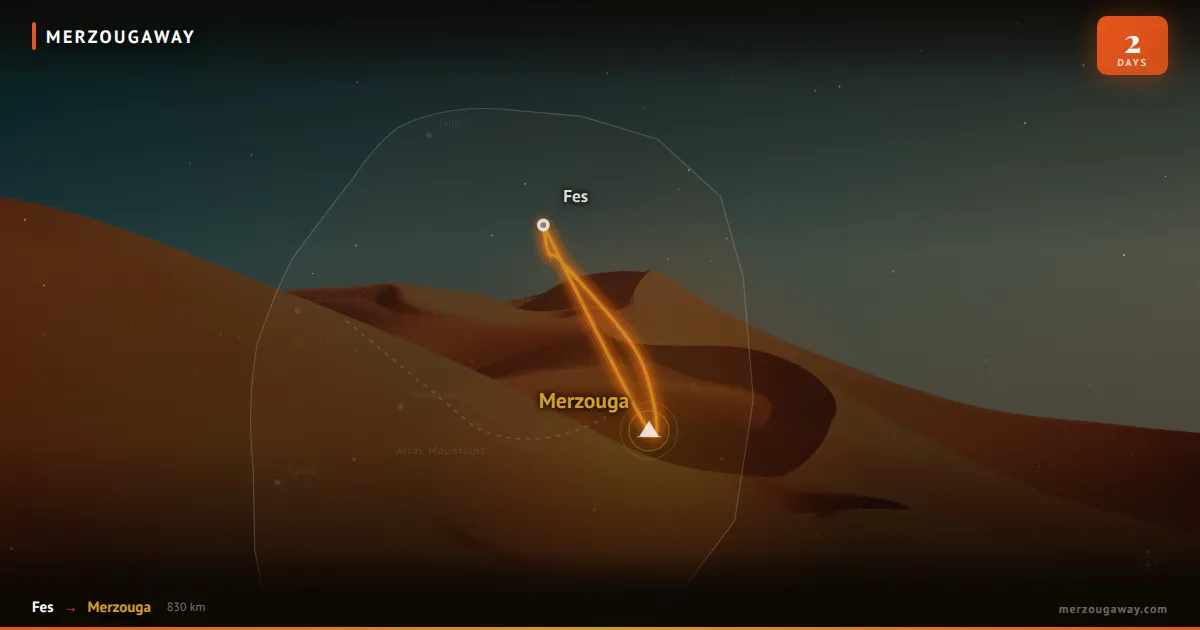
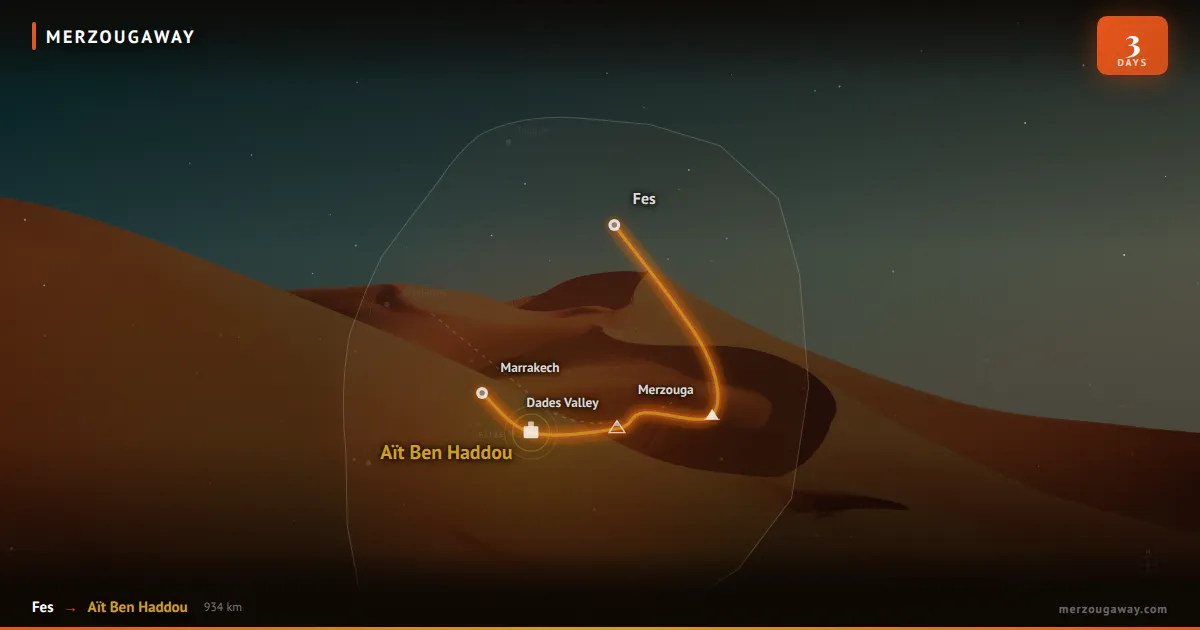
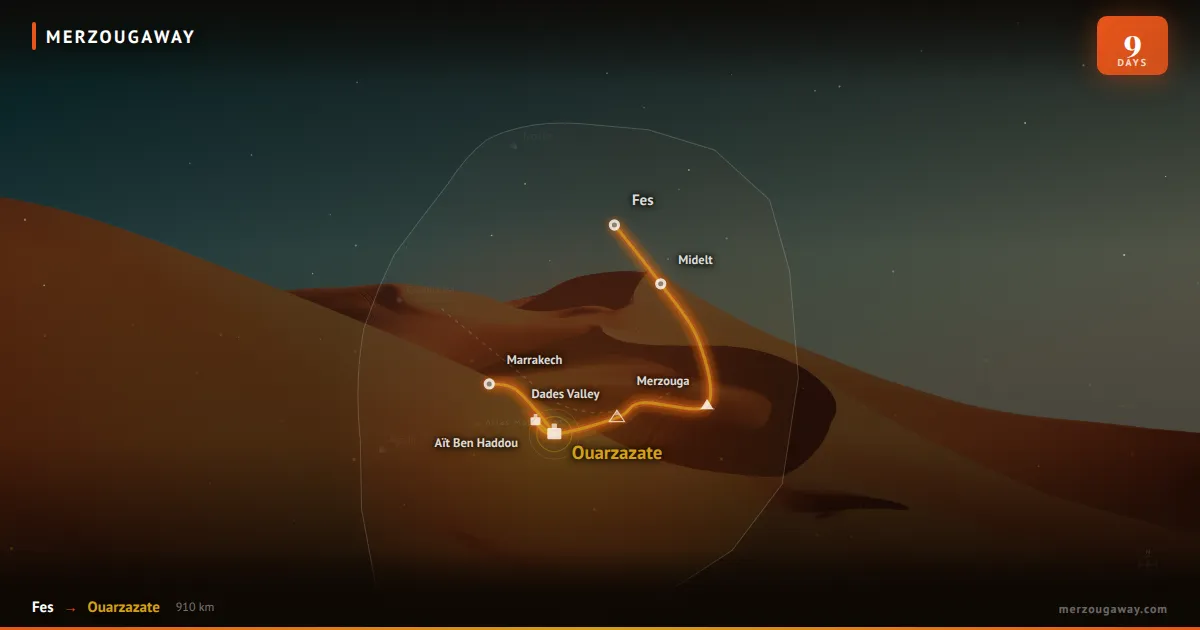
No. Merzouga and the Erg Chebbi sand dunes are 470 km south across the Middle and High Atlas Mountains via Route N13, requiring a 7.5 to 8-hour drive each way. Visiting the Sahara from Fes requires at least a 2-day or 3-day tour (often finishing in Marrakech).
Ready to plan a day trip from Fes?
- Email: [email protected]
- WhatsApp: +212675203319 / +212668534981
Contact us and we'll help you build the right day trip around your time in Fes.
Sahara Route & Drive-Time Estimator
Calculate realistic driving hours across the High Atlas (Tizi n'Tichka pass), compare scenic stops (Dadès, Todra, Ziz), and plan your custom desert itinerary.
MerzougaWay Team
We are a passionate team of local guides dedicated to sharing the beauty and culture of our home, Morocco. Our journey began with a simple desire to offer authentic, memorable experiences that go beyond the typical tourist trails.