Fes to Merzouga: A Journey Through Morocco's Most Magnificent Landscapes
The overland route from Fes to Merzouga crosses the Middle Atlas, the Ziz Valley, and the edge of the Sahara in a single long day — here's what the drive actually involves.
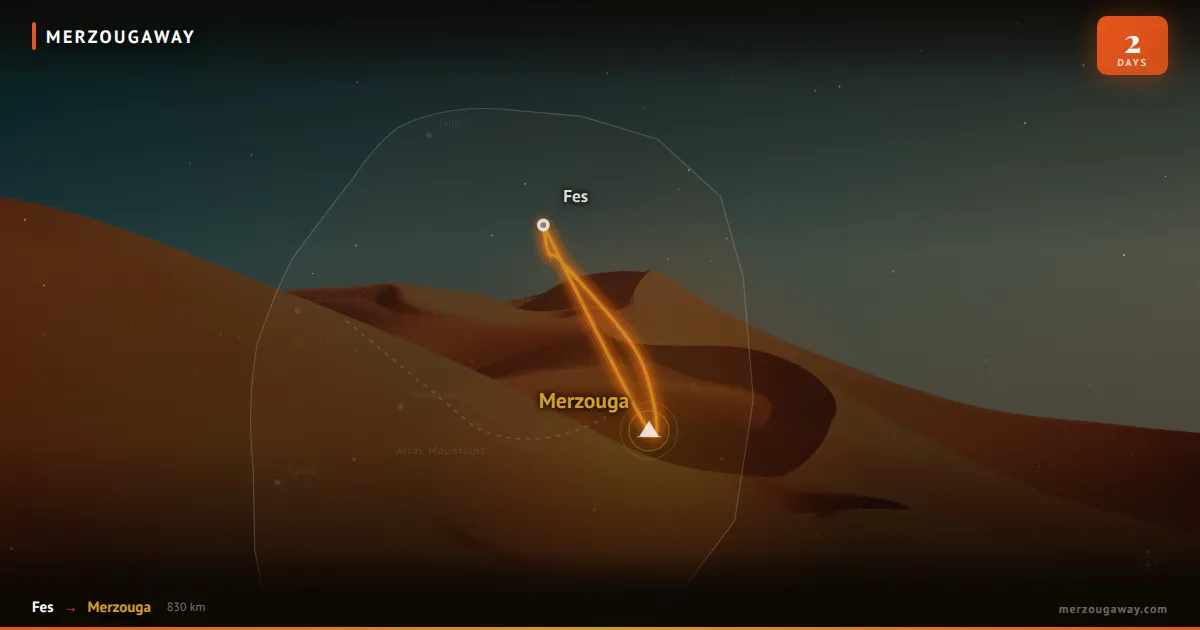
There's no shortcut between Fes and Merzouga — no direct train, no airport at the desert end (the nearest is Errachidia, roughly two hours further by road), just a long, genuinely spectacular overland drive that changes character completely every couple of hours. What starts as a mountain crossing through cedar forest ends, by evening, at the foot of the tallest dunes in Morocco. It's less a transfer than a full day of landscape, and it's worth understanding what you're actually signing up for before you commit to it.
[!NOTE] Fast-Facts & Direct Answer Summary
The route from Fes to Merzouga covers ~460 km along the N13 highway through the Middle Atlas and Ziz Valley, taking approximately 7.5 to 8 hours of direct driving.
- Recommended Duration: 2 Days (Direct Desert Tour) or 3–4 Days (Fes to Marrakech desert crossing)
- Primary Highway: N13 scenic corridor via Ifrane, Midelt, Errachidia, and Erfoud
- Scenic Waypoints: Azrou Barbary macaque cedar forest, Ziz Gorge palm oases, and Erg Chebbi dunes
- Realistic Pricing: 1,600–3,800 MAD (€160–€360) per person depending on camp category
- Alternative Travel Hub: 1-hour Royal Air Maroc flight from Casablanca to Errachidia Airport (ERH), followed by a 1.5-hour private transfer to Merzouga.
The route, start to finish
Leaving Fes early, the road climbs almost immediately into the Middle Atlas, and within about ninety minutes you reach Ifrane — an odd, genuinely convincing little alpine town, all red-roofed chalets and manicured parks, that feels transplanted rather than built. It's worth the fifteen or twenty minutes most itineraries give it, if only for how strange the contrast is with everything else on this route. From there, the road continues into denser cedar forest around Azrou, home to wild Barbary macaques — North Africa's only wild primate — which gather close enough to the road that a short walk usually brings you within easy viewing distance, without needing to feed or approach them directly.
Past Azrou, the terrain shifts again as the road descends toward Midelt and then into the Ziz Valley, where a river of date palms runs for kilometers between ochre cliffs and centuries-old fortified villages, or ksour, rise above the palm line. This stretch is where the drive stops feeling like mountains and starts feeling like the desert is genuinely close — the light changes, the vegetation thins, and by the time you reach Errachidia and then Erfoud, the landscape has become properly pre-Saharan. The final approach into Merzouga arrives in the late afternoon, with the Erg Chebbi dune field rising suddenly out of flat ground, exactly the way most people picture the Sahara before they've actually seen it.
What happens once you arrive
Timing this drive to reach Merzouga in the late afternoon isn't an accident — it's built around getting you to the dunes in time for a sunset camel trek, which is genuinely the best way to arrive at a desert camp rather than simply pulling up in a vehicle. The trek runs about forty-five minutes into the dunes, ending at a high ridge just as the light turns from gold to deep red to violet. Dinner at camp that night is a full traditional Moroccan spread eaten under a sky with essentially no light pollution, followed by Berber drumming and music around the fire — and for most first-time visitors, the sheer density of stars overhead is as memorable as the dunes themselves.
How long the drive actually takes, and whether to break it up
Realistically, the Fes to Merzouga drive takes eight to nine hours including stops — a long day, though rarely a dull one, since the landscape changes often enough to keep it interesting rather than monotonous. If you'd rather not do it all in one push, it's entirely possible to split the journey with an overnight stop in the Ziz Valley or around Errachidia on the way down, which turns one demanding day into two comfortable ones and adds time to properly explore places like Erfoud's fossil workshops or Rissani's old market town, rather than passing through them at speed.
Best time to travel
Spring (March-May) and autumn (September-November) are the easiest seasons for this route — comfortable daytime temperatures for a long day of driving, and desert nights that are cool without being genuinely cold. Winter (December-February) brings colder nights at camp, sometimes close to freezing, but also some of the clearest skies of the year for stargazing, and the mountain scenery around Ifrane can even see a dusting of snow. Summer (June-August) is the trickiest season simply because desert daytime heat is intense; the drive itself is fine in an air-conditioned vehicle, but plan on staying out of direct sun during the hottest midday hours once you arrive.
What to pack
Whatever the season, pack for two different climates rather than one: light, breathable clothing for the day (the mountain and valley legs of the drive can still be warm), and a proper warm layer for the desert evening, since temperatures drop sharply after sunset even when the day was hot. Sunscreen and a hat matter throughout, and comfortable shoes that can handle both a bit of walking at Ifrane or Azrou and the sand at camp are more useful than anything more specialized.
Doing it as a private tour
Our 2-day express tour from Fes to Merzouga follows exactly this route as a private trip — your own vehicle and driver-guide rather than a shared shuttle, with stops built in at Ifrane, Azrou, and the Ziz Valley on the way down, and a full desert night at camp before the return drive. If two days feels tight, ask about the longer 3- and 4-day versions, which add Todra Gorge, a fuller exploration of the Ziz Valley, and a more relaxed pace throughout.
The Definitive Northern Desert Corridor: Fes to Merzouga via Highway N13
While many travelers reach the Sahara from Marrakech, the 470-kilometer overland crossing connecting the medieval imperial capital of Fes to the golden sand sea of Merzouga along the N13 national highway is widely celebrated as Morocco's most scenically dramatic and efficient desert corridor.
Spanning approximately 7.5 to 8.5 driving hours, the northern route is roughly two hours faster than the drive from Marrakech and avoids the heavy truck traffic of the High Atlas, climbing instead through the tranquil apple orchards of the Middle Atlas, the ancient Atlantic cedar forests of Azrou, and the monumental limestone canyons of the Ziz River Valley.
The following master waypoint table outlines the step-by-step itinerary from Fes to Erg Chebbi:
| Highway Sector & Waypoint | Distance | Driving Time | Elevation & Microclimate | Key Sights & Attractions | | :--- | :--- | :--- | :--- | :--- | | Fes to Ifrane | 65 km | 1.0 Hour | 1,665m; Alpine French colonial hill resort | Pitched red-tile chalets, clean parks, WWII stone lion sculpture | | Ifrane to Azrou Cedar Forest | 20 km | 25 Minutes | 1,750m; Dense Atlantic cedar canopy | Wild Barbary macaques (Macaca sylvanus), Cèdre Gouraud | | Azrou to Midelt via Col du Zad | 120 km | 2.0 Hours | Climbs to 2,178m pass, then 1,500m plateau | Apple farming capital; universal lunch stop for lamb tagines | | Midelt to Ziz Canyon & Errachidia | 135 km | 2.25 Hours | Descends into arid pre-Saharan river valley | Colossal red limestone gorge, Tunnel du Légionnaire, date palms | | Errachidia to Erfoud Oasis | 75 km | 1.0 Hour | Flat desert oasis basin; palm groves | Prehistoric marine fossil quarries and marble carving workshops | | Erfoud to Rissani and Merzouga | 55 km | 45 Minutes | Pre-Saharan desert fringe | Historic caravan market in Rissani; golden dunes of Erg Chebbi |
Step-by-Step Waypoint Highlights Along the Route
- Ifrane ("Little Switzerland"): Established in the 1920s as a French colonial hill station, Ifrane's immaculate streets, manicured flowerbeds, and European alpine chalets offer a surreal contrast to the medieval medina of Fes.
- Azrou Cedar Forests & Barbary Macaques: Continuing south, the highway enters the protected cedar forests of Ifrane National Park. Stop near the historic Cèdre Gouraud monument to observe wild Barbary macaques. Ethical Wildlife Note: Do not feed monkeys processed human snack foods or peanuts; observe and photograph these magnificent primates from a respectful distance of 5 to 10 meters.
- The High Plateau of Midelt: Nestled between the Middle Atlas and High Atlas ranges, Midelt is the agricultural center of Morocco's apple harvest. Roadside restaurants serve succulent tagines of slow-cooked mountain lamb and fresh river trout.
- The Colossal Ziz River Gorge: Descending from the high plateau, the N13 passes through the historic French Foreign Legion tunnel (Foum Zabel) into the Gorges du Ziz. Pull over at the elevated panoramic mirador: below lies a winding green ribbon of over 300,000 date palms framed by sheer vertical red canyon cliffs.
Winter Mountain Realities: Crossing Col du Zad (2,178m)
While the southern desert is sunny, winter travelers crossing the Middle Atlas between Fes and Midelt must prepare for alpine conditions:
- The Col du Zad Mountain Pass: Situated between Azrou and Midelt, the Col du Zad pass rises to 2,178 meters (7,145 feet). During midwinter storms (December to February), cold Atlantic weather fronts bring localized snowfall and morning black ice to this high plateau.
- Government Snowplow Operations: The Moroccan highway authority (Direction des Routes) maintains active snowplow stations near Col du Zad. Paved surfaces are cleared and gritted promptly, but occasional weather holds lasting 1 to 3 hours can occur during intense squalls.
- Private Chauffeur Reassurance: When traveling with MerzougaWay, our experienced drivers monitor mountain pass weather advisories in real time, adjusting departure hours or utilizing alternative lowland routes to ensure smooth, secure transit.
The Ziz Valley: A Botanical Marvel in the Desert
Descending the southern flank of the High Atlas reveals one of North Africa's most breathtaking geological and botanical phenomena:
- The Ribbon of Date Palms: The Ziz River carves a dramatic trench through barren red limestone plateaus, creating an unbroken 100-kilometer emerald green corridor sheltering over 300,000 date palms (Phoenix dactylifera).
- Ancient Subterranean Khettaras: Near Erfoud, inspect the historic khettara irrigation wells—an ingenious centuries-old network of subterranean aqueducts built by medieval Amazigh engineers that channel mountain snowmelt underground for dozens of kilometers to irrigate oasis date palms without evaporating in the desert sun.
Cultural Encounters: Nomadic Life in the Ziz Valley
The northern corridor along Highway N13 provides authentic opportunities to witness traditional pre-Saharan nomadic culture:
- Nomadic Pastoralists of the High Steppe: Driving through the high plateau surrounding Midelt and Timahdite, you will observe nomadic Amazigh herders guiding massive flocks of sheep and goats across the rocky steppes. These resilient pastoralists live in traditional woven goat-hair tents, migrating seasonally between high mountain summer pastures and lowland winter oases.
- Traditional Date Farming in Erfoud: As the highway enters the Tafilalet oasis, the economy revolves around the annual harvest of over 30 varieties of dates. Stopping at local farmers' cooperatives along the road allows you to sample fresh Medjool, Deglet Noor, and Boufeggous dates harvested directly from the surrounding palm groves, experiencing the genuine generosity of southern Moroccan agricultural communities.
The Historic Foreign Legion Tunnel of Foum Zabel
Driving through the Ziz Gorge along Highway N13 brings travelers face to face with a remarkable feat of early 20th-century engineering:
- The Tunnel du Légionnaire: Carved through solid red limestone bedrock in 1927 by the French Foreign Legion to establish a military corridor connecting the imperial north to the pre-Saharan desert, this narrow single-lane tunnel (known locally as Foum Zabel) remains an iconic landmark. A carved stone inscription at the tunnel entrance commemorates the legionnaires who chiseled the mountain pass by hand with pickaxes and dynamite.
- The Gateway to the South: Emerging from the dark tunnel into the bright desert sun provides a stunning visual reveal: the rugged alpine mountain terrain abruptly terminates, and the vast, golden, palm-fringed expanse of the pre-Saharan river valley opens before your eyes.
Roadside Dining: Sampling Tender Mountain Lamb in Midelt
The agricultural town of Midelt, situated midway between Fes and Merzouga, is famous for its culinary hospitality:
- Authentic Roadside Grills: Pull over at reputable local restaurants along Avenue Mohammed V in Midelt to savor succulent tagines of mountain lamb slow-cooked with fresh local apples, prunes, and toasted sesame seeds, accompanied by warm, crusty barley flatbreads (khobz) and freshly brewed pots of mint tea infused with wild mountain wormwood (sheeh).
- Stretching Legs Amid Apple Orchards: Take a 15-minute post-lunch walk through the shaded agricultural lanes of Midelt, enjoying the crisp mountain air and panoramic views of the imposing Jbel Ayachi peak (3,747m) rising majestically to the south before continuing into the desert valleys.
Seasonal Farm Stands and Fresh Mountain Fruits
Traveling through the Middle Atlas foothills exposes you to delightful seasonal produce stands along the highway. Stop to sample crisp local apples, sweet mountain cherries, fresh walnuts, and wild thyme honey sold directly by local farming families at modest, honest prices.
Frequently Asked Questions (FAQ)
What landscapes do you see driving from Fez to Merzouga?
The 460 km route along Highway N13 passes the Swiss-style alpine architecture of Ifrane, ancient cedar forests inhabited by wild Barbary macaque monkeys in Azrou, the high mountain plateaus of Midelt, the dramatic limestone gorge and date palm oasis of the Ziz Valley, and the golden sand dunes of Erg Chebbi.
How long is the drive from Fez to Merzouga?
The drive takes approximately 7.5 to 8.5 hours in a private car or tour vehicle, including scenic breaks for tea, lunch, and photos in the cedar forest and Ziz palm valley.
Where do travelers stop for lunch between Fez and Merzouga?
Midelt—situated in the high plains between the Middle and High Atlas mountain ranges—is the classic halfway lunch stop, famous for roasted trout from nearby mountain streams and fresh apple orchards.
Are the wild Barbary apes in the Azrou cedar forest safe to visit?
Yes, they are accustomed to human visitors. Keep a respectful distance, do not tease them or attempt to pet them, and do not feed them salty or sugary junk food; vendors sell raw peanuts if you wish to observe them naturally.
Contact Us
For more information or to book your Fes to Merzouga journey, contact us at:
Email: [email protected] WhatsApp/Phone: +212675203319 / +212668534981
Sahara Route & Drive-Time Estimator
Calculate realistic driving hours across the High Atlas (Tizi n'Tichka pass), compare scenic stops (Dadès, Todra, Ziz), and plan your custom desert itinerary.
MerzougaWay Team
We are a passionate team of local guides dedicated to sharing the beauty and culture of our home, Morocco. Our journey began with a simple desire to offer authentic, memorable experiences that go beyond the typical tourist trails.