How to Get to Merzouga From Marrakech: Complete Transportation Guide
A straight comparison of every real way to get from Marrakech to Merzouga — tour, private transfer, bus, rental car — with honest cost and time trade-offs.
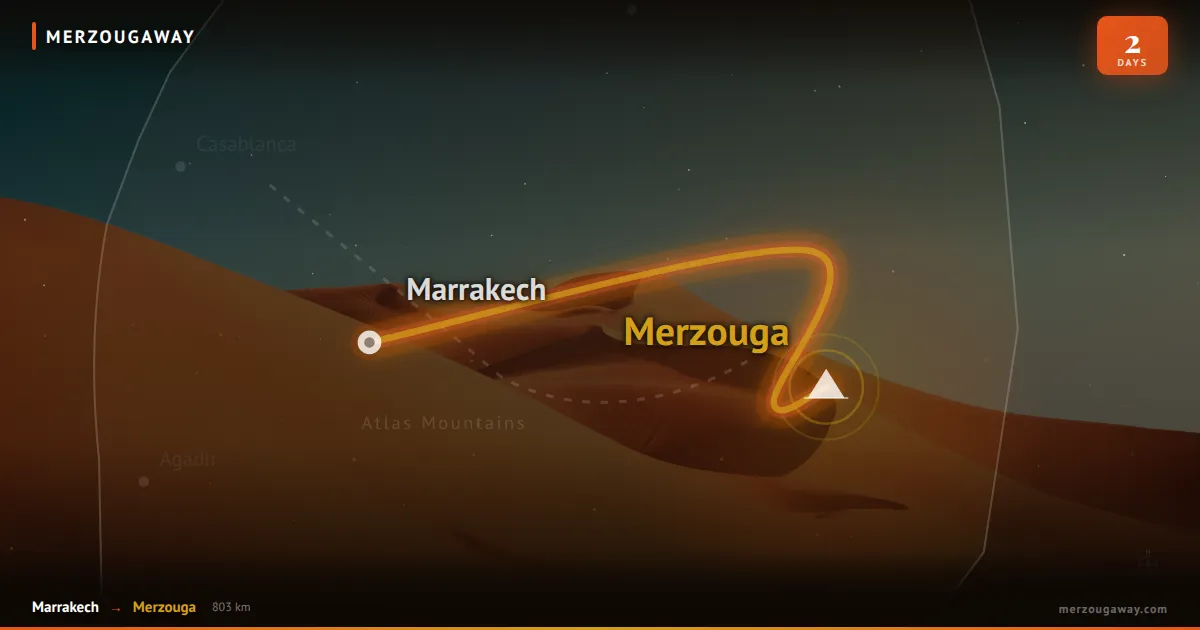
Marrakech and Merzouga sit about 560 km apart, and however you make the trip, you're looking at 9-11 hours of actual travel time across the High Atlas via the Tizi n'Tichka pass. There's no shortcut around that distance — no train reaches Merzouga, and Merzouga itself has no airport (the nearest, Errachidia, is still roughly two hours' drive away with limited connections). What differs between your options isn't really the distance, it's who's doing the driving, how much comfort you're paying for, and whether meals and a place to sleep are bundled in or left for you to sort out.
[!NOTE] Fast-Facts & Direct Answer Summary
A desert journey from Marrakech to Merzouga spans ~560 km across the High Atlas Mountains (Tizi n'Tichka pass, 2,260m). The drive takes 9–10 hours, making a 3-Day or 4-Day tour the minimum recommended duration for safety and comfort.
- Recommended Duration: 3 Days (Classic) or 4 Days (Relaxed & In-Depth)
- Primary Road Routes: N9 across the Atlas ➔ N10 through Dadès Valley ➔ N13 to Erg Chebbi
- Realistic Pricing: 1,800–4,500 MAD (€180–€420) per person for private tours with luxury desert camp
- Key Highlights: Aït Benhaddou UNESCO ksar, Todra Gorge canyons, sunset camel trek, and Erg Chebbi dunes
- Local Expert Tip: Avoid 2-day Merzouga tours (18–20 hours driving in 48h). Opt for Agafay Desert if you only have 1–2 days.
A multi-day tour is what most people end up booking
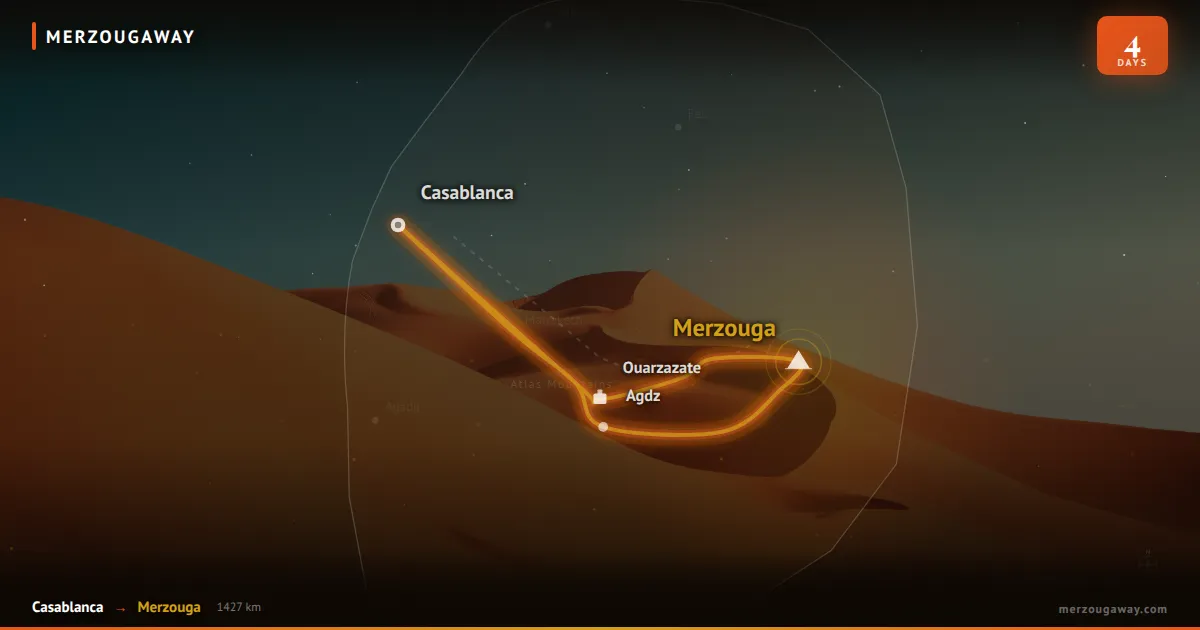
A pre-arranged private tour — typically 3 or 4 days — bundles the drive itself with accommodation, meals, and the desert activities (camel trekking, a night in a camp, sunset and sunrise at the dunes) into one price, usually somewhere in the €300-€600 range depending on tour length and accommodation level. The appeal isn't just convenience: split across a multi-day itinerary with proper overnight stops in Ouarzazate or the Dades Valley, the drive stops being an endurance test and becomes most of the point of the trip, since Ait Ben Haddou, the Atlas crossing, and the Dades gorges are genuinely worth seeing rather than something to rush past. A 2-day version exists and costs less, but it means one very long drive each way with barely a night in the desert to show for it — worth it only if time is truly the binding constraint. Book through an established operator (online, through your riad, or directly) with the itinerary, inclusions, and cancellation terms confirmed in writing.
Private transfer, if you just need the ride
If you already have accommodation and activities sorted and simply need to get from A to B, a private transfer covers just the drive — no meals, no camp, no overnight built in. Direct, it's still a 9-11 hour day, so most people split it with an overnight stop rather than doing it in one push; expect somewhere around €200-€350 solo, meaningfully less per person if you're sharing the car with others. It's the right call if your itinerary is already planned around specific dates and stops and a tour's fixed schedule doesn't fit.
Bus, for the lowest cost
CTM and Supratours run the route with a change or two (typically via Ouarzazate and Rissani, with a short taxi hop into Merzouga proper), for around €40-€60 total — genuinely the cheapest way to cover the distance, at the cost of 12-15 hours including transfers and waits, basic seating, and no guarantee of a smooth connection. It's a reasonable option if budget is the overriding priority and you don't mind a long, unglamorous day; it's a poor fit if comfort or a tight schedule matters more than saving money.
Renting a car and driving yourself
Doing the drive in your own rental gives you full control of the pace and stops, and split across a group of three or four it can come out as the cheapest per-person option — but it also means tackling the Tizi n'Tichka switchbacks and a long desert highway stretch yourself, with real fatigue by the end of the day. An economy car handles the paved main route fine in dry conditions; something with a bit more clearance is worth it if you want an easier ride on the rougher stretches near Merzouga. Budget the same 9-11 hours as any other option, plus fuel, and bring an international driving permit alongside your home license.
Flying partway
Domestic flight connections between Marrakech and the towns near this route are limited and seasonal rather than a dependable daily option, so treat "fly partway and drive the rest" as a fallback for someone with real driving anxiety about the mountain crossing rather than a standard plan — by the time you account for airport time and the ground transport still needed at the other end, it rarely saves meaningful time over just driving or being driven the whole way, and it adds cost.
Which one actually fits you
First time in Morocco, or simply want the trip handled end to end with meals, activities, and accommodation included: a multi-day private tour is the easiest and most complete choice, and the total cost usually comes out comparable to piecing together transport, food, and lodging yourself. Already have your own plan and just need transport: a private transfer or rental car both work, depending on whether you want to drive. Budget is the overriding factor and you don't mind a long day: the bus is genuinely the cheapest way to cover the ground. There's no wrong answer here — just a trade-off between cost, comfort, and how much of the planning you want to hand off.
We run this route as a private multi-day tour and as standalone transfers — happy to help you figure out which fits your trip:
Master Multi-Modal Transit Comparison Matrix: Marrakech to Merzouga
Planning an expedition from Marrakech across the High Atlas mountains to the desert dunes of Merzouga requires choosing between five distinct transportation methods. Covering 560 kilometers (348 miles) across rugged alpine passes and pre-Saharan valleys, each travel mode represents a distinct balance of financial cost, physical comfort, travel time, and sightseeing flexibility.
The following master comparison table breaks down all five transit options head-to-head:
| Transportation Mode | Travel Duration | Departure Frequency | Approximate Cost per Person (MAD / EUR) | Comfort & Scenic Stop Flexibility | Best Suited Traveler Profile | | :--- | :--- | :--- | :--- | :--- | :--- | | Private Chauffeur 4x4 Tour (MerzougaWay Standard) | 3 or 4 Days (Custom Pacing) | On demand; flexible morning riad pickup | 2,500 – 4,800 MAD (€230 – €450) per person (2-4 guests) | Maximum Luxury: 100% schedule control; stops at Ait Benhaddou & Todra | Couples, families, photographers wanting total comfort & safety | | Rental Car Self-Drive (4 to 5 Days) | 4 to 5 Days (Autonomous) | 100% on your own schedule | 3,000 – 4,500 MAD (~€280 – €420) vehicle + fuel/tolls | High flexibility; driver endures 20+ hours of intense mountain driving | Confident independent drivers seeking total autonomy | | Shared Minibus Group Tour (3 Days / 2 Nights) | 3 Full Days | Departs central Marrakech daily at 07:30 AM | 1,200 – 1,600 MAD (€110 – €150) per person | Basic; cramped 14-seater van; hurried commercial stops | Social budget backpackers seeking low-cost bundled packages | | Supratours Direct Public Coach (Day or Night) | 12.0 to 12.5 Hours | 2 Departures Daily (08:30 AM & 20:30 PM) | 280 MAD (~€26 EUR) one way + 10 MAD luggage | Moderate; comfortable reclining bus seats; strictly point-to-point | Solo travelers and extreme budget travelers skipping tours | | Domestic Flight via Casablanca to Errachidia | 1 hr flight + 1.5 hr taxi to dunes | Select days (Royal Air Maroc schedule) | 900 – 1,600 MAD (~€85 – €150 EUR) combined | Maximum Speed: Skips 10 hours of mountain curves entirely | Time-limited travelers with evening camp reservations |
The Driving Route Blueprint: Highway Numbers and Waypoints
For self-drivers and private tour guests, understanding the geographic corridors prevents navigational errors:
- Highway N9 (Marrakech to Ouarzazate - 200 km / 4.5 hrs): Leaves Marrakech, crossing the Haouz plain through Ait Ourir before climbing the dramatic switchbacks of the Tizi n'Tichka Pass (2,260m). Paved with smooth modern asphalt and wide climbing lanes, the pass requires careful speed management around tight curves.
- Highway N10 (Ouarzazate to Tinghir - 170 km / 2.5 hrs): The celebrated "Route of a Thousand Kasbahs." Straight, fast two-lane national highway traversing the Skoura palm grove, Kelaat M'Gouna (Valley of the Roses), and Boumalne Dades.
- Highway R702 and N13 (Tinghir to Merzouga - 190 km / 2.5 hrs): Crosses pre-Saharan flat plains through Tinjdad, joining Highway N13 at the date-farming capital of Erfoud. The final 55 kilometers is a smooth two-lane asphalt road running parallel to the golden dunes of Erg Chebbi.
The Aviation Shortcut: Errachidia Airport (ERH)
For travelers who dread 10 hours of mountain driving, Morocco operates a brilliant regional flight shortcut:
- Royal Air Maroc operates regular domestic flights connecting Casablanca Mohammed V Airport (CMN) directly to Moulay Ali Cherif Airport (ERH) in Errachidia in just 1 hour.
- From Errachidia Airport, the drive to the dunes of Erg Chebbi takes only 1 hour and 45 minutes along the flat, paved N13 highway. A private pre-arranged MerzougaWay 4x4 transfer meets your flight at the terminal, delivering you directly to your luxury desert glamping tent with zero mountain driving fatigue!
Road Safety, Checkpoints, and Fuel Logistics on Highway N9 & N10
Driving across southern Morocco requires attentiveness to local road regulations and conditions:
- Royal Gendarmerie Police Checkpoints: Regular police checkpoints (Gendarmerie Royale) operate at the entrances and exits of major towns (Ait Ourir, Ouarzazate, Tinghir, and Erfoud). Always slow down to a complete stop at the stop sign (Halte Gendarmerie) and wait for the officer to wave you forward with a friendly nod. Keep your passport, international driving permit, vehicle rental registration papers, and insurance readily accessible. Speed cameras (both fixed and handheld radar guns) are strictly enforced in 60 km/h and 80 km/h zones.
- Mountain Driving & Brake Management: When descending from the Tizi n'Tichka Pass (2,260m) toward Ouarzazate, avoid continuous braking to prevent brake rotor overheating. Downshift into a lower gear (second or third gear in a manual transmission, or manual mode in an automatic SUV) to utilize engine braking.
- Fuel Stations (Afriquia, Shell, TotalEnergies): Modern service stations with clean restrooms and convenience stores are located every 40 to 60 kilometers along Highway N9 and Highway N10. When leaving Tinghir toward Erfoud and Merzouga, always top off your fuel tank, as service stations become more sparse along the desert plain.
- Winter Snow Precautions (December to February): Severe winter snowstorms can occasionally lead the Ministry of Equipment to close the Tizi n'Tichka Pass for 6 to 24 hours while snowplows clear the roadway. Private MerzougaWay drivers monitor real-time road conditions and gendarmerie alerts to adjust departure times accordingly.
Supratours Bus Service: In-Depth Practical Breakdown
For independent travelers opting for public transit, the Supratours coach is the only direct public carrier operating between Marrakech and Merzouga:
- Schedule and Timings: The bus departs daily from the dedicated Supratours terminal next to the Marrakech Train Station (Gare de Marrakech) in Gueliz at 08:30 AM, arriving in Merzouga around 20:30 PM (a 12-hour journey). An overnight service also operates on select seasonal schedules.
- Fares and Luggage: A one-way ticket costs approximately 280 MAD (~€26 EUR), plus a mandatory 10 MAD baggage ticket stamped at the luggage desk.
- Comfort on Board: Coaches are modern, air-conditioned 48-seater Scania buses with reclining seats, curtains, and overhead reading lights. The bus makes scheduled 15-to-20-minute rest stops at mountain cafes in Taddert, Ouarzazate, Tinghir, and Erfoud for quick tagine meals and restroom breaks.
Navigation, Connectivity, and Offline GPS Maps
For independent self-drivers embarking on the overland drive from Marrakech to Merzouga:
- Offline Digital Maps (Google Maps & Maps.me): Mobile data reception can be intermittent in narrow mountain gorges and remote desert plains. Prior to leaving Marrakech, download the complete offline regional maps of the Marrakech-Safi and Draa-Tafilalet regions in Google Maps or Maps.me.
- Road Signage & Languages: Major intersections throughout Morocco feature bilingual signage in Arabic and French, with Tifinagh (the Amazigh script) increasingly displayed on national highway signs. National highways (N routes) are well-signposted with green mileage markers (bornes kilométriques) indicating distances to the next major settlement.
- Emergency Assistance & Roadside Support: Save the emergency contact numbers on your mobile phone: Moroccan National Police / Urban Police (
19), Royal Gendarmerie for rural highways (177), and Civil Protection / Medical Ambulances (15).
Essential Pre-Departure Checklist for the Desert Drive
Before embarking on the 560-kilometer mountain drive to Merzouga:
- Vehicle Inspection: Check tire pressure (including spare tire), engine coolant levels, windshield washer fluid, and brake pads.
- Cash Reserves: Credit card terminals are rare outside major hotel lobbies in the desert. Carry at least 1,500 to 2,500 MAD in cash (in 50, 100, and 200 MAD banknotes) for fuel, roadside cafes, monument entrance tickets, and gratuities.
- Snacks & Hydration: Stock a cooler bag with fresh fruit (bananas, mandarins), unsalted almonds, dates, and several 1.5-liter bottles of mineral water.
Frequently Asked Questions (FAQ)
What transportation options exist to get from Marrakech to Merzouga?
Four main options exist: 1. Private multi-day 4x4 desert tour (most comfortable and flexible); 2. Shared group tour in a 14-seater minibus (budget-friendly); 3. Self-drive rental car; 4. Direct Supratours scheduled coach bus.
How many days should I budget to visit Merzouga from Marrakech?
Budget a minimum of 3 days and 2 nights. A 2-day trip is not recommended as you will spend 20 hours in a vehicle with virtually no time to enjoy the sand dunes. 4 days is ideal for a relaxed pace.
Do shared group tours from Marrakech take you to real dunes?
Be careful when booking in Jemaa el-Fnaa: some operators sell cheap 2-day "desert tours" that only take you to Zagora (flat rocky desert with 10m dunes), not the 150m golden sand dunes of Merzouga. Confirm your tour destination is Erg Chebbi in Merzouga.
How much does a 3-day tour from Marrakech to Merzouga cost?
Shared budget minibus tours start from €100–€150 per person. Private tours with MerzougaWay range from €250 to €480 per person depending on group size, vehicle, and whether you select standard or luxury glamping.
What happens to our luggage during the camel trek in Merzouga?
Your main luggage remains locked safely in the tour vehicle or at the staging hotel. You only pack a small overnight daypack with water, warm clothes, and toiletries for the camel ride into camp.
WhatsApp: +212675203319 Email: [email protected]
Last updated: August 2026.
Sahara Route & Drive-Time Estimator
Calculate realistic driving hours across the High Atlas (Tizi n'Tichka pass), compare scenic stops (Dadès, Todra, Ziz), and plan your custom desert itinerary.
MerzougaWay Team
We are a passionate team of local guides dedicated to sharing the beauty and culture of our home, Morocco. Our journey began with a simple desire to offer authentic, memorable experiences that go beyond the typical tourist trails.