Marrakech to Merzouga: A Complete Guide to the Tour
What the Marrakech-to-Merzouga desert route actually involves — the drive, the stops, what tours include and don't, and how to plan the trip without guesswork.
Marrakech to Merzouga: A Complete Guide to the Tour
The road from Marrakech to Merzouga is one of the more dramatic overland routes in Morocco — you climb the High Atlas Mountains on the Tizi n'Tichka pass, drop into red-rock kasbah country, and end at the golden dunes of Erg Chebbi on the edge of the Sahara. It's a genuinely long drive, not a day trip disguised as one, and understanding what the route actually involves makes a much bigger difference to how you enjoy it than picking between near-identical tour brochures.
When to go
Spring (March-May) and autumn (September-November) are the most comfortable stretches, with daytime temperatures in the low-to-high 20s°C and cool nights — good conditions for both the mountain crossing and a night in the desert camp. Summer (June-August) gets genuinely extreme in the desert, regularly above 40°C during the day, though the Atlas crossing itself is cooler and the desert nights, while still warm, are more bearable than the days. Winter (December-February) brings mild days but cold nights that can drop close to freezing at the camp, and the Tizi n'Tichka pass occasionally sees snow, which can affect the crossing — worth checking conditions if you're traveling in January or February specifically.
How the route is usually structured
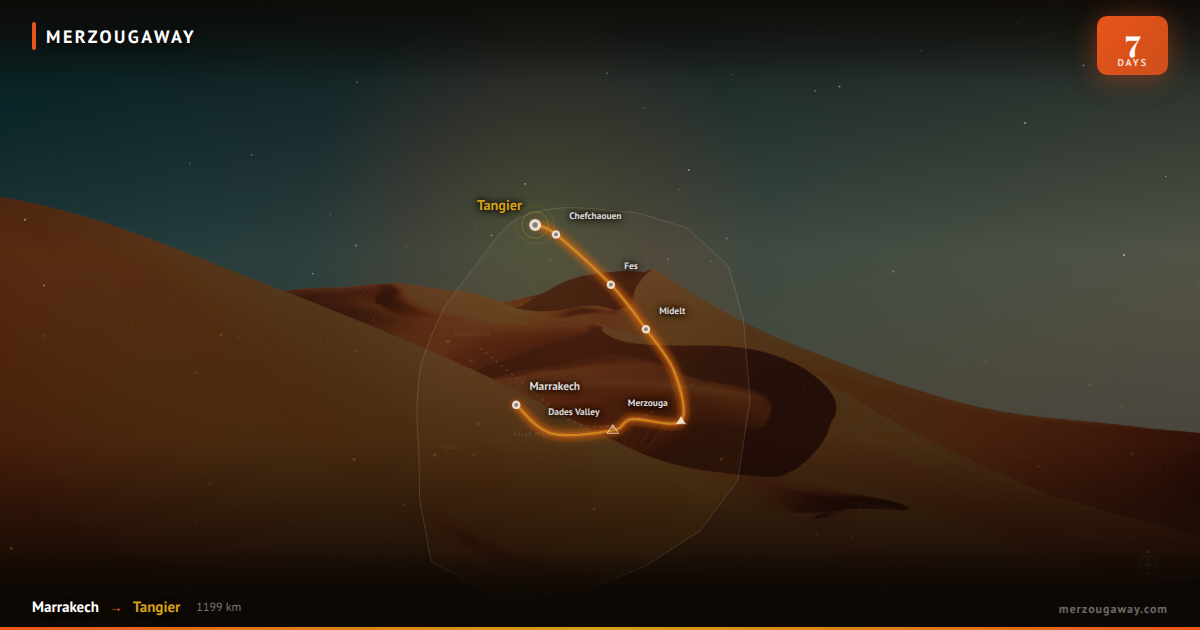
Most tours run 3 to 4 days. A 3-day tour crosses the Atlas via Tizi n'Tichka, stops at Aït Benhaddou (the UNESCO-listed kasbah familiar from film and TV productions), continues through Ouarzazate and the Dades Valley, and reaches Merzouga in time for a sunset camel trek and a night in a desert camp. A 4-day version adds more time in the Dades and Todgha Gorges and usually a stop in a Berber village along the way, which matters if the drive-heavy pace of the 3-day version feels too rushed for you. There's no single "correct" length — it's a genuine tradeoff between more time in the mountains and gorges versus a shorter overall trip.
What's typically included, and what isn't
Across most operators, a tour price covers transport in an air-conditioned 4x4 or minibus, an English/French/Spanish-speaking driver-guide, accommodation for the overland nights (standard or upgraded, depending on what you book), breakfast and dinner on most days, and the camel trek to and from the desert camp. Lunches, drinks, monument entrance fees, tips, and travel insurance are usually separate — worth budgeting for on top of whatever price you're quoted. Ask specifically what's included before booking, since operators vary in exactly where the line falls.
What the days actually look like
Day one leaves Marrakech early, crosses the Atlas, and stops at Aït Benhaddou, Ouarzazate, and the Dades Valley before an overnight in a riad or hotel in the Dades Gorge area. Day two continues through the Todgha Gorge and the palm groves around Erfoud before arriving in Merzouga in the afternoon, in time for a sunset camel trek into the dunes and a night at the camp. Day three starts with sunrise over the dunes — genuinely one of the best moments of the trip if you're willing to get up for it — before the return journey to Marrakech, or a continuation onward if you're doing a one-way tour ending in Fes instead.
Choosing between tour formats
We run private tours only — no shared departures with strangers to coordinate a schedule around. A private tour means the pace, stops, and timing are yours to adjust: more time at Aït Benhaddou if you want it, an earlier or later start, a detour for something that catches your eye along the way. For travelers who specifically want a romantic, slower-paced version of the same route, our Marrakech to Merzouga honeymoon escape builds in more time at each stop and a private setup at the camp.
What to pack
Sun protection (hat, sunglasses, sunscreen), warm layers for the cold desert night regardless of season, comfortable walking shoes, a headlamp, a scarf for sand protection, and a reusable water bottle cover the essentials. A camera with spare batteries is worth the extra weight — the sunrise over the dunes is the kind of thing you'll regret not capturing.
Frequently asked
How long is the drive from Marrakech to Merzouga? Around 9-10 hours of total driving, split across two days with stops at the major sights along the way rather than done in one push.
Is the desert camp comfortable? Most camps offer private tents with proper bedding and a shared or private bathroom depending on the tier you book, plus a communal dining and lounge area. Ask specifically about the tent and bathroom setup when booking if comfort level matters to you — "desert camp" covers a wide range, from simple tents to genuinely luxury setups.
Booking
Contact us with your preferred dates, and we'll confirm availability and walk you through what's included at each accommodation tier.
Contact us:
- Email: hello@merzougaway.com
- WhatsApp: +212675203319 / +212668534981
See our 3-day Marrakech to Merzouga desert tour or the 4-day version for full itineraries and current pricing.

MerzougaWay Team
We are a passionate team of local guides dedicated to sharing the beauty and culture of our home, Morocco. Our journey began with a simple desire to offer authentic, memorable experiences that go beyond the typical tourist trails.