Marrakech to Merzouga Drive: Complete Road Trip Guide 2026
Everything you need to know about driving from Marrakech to Merzouga, including routes, stops, tips, and what to expect on this epic Moroccan road trip.
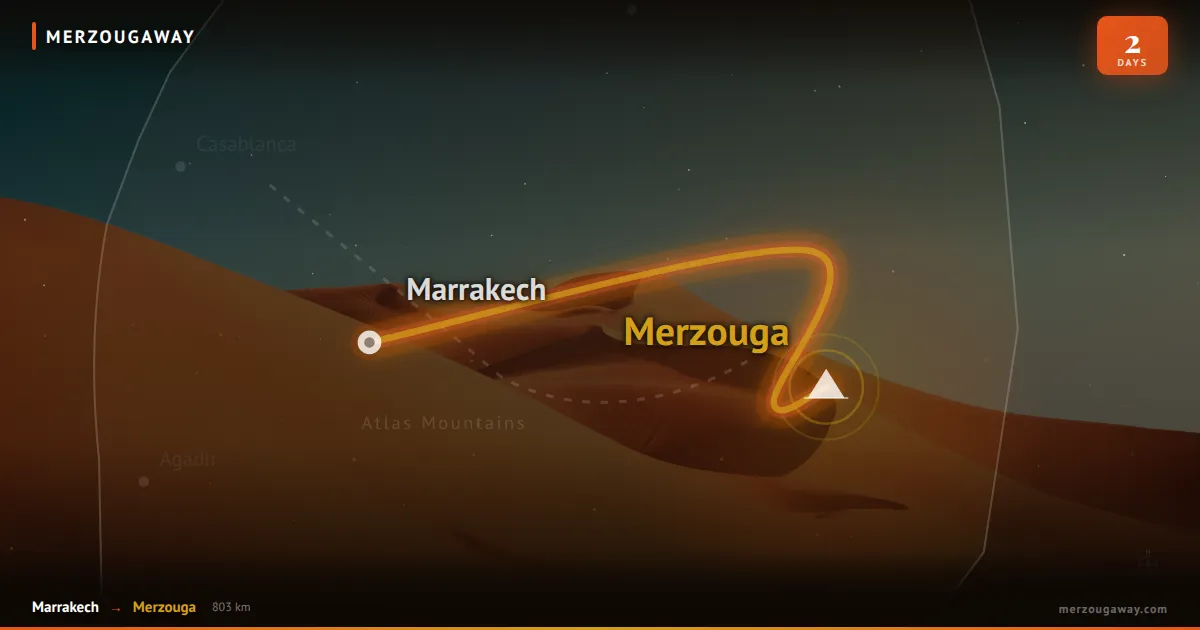
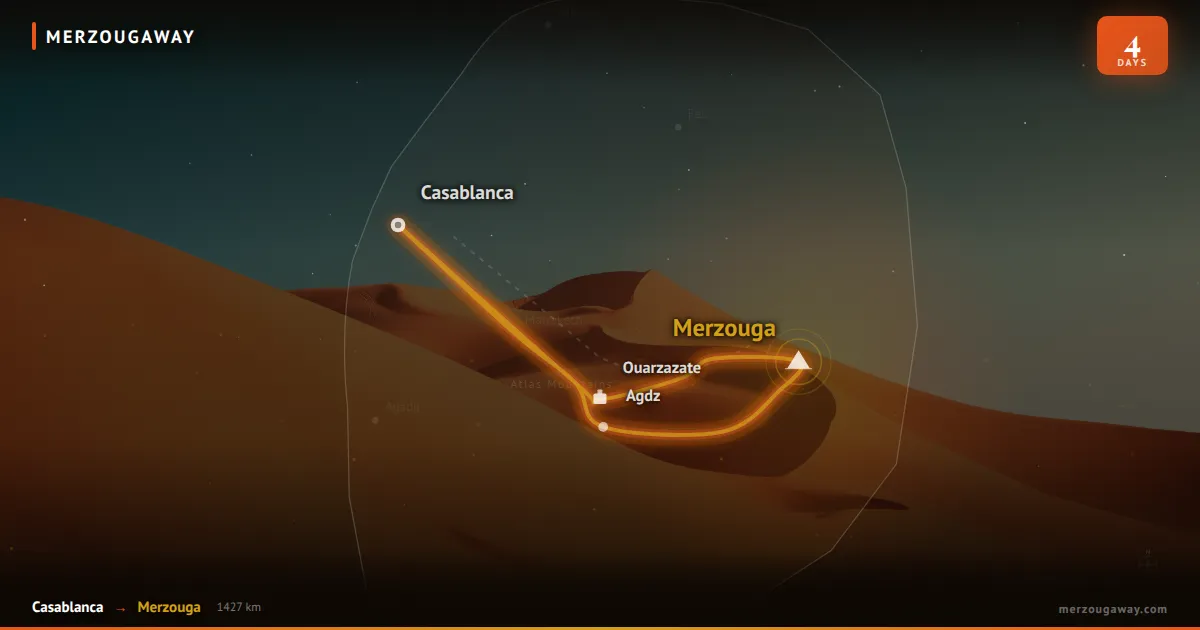
The drive from Marrakech to Merzouga covers roughly 560 km and takes 9 to 10 hours behind the wheel, which is the single fact that should shape how you plan this trip: it is not a day trip, and treating it like one — leaving Marrakech at dawn hoping to see the dunes and get back to your riad by night — simply doesn't work. There's no airport near Merzouga either (the closest one, Errachidia, is still a good two hours away by car), and no direct train, so the road really is the way in and out. Once you accept that, the drive itself turns into one of the best parts of the trip: you cross the entire High Atlas range over the Tizi n'Tichka pass, drop into kasbah country around Ouarzazate, and follow a chain of gorges and oases east until the flat hamada suddenly gives way to a 150-metre wall of orange dunes.
[!NOTE] Fast-Facts & Direct Answer Summary
A desert journey from Marrakech to Merzouga spans ~560 km across the High Atlas Mountains (Tizi n'Tichka pass, 2,260m). The drive takes 9–10 hours, making a 3-Day or 4-Day tour the minimum recommended duration for safety and comfort.
- Recommended Duration: 3 Days (Classic) or 4 Days (Relaxed & In-Depth)
- Primary Road Routes: N9 across the Atlas ➔ N10 through Dadès Valley ➔ N13 to Erg Chebbi
- Realistic Pricing: 1,800–4,500 MAD (€180–€420) per person for private tours with luxury desert camp
- Key Highlights: Aït Benhaddou UNESCO ksar, Todra Gorge canyons, sunset camel trek, and Erg Chebbi dunes
- Local Expert Tip: Avoid 2-day Merzouga tours (18–20 hours driving in 48h). Opt for Agafay Desert if you only have 1–2 days.
Choosing a route
Most people take the direct route: the N9 south out of Marrakech, over Tizi n'Tichka, through Ouarzazate and Tinghir, and on to Erfoud and Merzouga. It's the fastest way there and the roads are in good condition throughout, though it's also the route everyone else is on, so don't expect solitude at the classic viewpoints. A slightly longer variant swaps the direct run east of Ouarzazate for a detour through the Dades Gorge on the R704 — about 20 extra kilometres and an extra hour, in exchange for genuinely dramatic gorge scenery and a couple of kasbah towns you'd otherwise skip. There's also a rougher option for people who've already done the standard route once: heading south over the Tizi n'Test pass instead of Tizi n'Tichka, then cutting east to rejoin the N10 near Ouarzazate. It adds a few hours and the road is narrower and less maintained, but it passes through Berber villages that see far fewer tour vehicles.
| Route | Distance | Drive time | Character | |---|---|---|---| | Direct (N9 via Ouarzazate) | ~560 km | 9-10 hrs | Fastest, best roads, busiest | | Dades Valley detour | ~580 km | 10-11 hrs | Same roads plus gorge scenery | | Tizi n'Test approach | ~620 km | 12+ hrs | Remote villages, rougher road |
Spreading it over two or three days
Doing the drive in one push is possible but not something we'd recommend, and almost nobody who does this trip regrets slowing down. A two-day version typically means leaving Marrakech early, crossing Tizi n'Tichka before midday, stopping at Aït Ben Haddou for an hour or two, and pushing on to overnight around Ouarzazate or a little further east — Skoura and the Dades area both work well as a stopping point roughly halfway. The second day covers the remaining ground through the Dades and Todra gorges, Erfoud, and into Merzouga in time to catch the camel trek and sunset over Erg Chebbi. If you have a third day to spare, splitting the second leg in two means you can actually walk into Todra Gorge rather than glancing at it from the road, and arrive in Merzouga with enough daylight left to properly settle into camp before the sun goes down.
What the road is actually like
The mountain stretch between Marrakech and Ouarzazate is well maintained but genuinely winding — tight switchbacks climbing to 2,260 metres at the pass, which is worth taking slowly regardless of what kind of car you're driving. East of Ouarzazate toward Errachidia the road opens up into fast, straight highway, and the final stretch from Errachidia down to Merzouga is mostly good tarmac with the occasional rough patch and drifting sand near the dunes themselves. None of it requires a 4x4 — a standard rental car with reasonable ground clearance handles the whole route fine, and a 4x4 only becomes useful if you're planning to go off the paved road once you're actually in the desert. Fuel up in the towns rather than assuming you'll find a station whenever you need one — Ouarzazate, Tinghir, and Errachidia are the reliable stops — and avoid driving after dark: unlit sections, stray livestock, and unmarked speed bumps through villages make night driving on this route genuinely more stressful than it needs to be.
The stops worth actually building time around
Tizi n'Tichka itself is worth a proper stop, not just a photo through the windscreen — the viewpoints near the summit look back over terraced Berber villages and, on a clear day, toward the haze of the Marrakech plain far below. Aït Ben Haddou, the UNESCO-listed fortified village just past Ouarzazate, rewards the twenty minutes it takes to climb to the old granary at the top, where the view opens out across the river valley. Ouarzazate itself is worth a brief stop for its film-studio history and the Taourirt Kasbah, even if you don't linger. Further east, Skoura's palm oasis and the Dades Gorge's "Monkey Fingers" rock formations are the kind of stops that photograph better than they sound described in a list, and Todra Gorge — where the canyon narrows to a few metres between 300-metre cliffs — is genuinely worth getting out of the car and walking into rather than just driving past. Erfoud, the last town of any size before Merzouga, is known for its fossil workshops, where 380-million-year-old marine fossils are cut and polished into tables and souvenirs; it's a good place to stretch your legs before the final push into the dunes.
Where to stay along the way
If you're breaking the journey up, Ouarzazate has the widest range of accommodation on the route, from simple guesthouses to properly comfortable hotels, and makes a sensible first-night stop if you left Marrakech in the morning. Further along, the Dades Valley and Tinghir area are dotted with kasbah-style guesthouses built directly into the gorge walls, which is a genuinely memorable place to wake up before the second leg to Merzouga. In Merzouga itself, the choice is really between a hotel or riad in the village and a desert camp out among the dunes — most travelers doing a multi-day version of this trip spend at least one night in a camp, since that's the part of the journey the whole drive is built around.
Packing for the drive
Beyond the obvious documents — passport, rental agreement, insurance papers, and an International Driving Permit if your license requires one — pack for a bigger temperature swing than you'd expect from a single road trip: sunglasses, sunscreen, and a hat for the exposed desert stretches, but also a light jacket for the mountain pass and for desert nights, which get properly cold even when the daytime temperature was uncomfortable. A scarf or shemagh earns its keep against sun and blown sand once you're near the dunes, and it's worth having a basic emergency kit in the car — a spare tire, jack, and jumper cables — along with small-denomination dirhams for tolls and roadside purchases, since change is often in short supply outside the bigger towns.
Driving it yourself versus having someone else drive
Self-driving gives you total control over the pace and the stops, and the roads don't demand any special skill beyond patience on the mountain switchbacks. The trade-off is that you're driving rather than looking out the window on the most scenic day of your Morocco trip, and navigating fuel stops, unfamiliar signage, and the occasional police checkpoint adds a layer of logistics some travelers would rather skip. A private driver-guide solves that by taking the wheel and the route-planning off your hands while keeping the trip entirely private to your own group — no fixed departure times, no other travelers folded into your itinerary, and a local who can actually explain what you're looking at along the way. If you'd rather have someone else handle the driving and the stops, our 3-day Marrakech to Merzouga tour runs this exact route with a private vehicle and guide.
Best time of year to make this drive
Spring (March-May) and autumn (September-November) are the easiest months: mild temperatures in the mountains, comfortable desert evenings, and a reasonable chance of clear skies. Summer brings genuinely extreme heat once you're down in the desert — regularly above 45°C in July and August — which is manageable if you drive the exposed stretches early in the day, but not pleasant if you don't. Winter is cool and often crowd-free, with cold, sometimes near-freezing nights in the desert and, occasionally, snow closing sections of the mountain pass, so it's worth checking conditions before a winter crossing rather than assuming the road is guaranteed open.
⛽ Fuel Strategy & Gendarmerie Royale Checkpoint Protocols
Embarking on a self-drive road trip from Marrakech across the High Atlas to Erg Chebbi requires strategic fuel management and an understanding of Moroccan highway law enforcement:
┌─────────────────────────────────────────────────────────────────────────────────────────────┐
│                 SELF-DRIVE WAYPOINT, FUEL & POLICE CHECKPOINT DIRECTORY                     │
├───────────────────────┬────────────┬─────────────┬────────────────┬─────────────────────────┤
│ ROUTE SECTOR          │ DISTANCE   │ DRIVE TIME  │ FUEL STATIONS  │ GENDARMERIE PROFILE     │
├───────────────────────┼────────────┼─────────────┼────────────────┼─────────────────────────┤
│ Marrakech ➔ Taddert   │ 85 km (N9) │ 2h 00m      │ Shell, Afriquia│ Ait Ourir speed traps   │
│ Taddert ➔ Ouarzazate  │ 115 km(N9) │ 2h 30m      │ Afriquia Agdz  │ Tizi n'Tichka pass radar│
│ Ouarzazate ➔ Tinghir  │ 168 km(N10)│ 2h 45m      │ Total, Shell   │ Skoura / Kelaat speed   │
│ Tinghir ➔ Erfoud      │ 142 km(N10)│ 2h 15m      │ Winxo, Afriquia│ Tinjdad village limits  │
│ Erfoud ➔ Merzouga     │ 55 km (N13)│ 0h 50m      │ Afriquia, Petrom Rissani roundabout check │
└───────────────────────┴────────────┴─────────────┴────────────────┴─────────────────────────┘
Gendarmerie Checkpoint Protocols & Radar Enforcements
- Approaching the Checkpoint: The Gendarmerie Royale maintains permanent security checkpoints at the entry and exit of every major town and provincial boundary. Signs marked "Halte Gendarmerie" or "Ralentir" require you to slow your vehicle down to 20 km/h. Do not blow through the stop line; bring your vehicle to a complete stop, roll down your front driver's window, turn on your interior dome light if arriving after dark, and wait for the officer to gesture you forward with a wave or flashlight beam.
- Speed Traps in Small Hamlets: Moroccan national highways feature a maximum speed limit of 100 km/h, which abruptly drops to 60 km/h or 40 km/h when passing through rural villages or school zones. Mobile laser radar guns mounted on tripods are stationed behind palm trees and village bus shelters along the N9 and N10. Exceeding the posted limit by 1 to 20 km/h carries a standard on-the-spot fine of 150 MAD (€14); exceeding by 20 to 40 km/h carries a 300 MAD fine (€28). Always insist on an official stamped pink carbon-copy receipt (quittance).
- Fuel Reserve Golden Rule: While modern service stations (Afriquia, Shell, TotalEnergies, Winxo) accept international Visa and Mastercard in major towns, payment terminals frequently suffer temporary network dropouts in desert valley stations. Always carry at least 500 to 800 MAD in physical cash dedicated exclusively to fuel purchases, and never let your fuel gauge fall below one-third of a tank once east of Ouarzazate.
- Navigating the Tizi n'Tichka Construction & Hairpins: While the national highway N9 has undergone massive widening over the past five years, certain mountain sectors between Taddert and the summit at 2,260 meters remain subject to periodic rockfall after heavy rain or winter freeze-thaw cycles. Drive defensively: keep headlights on even during daylight hours, give way to heavily loaded olive trucks crawling uphill, and avoid overtaking on blind curves marked with solid white lines.
- Tire Pressure Adjustments for Desert Heat: Driving from the cool high-altitude Atlas down into the arid pre-Saharan plateau causes significant tire pressure expansion due to road surface temperatures exceeding 50°C in warmer months. Inspect tire condition before leaving Marrakech, ensure your rental vehicle includes an inflated spare tire and working scissor jack, and check cold pressure at a highway station air pump before beginning the eastern leg.
Frequently Asked Questions
Is it safe to drive from Marrakech to Merzouga?
Yes, the route is generally safe for a self-drive trip. The usual precautions apply: avoid driving after dark, keep valuables out of sight in the car, and take the mountain switchbacks at a sensible pace rather than rushing them.
Do I need a 4x4 for the Marrakech to Merzouga drive?
No. A standard rental car handles the paved route the whole way. A 4x4 only matters if you plan to leave the tarmac once you're in the desert itself, which is usually done as a separate guided excursion rather than something you'd attempt solo.
Are there tolls on the Marrakech to Merzouga route?
There are a few toll sections, mostly on the stretch out of Marrakech. Budget somewhere around 50-100 MAD in total for tolls across the whole drive.
Can I do the drive in one day?
Technically, yes — it's a 9-10 hour drive if you don't stop. In practice almost nobody does it that way, since it means skipping every worthwhile stop along a route that's specifically known for those stops. Two to three days is what most travelers actually spend on it.
Where should I stay overnight if I'm splitting the drive?
Ouarzazate works well for a first night if you leave Marrakech in the morning; Tinghir or the Dades Valley suit a second stopping point if you're taking three days rather than two.
Contact Us for More Travel Tips
Need personalized advice for your Moroccan road trip? Our local experts are here to help!
- WhatsApp: +212675203319 / +212668534981
- Email: [email protected]
This guide is regularly updated with the latest information. Last updated: July 2026.
Sahara Route & Drive-Time Estimator
Calculate realistic driving hours across the High Atlas (Tizi n'Tichka pass), compare scenic stops (Dadès, Todra, Ziz), and plan your custom desert itinerary.

MerzougaWay Team
We are a passionate team of local guides dedicated to sharing the beauty and culture of our home, Morocco. Our journey began with a simple desire to offer authentic, memorable experiences that go beyond the typical tourist trails.