Marrakech to Merzouga Desert Tour: Complete Guide 2026
How a private Marrakech-to-Merzouga desert tour actually works — realistic durations, what a typical desert day looks like, and how to think about cost and comfort tiers before booking.
A Marrakech to Merzouga desert tour is the classic way to see Morocco's Sahara — the High Atlas crossing, a night or two in a desert camp among the dunes of Erg Chebbi, and everything handled for you along the way: driver, guide, meals, and accommodation. We run these as private tours, meaning it's your vehicle and your itinerary rather than a fixed group schedule, which matters more than it might sound like once you're actually planning the days.
[!NOTE] Fast-Facts & Direct Answer Summary
A desert journey from Marrakech to Merzouga spans ~560 km across the High Atlas Mountains (Tizi n'Tichka pass, 2,260m). The drive takes 9–10 hours, making a 3-Day or 4-Day tour the minimum recommended duration for safety and comfort.
- Recommended Duration: 3 Days (Classic) or 4 Days (Relaxed & In-Depth)
- Primary Road Routes: N9 across the Atlas ➔ N10 through Dadès Valley ➔ N13 to Erg Chebbi
- Realistic Pricing: 1,800–4,500 MAD (€180–€420) per person for private tours with luxury desert camp
- Key Highlights: Aït Benhaddou UNESCO ksar, Todra Gorge canyons, sunset camel trek, and Erg Chebbi dunes
- Local Expert Tip: Avoid 2-day Merzouga tours (18–20 hours driving in 48h). Opt for Agafay Desert if you only have 1–2 days.
How long should the tour actually be
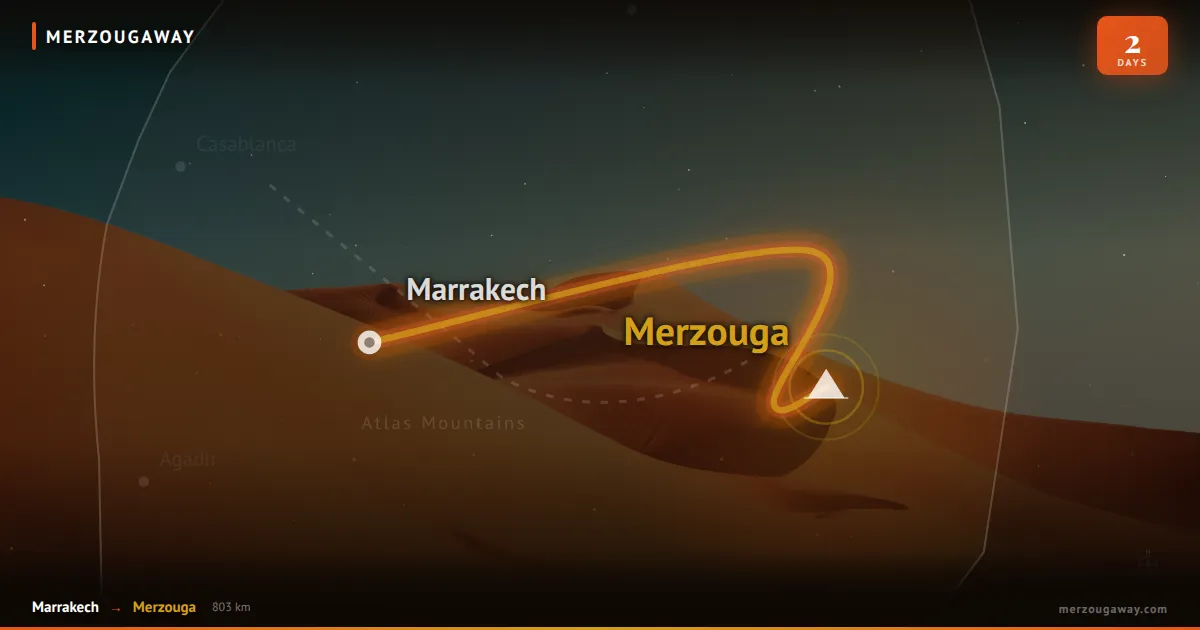
Two days is technically possible but not something we'd recommend booking as your main desert experience: with 560 km each way and 9-10 hours of driving, a 2-day version means one full day of near-continuous travel and barely an evening in the desert before turning around. It works only if time is genuinely the binding constraint and you've accepted the tradeoff going in.
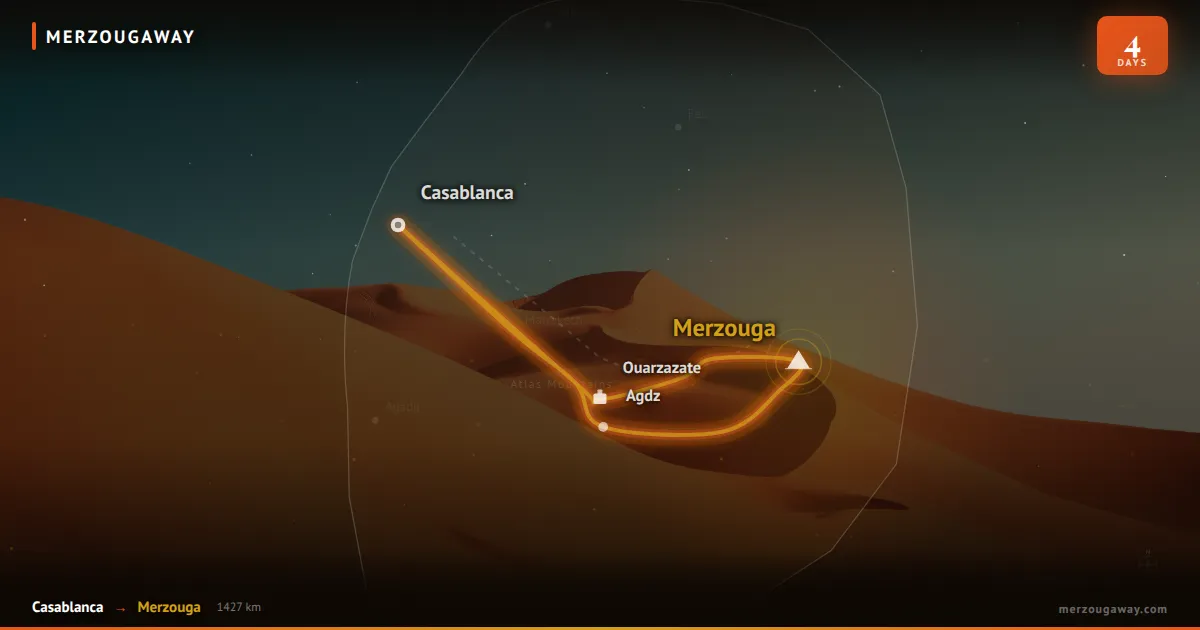
Three days is where most people land, and for good reason — it's enough to cross the Atlas properly with a stop at Ait Ben Haddou, spend a full day reaching Merzouga through the Dades or Todgha valleys, get a proper sunset camel trek and night in camp, and still have a relaxed return. Four and five day versions add a second night in the desert, more time in the Dades/Todgha gorges, and room for extras like sandboarding or quad biking without the trip feeling rushed — worth considering if you have the days and want the desert portion to feel less like a single overnight stop.
What an actual day in the desert looks like
The rhythm of the "desert day" — usually the middle day of a 3-day tour — tends to follow a similar shape regardless of exact itinerary. Breakfast at whatever accommodation you stopped at the night before (Ouarzazate or the Dades Valley, typically), then several hours of driving through increasingly arid landscape until the dunes of Erg Chebbi come into view in the early-to-mid afternoon. From there it's a rest and freshen-up window at the edge of the desert before the timed part of the day: a camel departs toward camp in the late afternoon, timed so you're on a high dune ridge right as the sun sets — genuinely the single moment most people photograph most on the whole trip. Dinner follows at camp, then Berber music around a fire, and for most people, more time than expected just looking at the sky, since there's essentially no light pollution out here and the Milky Way is visible as a distinct band on clear nights. Many guests do an optional sunrise walk the next morning before breakfast and the drive onward — quieter and slower than sunset, but a real highlight in its own right for those who make the early start.
What's actually included, and what tends to cost extra
A properly run private tour includes the vehicle and driver, a guide, all accommodation (hotel or riad nights plus the desert camp), and full board — breakfast, lunch, and dinner throughout. The camel trek to and from camp is part of the standard package, not an add-on. Things that typically cost extra: quad biking or ATV rides in the dunes, a dedicated stargazing session with a telescope, sandboarding equipment at some camps, and upgrading from a standard to a private luxury tent with its own en-suite bathroom. None of these are essential to a good trip, but it's worth asking specifically what's included before booking rather than assuming.
Comfort and cost tiers
Pricing on this route varies mainly with three things: the quality of the desert camp (shared bathroom block versus a private en-suite tent), the vehicle (standard versus a more comfortable 4x4), and how much flexibility you want in the itinerary. A private tour naturally costs more per person than a shared group departure would, but it buys real flexibility — stopping where you want, adjusting pace for kids or older travelers, and not being tied to strangers' preferences on a fixed schedule. If cost is the main constraint, the biggest lever is usually the camp tier rather than the vehicle or route — a standard camp with a good, comfortable tent is a perfectly good experience for most travelers, and the jump to a private luxury tent matters most for honeymoons, anniversaries, or anyone who specifically wants the extra privacy.
What to actually expect physically
Camel riding causes real, if mild and temporary, soreness for most first-timers — inner thighs and lower back mainly — and it fades within a few days. The desert sun is intense even outside summer, so sunscreen and a hat aren't optional. Nights get cold, sometimes near-freezing in winter, so pack a proper layer even if you're traveling in a hot month. None of this is a reason not to go; it's just worth going in with realistic expectations rather than a resort mindset, especially outside the luxury camp tier.
A note on timing and booking
Book at least a few weeks ahead if you can, especially in the October-to-April high season when good camps and vehicles get reserved early. Confirm directly what tent type, meal plan, and vehicle you're getting rather than assuming from a generic price range — a real operator will answer all of that clearly before you pay.
Frequently Asked Questions (FAQ)
What makes a private Marrakech to Merzouga tour worth the investment?
A private tour gives you complete control over your timetable: stop whenever you want for photos, spend as long as you like exploring Ait Benhaddou and Todra Gorge, avoid crowded tour buses, and enjoy direct personalized guidance from an experienced local Berber host.
Are entrance fees to monuments included in the tour price?
Ait Benhaddou is a free UNESCO village, though local community associations charge 10–20 MAD for museum houses. Kasbah Taourirt in Ouarzazate costs 20 MAD. Entry fees are nominal and paid directly at the sites.
What time does the tour depart from Marrakech on Day 1?
Departures typically take place between 7:30 AM and 8:00 AM directly from your hotel or riad to maximize daylight sightseeing in the Atlas Mountains and arrive at your Dades Valley hotel before sunset.
Can luggage be stored in Marrakech while on the desert tour?
Yes. Most hotels and riads in Marrakech happily store your non-essential heavy luggage in their secure luggage rooms free of charge until you return from the desert.
Ready to plan your desert tour, or want help deciding between a 3-day and 4-day version? Get in touch and we'll put together an itinerary that fits your time and budget.
- WhatsApp: +212675203319 / +212668534981
- Email: [email protected]
Last updated: August 2026.
Sahara Route & Drive-Time Estimator
Calculate realistic driving hours across the High Atlas (Tizi n'Tichka pass), compare scenic stops (Dadès, Todra, Ziz), and plan your custom desert itinerary.

MerzougaWay Team
We are a passionate team of local guides dedicated to sharing the beauty and culture of our home, Morocco. Our journey began with a simple desire to offer authentic, memorable experiences that go beyond the typical tourist trails.