Marrakech to Merzouga Dunes: Your Complete Guide to Erg Chebbi
What to actually expect at the Erg Chebbi dunes near Merzouga — the activities, the camp experience, what to pack, and honest answers to the questions travelers ask most before going.
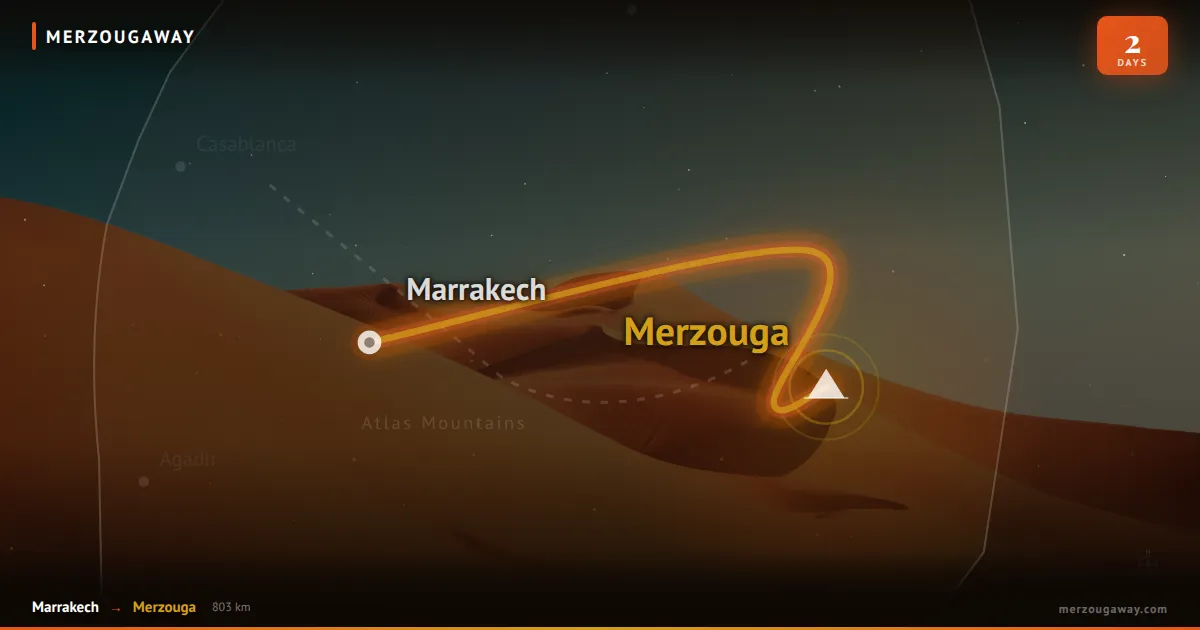
Erg Chebbi is the specific stretch of dunes that most people picture when they imagine "the Sahara" — golden sand rising up to roughly 150 meters, shifting in color from pale gold at midday to deep orange-red at sunset, with essentially nothing but sand to the horizon once you're a few kilometers in. It sits just outside Merzouga village, roughly 560 km and 9-10 hours of driving from Marrakech across the High Atlas, which is why almost nobody treats it as a day trip — it's the destination of a multi-day tour, not a stop along the way.
[!NOTE] Fast-Facts & Direct Answer Summary
A desert journey from Marrakech to Merzouga spans ~560 km across the High Atlas Mountains (Tizi n'Tichka pass, 2,260m). The drive takes 9–10 hours, making a 3-Day or 4-Day tour the minimum recommended duration for safety and comfort.
- Recommended Duration: 3 Days (Classic) or 4 Days (Relaxed & In-Depth)
- Primary Road Routes: N9 across the Atlas ➔ N10 through Dadès Valley ➔ N13 to Erg Chebbi
- Realistic Pricing: 1,800–4,500 MAD (€180–€420) per person for private tours with luxury desert camp
- Key Highlights: Aït Benhaddou UNESCO ksar, Todra Gorge canyons, sunset camel trek, and Erg Chebbi dunes
- Local Expert Tip: Avoid 2-day Merzouga tours (18–20 hours driving in 48h). Opt for Agafay Desert if you only have 1–2 days.
What there actually is to do at the dunes
Camel trekking is the default activity and, for most people, the highlight — a gentle ride out to a desert camp timed for sunset, led by a local handler who knows the dunes well enough to find the best viewpoint without a map. It's not physically demanding, though a couple of hours in an unfamiliar saddle does leave most first-timers a little sore the next day; that fades within a few days and is genuinely nothing to worry about going in. Quad biking and sandboarding are both available as more active alternatives or add-ons if you want something with a bit more adrenaline than a camel ride — quad tours run for an hour or two through the dune fields, and sandboarding is exactly what it sounds like, sliding down a dune face on a board the camp provides. None of these require any real skill; guides run them for complete beginners as a matter of course.
Photography is arguably the biggest reason people come specifically to Erg Chebbi rather than any other desert access point in Morocco — the dune shapes here are genuinely dramatic, and sunrise and sunset both produce the kind of light that's hard to get anywhere else in the country. If you're serious about it, ask your guide about timing a walk out to a quiet ridge before the group activity starts; the difference between a crowded viewpoint and an empty one is mostly a matter of walking an extra ten minutes.
A night at camp
Camps here range from simple shared-tent setups to private tents with their own en-suite bathroom and proper bedding — the gap between tiers matters more here than it might at a city hotel, mainly because a private bathroom means not crossing cold sand in the middle of the night. Whatever the tier, the evening tends to follow a similar arc: arrival by camel in the late afternoon, sunset from a dune ridge, dinner (usually tagine or couscous) under the stars, then Berber music around a fire before the desert goes properly quiet. With essentially no light pollution for hundreds of kilometers, the night sky here is one of the most striking you'll see anywhere — the Milky Way is visible as a distinct band on any clear night, which is most nights. A sunrise walk the next morning, quieter and less crowded than the sunset, is worth the early alarm if you can manage it.
Best time to go
October through April is the comfortable window — daytime temperatures are pleasant, nights are cool rather than brutal, and the light for photography is generally excellent. Summer (roughly May to September) brings genuinely extreme heat, often into the 40s during the day, which makes camel riding and dune walking considerably less pleasant even if the site itself is still beautiful. December and January bring the coldest nights, occasionally close to freezing, so pack a real layer if you're visiting in deep winter regardless of how hot the days sound.
What to actually pack
Loose, breathable clothing for the day and a proper warm layer for the evening cold snap — the temperature swing between afternoon and night is bigger than most first-time visitors expect. A hat, sunglasses, and high-SPF sunscreen are non-negotiable; the desert sun is stronger than it looks even in cooler months. Bring more water than you think you'll need, comfortable closed shoes rather than sandals (sand gets everywhere regardless, but closed shoes help), and if you're a light sleeper, earplugs — desert silence is real, but so is the occasional early call to prayer or camp noise. Leave the heavy luggage and any valuable jewelry behind; there's nowhere secure to store it at camp and no real reason to bring it.
Highway Breakdown: Crossing the Atlas to the Sahara
The drive from Marrakech to Erg Chebbi spans roughly 560 kilometers each way. Navigating this vast route requires understanding the two major highway corridors:
+------------------+---------------+----------------+--------------------------------+
| Highway Segment  | Distance (km) | Realistic Time | Topography & Key Hazards       |
+------------------+---------------+----------------+--------------------------------+
| Marrakech to     | 200 km        | 4.5 - 5.0 hrs  | N9 over Tizi n'Tichka (2,260m);|
| Ouarzazate       |               |                | winding hairpins, mountain fog |
+------------------+---------------+----------------+--------------------------------+
| Ouarzazate to    | 165 km        | 2.5 - 3.0 hrs  | N10 through Skoura palm groves |
| Tinghir (Todra)  |               |                | and Kelaat M'gouna Rose Valley |
+------------------+---------------+----------------+--------------------------------+
| Tinghir to       | 195 km        | 3.0 - 3.5 hrs  | N10 & N13 across pre-Saharan   |
| Merzouga Dunes   |               |                | plains via Erfoud and Rissani  |
+------------------+---------------+----------------+--------------------------------+
The first major segment along the N9 highway climbs from the Haouz plains of Marrakech up through the High Atlas Mountains. The road reaches its highest point at Tizi n'Tichka (2,260 meters), offering sweeping panoramas of snow-capped peaks and terraced Berber villages. Major civil engineering projects have widened this road considerably, but tight switchbacks demand attentive driving.
After crossing the pass and passing Ouarzazate, the route connects to the N10 highway along the "Road of a Thousand Kasbahs." Here, the scenery shifts to lush river valleys flanked by dramatic red-clay canyon walls. Finally, taking the N13 highway south from Erfoud leads through the ancient oasis capital of Rissani before terminating directly at the base of the Erg Chebbi dune field in Merzouga.
Fuel, Checkpoints, and Radar Realities
Driving through southern Morocco is safe and orderly, provided you adhere strictly to road regulations:
- Police Checkpoints (Contrôles de Gendarmerie): Checkpoints are situated at the entrances and exits of every major town along the N9 and N10. When approaching a checkpoint, look for the sign reading "Halte Gendarmerie" or "Ralentir". Come to a complete stop at the stop line and wait for the officer to wave you forward before proceeding.
- Speed Limits & Radar: Speed limits are enforced with mobile laser radar teams: 60 km/h in urban areas and 100 km/h on open highways. Exceeding the speed limit by even 5–10 km/h incurs an on-the-spot fine of 150 to 300 MAD.
- Fuel Planning: Modern service stations (Afriquia, Total, Shell, Winxo) are plentiful between Marrakech, Ouarzazate, and Tinghir. However, fuel stations become sparser between Tinghir and Erfoud. Always top up your tank whenever your fuel level drops below half.
Scenic Detours: The Ounila Valley and Kasbah Telouet
For travelers undertaking the drive in a private vehicle, one of the most rewarding diversions along the N9 is the Ounila Valley shortcut (Route P1506):
+-----------------------+-----------------------------+-----------------------------+
| Route Leg             | Standard N9 Highway Route   | Ounila Valley Detour (P1506)|
+-----------------------+-----------------------------+-----------------------------+
| Waypoints Passed      | Tichka Pass -> Aguelmous -> | Tichka Pass -> Telouet ->   |
|                       | Ouarzazate direct           | Anmiter -> Ait Benhaddou    |
+-----------------------+-----------------------------+-----------------------------+
| Transit Duration      | 4.5 hours driving           | 5.5 hours driving           |
| Road Condition        | Fully paved multi-lane      | Paved single-lane canyon    |
|                       | national highway (N9)       | road; dramatic cliff views  |
+-----------------------+-----------------------------+-----------------------------+
| Architectural Value   | Modern roadside villages    | Ruined palace of El Glaoui; |
|                       | and distant valley views    | ancient fortified ksar hamlets|
+-----------------------+-----------------------------+-----------------------------+
This detour leaves the main N9 just after the crest of Tizi n'Tichka and winds down through the red-clay canyon of the Ounila River. You visit the crumbling palace of Kasbah Telouet, the historic stronghold of Thami El Glaoui, the former Pasha of Marrakech. Behind its decaying exterior walls lie rooms filled with hand-chiseled stucco, Italian Carrera marble, and zellij mosaic tiles. The road continues south through dramatic red canyons before rejoining the main route directly at Ait Benhaddou.
Winter Hazards: Navigating Tizi n'Tichka Snow and Fog
While southern Morocco is sunny, crossing the High Atlas Mountains between December and February requires cold-weather awareness:
- Snow and Ice: At 2,260 meters elevation, winter storms occasionally dust the pass with snow. The Moroccan Ministry of Equipment deploys snowplows promptly, but temporary closures of 2 to 4 hours can occur during active winter blizzards.
- Morning Black Ice (Verglas): Before 09:00 AM in mid-winter, shaded mountain turns can develop thin sheets of invisible black ice. Professional private drivers time their morning departures from Marrakech around 08:00 AM so the sun has warmed the tarmac by the time they reach high altitudes.
- Mountain Fog: Thick valley fog frequently rolls across the northern slopes of the Atlas near Taddert, reducing visibility to under 30 meters. Turn on low-beam headlights and maintain safe following distances behind slow-moving commercial trucks.
Self-Drive Rental Cars vs. Private Chauffeur 4x4
Weighing whether to rent a self-drive car or hire a private vehicle with an indigenous Berber driver-guide depends on your comfort with mountain driving:
+-----------------------+-----------------------------+-----------------------------+
| Travel Aspect         | Self-Drive Rental Car       | Private MerzougaWay 4x4     |
+-----------------------+-----------------------------+-----------------------------+
| Navigation Stress     | High; mountain hairpins,    | Zero; sit back, relax, and  |
|                       | aggressive trucks, radar    | enjoy panoramic views       |
+-----------------------+-----------------------------+-----------------------------+
| Dune Sand Access      | Prohibited; rental contracts| 4WD drives directly across  |
|                       | forbid off-asphalt driving  | dunes to luxury camp tent   |
+-----------------------+-----------------------------+-----------------------------+
| Security & Checkpoints| Must handle police stops,   | Handled fluently in Arabic  |
|                       | radar fines, and parking    | and French by your driver   |
+-----------------------+-----------------------------+-----------------------------+
| Local Cultural Access | Limited to roadside cafes;  | Visits to nomad families,   |
|                       | language barriers           | Berber oases, hidden spots  |
+-----------------------+-----------------------------+-----------------------------+
Driving over the High Atlas requires navigating narrow lanes alongside large commercial trucks and buses that overtake on blind turns. For most travelers, the peace of mind, cultural translation, and off-road dune capability of a private 4x4 expedition far outweigh the minor savings of renting a small economy car.
The Return via the N12 Southern Loop: N'Kob and Agdz
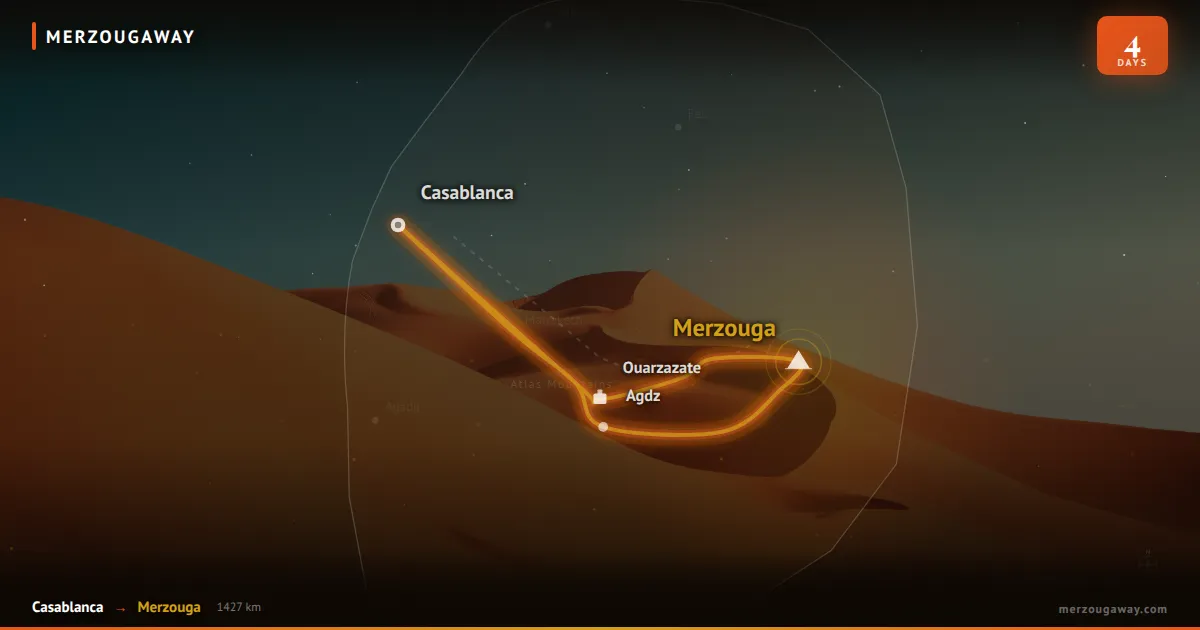
Instead of retracing the N10 highway on Day 3, private tours can return via the N12 Southern Loop:
- Alnif and Tazzarine: Cross the volcanic stone plains of the Jbel Saghro range, renowned for rich trilobite and ammonite fossil beds.
- N'Kob (The Kasbah Capital): An ancient Berber oasis village boasting 45 fortified mud-brick kasbahs nestled within lush date palm groves.
- The Draa Valley Oasis: Follow Morocco's longest river valley along highway N9, passing through Agdz with sweeping views of the historic Jbel Kissane mountain peak before climbing back over Tizi n'Tichka to Marrakech.
Dades Valley vs. Todra Gorge: Choosing Night One
On the drive toward Erg Chebbi, Day 1 concludes in either the Dades Valley or Todra Gorge:
+-----------------------+-----------------------------+-----------------------------+
| Stop Feature          | Dades Valley Overnight      | Todra Gorge Overnight       |
+-----------------------+-----------------------------+-----------------------------+
| Landscape Vibe        | Winding river canyon flanked| Massive vertical limestone  |
|                       | by the "Monkey Fingers" rock| cliffs rising 300m straight |
+-----------------------+-----------------------------+-----------------------------+
| Accommodation Style   | Boutique cliffside kasbahs  | Characterful valley riads   |
|                       | with panoramic dining decks | set inside lush palm groves |
+-----------------------+-----------------------------+-----------------------------+
| Driving Timing        | Arrive around 17:30 - 18:00 | Arrive around 18:30 - 19:00 |
| (Day 1 from Marrakech)| (Ideal relaxed arrival)     | (Adds 1 extra hour driving) |
+-----------------------+-----------------------------+-----------------------------+
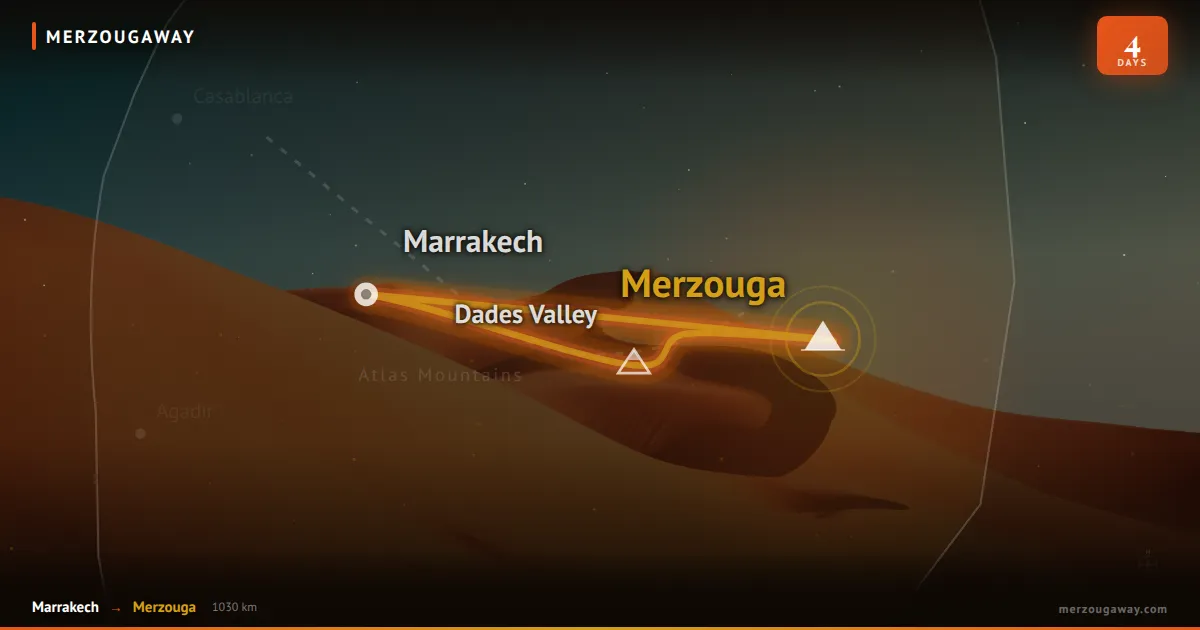
MerzougaWay itineraries generally recommend spending Night 1 in the Dades Valley. Arriving in Dades around 17:30 allows you to relax on your hotel terrace as sunset illuminates the red canyon walls, leaving the majestic vertical cliffs of Todra Gorge as a fresh morning walk on Day 2.
Arrival at the Dunes: Meeting Your Camel Caravan
After two days of traveling through mountains and gorges, arriving at the edge of the Erg Chebbi dunes is a dramatic transition:
- Base Lodge Transition: Your private vehicle arrives at the auberge base lodge on the edge of the sand around 16:30 to 17:00 PM. Here, you can freshen up, use the restroom, and pack your overnight bag.
- Mounting Your Camel: Your indigenous Berber camel team greets you with warm smiles and helps you mount your camel as the afternoon sun begins to lower.
- The Sunset Caravan: As your camel caravan steps onto the golden sands, the sounds of the road fade away, replaced only by the soft rhythm of camel footfalls across the dunes.
Evening Stargazing Etiquette in the Camp
Once dinner concludes at your desert camp, the camp lanterns are dimmed to maximize dark sky observation. Step onto the dunes away from camp lights, allow your eyes 20 minutes to adapt, and take in the magnificent sweep of the Milky Way stretching from horizon to horizon.
Frequently Asked Questions (FAQ)
Can you visit the Merzouga sand dunes as a day trip from Marrakech?
No. Merzouga is located 560 km from Marrakech, requiring 9 to 10 hours of driving each way. A minimum 3-day / 2-night trip is necessary to experience the dunes safely and comfortably.
How tall are the sand dunes in Erg Chebbi (Merzouga)?
The golden dunes of Erg Chebbi rise up to 150 meters (nearly 500 feet) in height, making them the tallest and most dramatic sand dunes in Morocco.
What is the best month to visit the dunes of Merzouga?
The best months are October to April, when daytime temperatures are pleasant (20°C–26°C / 68°F–78°F). Summer (July and August) should be avoided as midday temperatures exceed 42°C (108°F).
Sahara Route & Drive-Time Estimator
Calculate realistic driving hours across the High Atlas (Tizi n'Tichka pass), compare scenic stops (Dadès, Todra, Ziz), and plan your custom desert itinerary.

MerzougaWay Team
We are a passionate team of local guides dedicated to sharing the beauty and culture of our home, Morocco. Our journey began with a simple desire to offer authentic, memorable experiences that go beyond the typical tourist trails.