Merzouga, Morocco: What to Know Before You Go
A practical overview of Merzouga and the Erg Chebbi dunes — when to visit, how to get there, and what to actually expect from a Sahara trip.
Merzouga is a small village on the edge of the Sahara in southeastern Morocco, and it exists almost entirely as the gateway to the Erg Chebbi dunes — a stretch of golden sand dunes rising as high as 150 meters that's one of the most striking landscapes in the country. It's a Berber region at heart, and most of what makes a trip here memorable — the camel treks, the music, the desert camps — grows out of that local culture rather than being built for tourism from scratch.
[!NOTE] Fast-Facts & Direct Answer Summary
A practical overview of Merzouga and the Erg Chebbi dunes — when to visit, how to get there, and what to actually expect from a Sahara trip.
- Destination Focus: Authentic Moroccan culture, scenic routes, and local travel insights
- Currency & Payments: Moroccan Dirham (MAD; ~10 MAD ≈ €1 / $1.08 USD). Cash is essential outside major hotels
- Best Travel Window: October through April offers ideal temperate weather across Morocco and the desert
- Local Hospitality: Berber culture is renowned for warm hospitality, mint tea welcoming rituals, and rich musical heritage.
When to go
Spring (March-May) and autumn (September-November) are the sweet spot, with daytime temperatures around 25-30°C and cooler, comfortable evenings. Summer (June-August) is genuinely harsh, regularly exceeding 40°C, while winter nights (December-February) can drop below freezing even though the days stay mild — pack for both extremes if you're visiting outside spring or fall.
Getting there
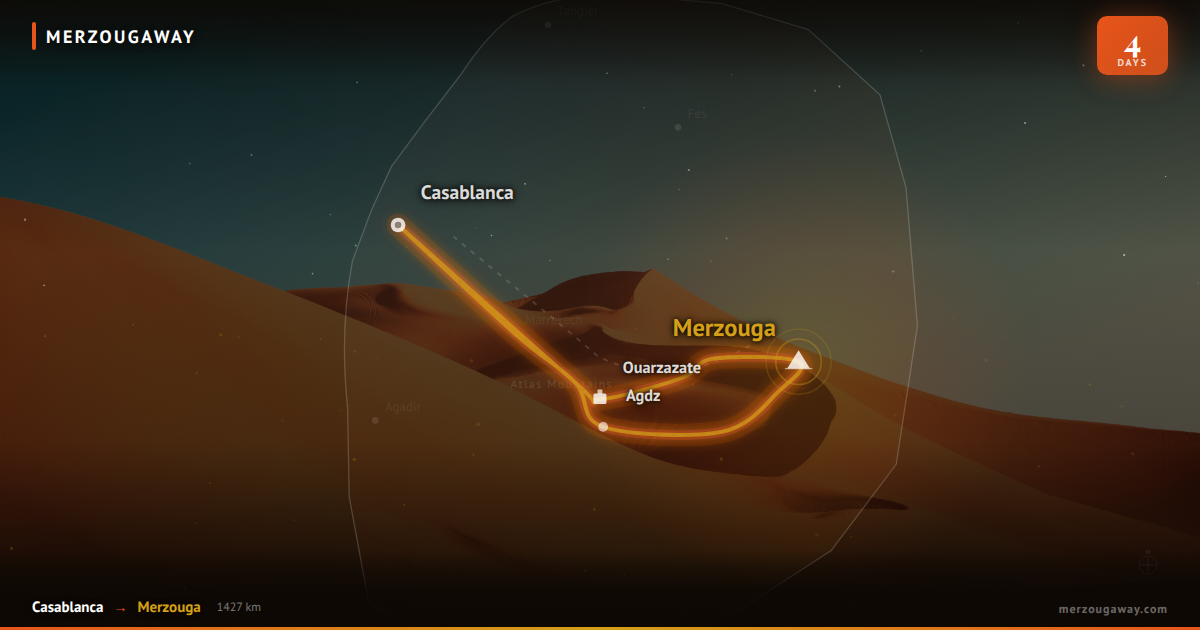
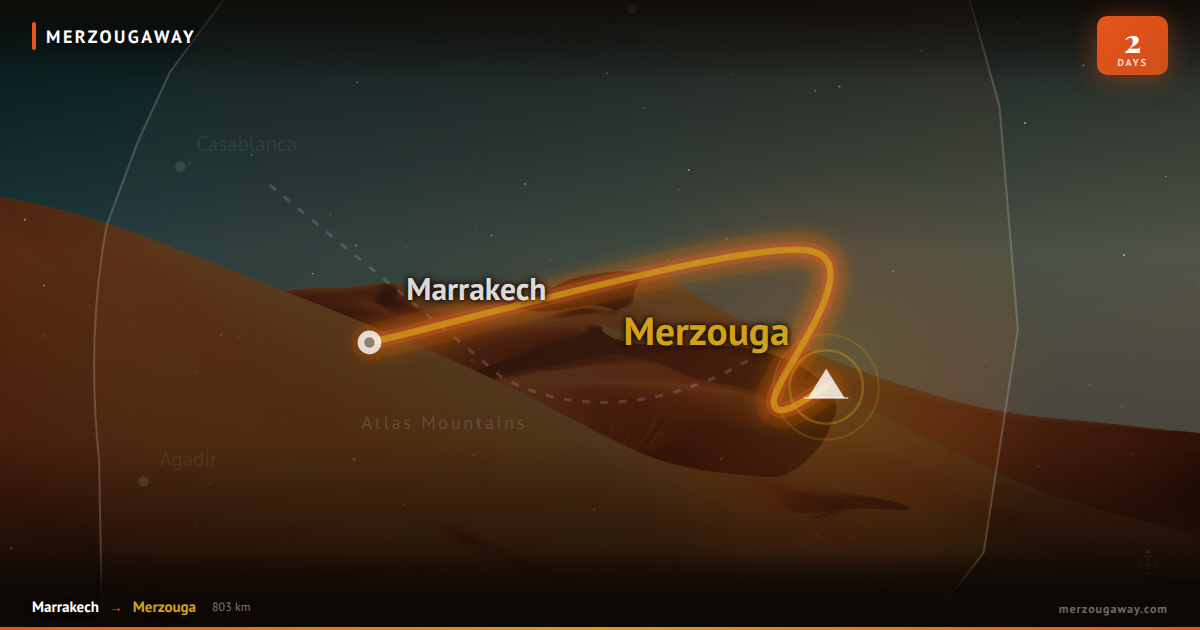
There's no airport in Merzouga itself. The nearest is Errachidia (ERH), about 2.5 hours away by road, though it has limited flight connections; most visitors instead fly into Marrakech (RAK) or Ouarzazate (OZZ) and travel overland from there. By road, it's roughly a 10-11 hour drive from Marrakech (560 km) over the High Atlas via Tizi n'Tichka, or about 7-8 hours from Fes (470 km) through the Middle Atlas — both routes are usually split across two or more days by private tours rather than driven in one push.
What's actually here
The dunes themselves are the main event, and a sunset or sunrise camel trek out to them is the trip's centerpiece for most visitors. Khamlia village, a short drive from Merzouga, is known for its Gnawa music tradition — descendants of West African communities who settled in the region generations ago, with performances that are a genuine cultural experience rather than a staged show. The desert around Merzouga is also fossil country: ancient marine fossils turn up throughout the area, and nearby Erfoud has workshops built around the trade. Merzouga Lake, when it holds water seasonally, draws flamingos and other migratory birds, though it's dependent on rainfall and isn't guaranteed to be present.
Beyond the camel trek, most visitors add a 4x4 excursion into the dunes and surrounding oases, sandboarding down the dune faces, and a night of stargazing — the lack of light pollution here makes for genuinely dark skies. Quad biking is available too, generally as a separate add-on rather than part of a standard tour package.
Where you'll sleep
Options range from luxury desert camps with private en-suite tents to simpler standard camps with shared facilities, plus budget guesthouses in the village itself for anyone not staying out in the dunes. Whatever tier you choose, book ahead for spring and autumn — the good camps fill up during peak season.
Practical notes
Dress modestly, particularly around the village, and ask before photographing people. Bargaining is normal in markets but not really a feature of camp or tour pricing. The Moroccan Dirham (MAD) is the currency, with ATMs available in Merzouga village itself. Wi-Fi at desert camps is inconsistent at best — treat a night in the dunes as a chance to disconnect rather than rely on a signal. We'd generally recommend at least 2-3 nights in the area if your schedule allows it; a single day trip is possible but means missing the sunrise, the stargazing, and the night in camp that make the desert worth the drive in the first place.
Frequently Asked Questions (FAQ)
What is the best month to visit Merzouga?
October, November, March, and April are the best months to visit Merzouga. Daytime temperatures average 22°C to 28°C (72–82°F), perfect for outdoor desert activities, while nights are cool and refreshing without the freezing winter chill or oppressive summer heat.
How do I get to Merzouga from Marrakech or Fes?
From Marrakech, travel overland via Route N9 and N10 (560 km, 9–10 hours), ideally stopping overnight in Dadès or Ouarzazate. From Fes, travel south via Route N13 through Ifrane, the cedar forest of Azrou, and the dramatic Ziz Gorge (470 km, 7.5–8 hours).
What is the difference between luxury and standard desert camps in Merzouga?
Luxury desert camps feature private tents with raised real beds, private en-suite flush toilets and hot showers, electric lighting, and plush carpets. Standard camps feature shared communal bathrooms located in a separate block, simple mattress bedding, and battery lanterns.
Can I charge my phone and camera at a desert camp?
Yes. Luxury desert camps are equipped with solar-powered inverter systems and generators that provide standard 220V electrical outlets in every tent for charging cameras, phones, and drones. Standard camps typically offer USB charging stations in the main dining tent.
What should I pack for a desert camp overnight?
Pack comfortable trousers for camel riding, closed-toe walking shoes, a wide-brimmed sun hat, sunglasses, sunscreen, a warm fleece or jacket for the cold desert night, power bank, wet wipes, and a small backpack with essentials (larger suitcases remain safely secured in the transport vehicle or at the hotel base).
Planning a trip out here?
- Email: [email protected]
- WhatsApp: +212675203319 / +212668534981
Sahara Route & Drive-Time Estimator
Calculate realistic driving hours across the High Atlas (Tizi n'Tichka pass), compare scenic stops (Dadès, Todra, Ziz), and plan your custom desert itinerary.
MerzougaWay Team
We are a passionate team of local guides dedicated to sharing the beauty and culture of our home, Morocco. Our journey began with a simple desire to offer authentic, memorable experiences that go beyond the typical tourist trails.