How Many Days in Morocco? The Ultimate 7, 10, and 14-Day Itinerary Planner (2026)
How many days do you actually need in Morocco? Complete 7-day, 10-day, and 14-day master itineraries covering Marrakech, the Sahara Desert, Fes, Chefchaouen, and Essaouira.
"How many days do I really need in Morocco?" is the single most important question every traveler asks when planning a trip to North Africa. The honest answer depends less on how many places you want to see and far more on how you plan your route to eliminate unnecessary backtracking.
Morocco is a vast, geographically diverse country. Driving from Tangier on the Mediterranean coast down to the Sahara sand dunes of Merzouga covers more distance than driving from London to Marseille. The single most common mistake first-time visitors make is booking a closed "round-trip loop" in and out of the same city, which wastes 10 to 14 valuable vacation hours retracing the exact same mountain highways.
In this comprehensive 2026 itinerary planner, our local guides at MerzougaWay break down what is realistically achievable in 7 Days, 10 Days, and 14 Days, providing complete day-by-day schedules, route maps, transport logistics, budget calculations, and insider advice.
⚡ Quick Summary: Which Morocco Itinerary Fits You Best?
[!NOTE] At a Glance — Choose Your Perfect Trip Length
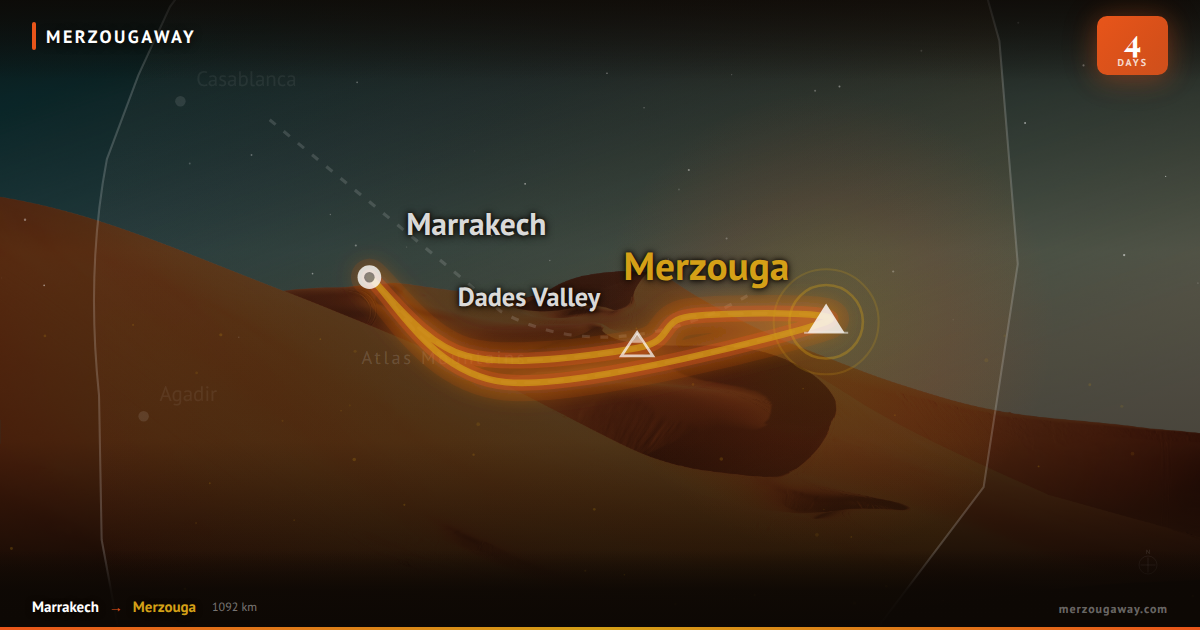
- 7 Days (The Express Highlight Arc): Best for travelers with 1 week off. Focuses on a high-impact One-Way Crossing: Marrakech ➔ High Atlas ➔ Erg Chebbi Desert Camp ➔ Middle Atlas ➔ Fes (or Chefchaouen). Covers ancient medinas, mountain passes, and the Sahara without repeating a single mile of road.
- 10 Days (The Golden Standard — Highly Recommended): The sweet spot for first-timers. Allows for 2 nights in the Sahara Desert, 2 full days in Fes, 2 full days in Marrakech, and a relaxing day trip to the Atlantic coastal town of Essaouira.
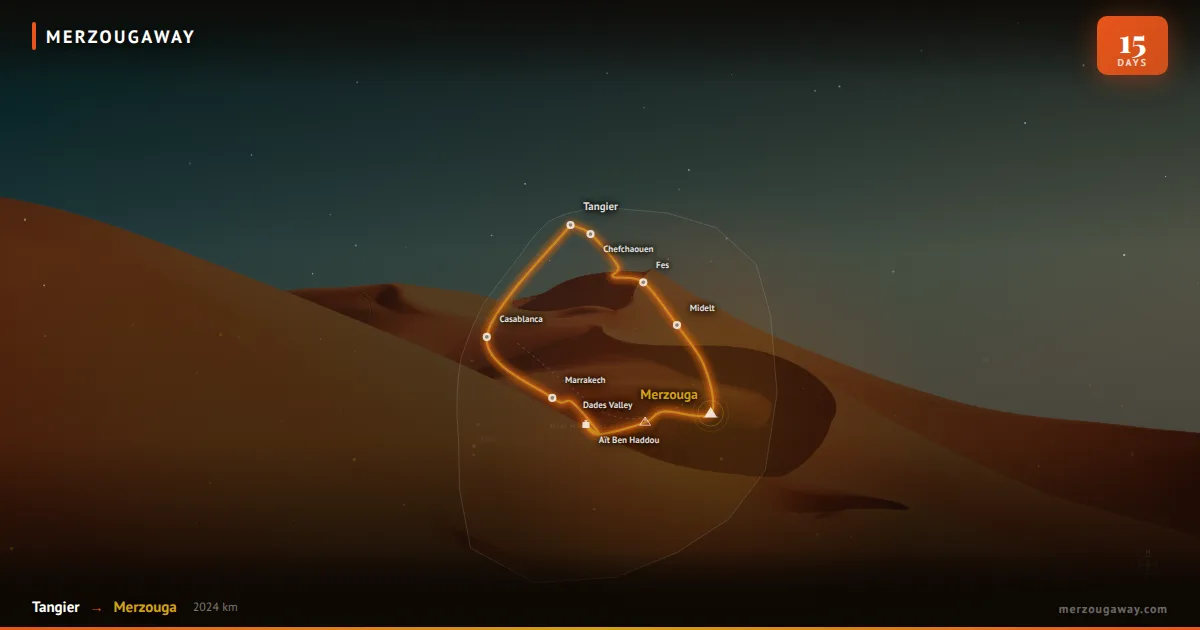
- 14 Days (The Complete Grand Moroccan Odyssey): For travelers who want it all at an unhurried, luxurious pace. Connects Tangier, the Blue City of Chefchaouen, Fes, Meknes, the Sahara Desert (2 nights), Dades Valley, Marrakech, the High Atlas Mountains (Mount Toubkal), and Essaouira.
┌─────────────────────────────────────────────────────────────────────────────────┐
│                     MOROCCO ITINERARY COMPARISON MATRIX                         │
├────────────────────┬──────────────────────┬─────────────────────────────────────┤
│ DURATION           │ ROUTE SHAPE          │ KEY REGIONS COVERED                 │
├────────────────────┼──────────────────────┼─────────────────────────────────────┤
│ 7 Days (Express)   │ One-Way (Kech ➔ Fes) │ Marrakech, Atlas, Sahara, Fes       │
├────────────────────┼──────────────────────┼─────────────────────────────────────┤
│ 10 Days (Optimal)  │ One-Way + Coast      │ Fes, Sahara (2N), Dades, Kech, Swira│
├────────────────────┼──────────────────────┼─────────────────────────────────────┤
│ 14 Days (Grand)    │ Grand National Loop  │ Tangier, Chefchaouen, Fes, Sahara,  │
│                    │                      │ Dades, Marrakech, Atlas, Essaouira  │
└────────────────────┴──────────────────────┴─────────────────────────────────────┘
The Core Strategic Rule: Loop vs One-Way Route
Before deciding on your day count, you must decide on the shape of your route:
┌─────────────────────────────────────────────────────────────────────────────────┐
│                     ONE-WAY OVERLAND vs CLOSED-LOOP ROUTE                       │
├────────────────────────────────────────┬────────────────────────────────────────┤
│ ONE-WAY POINT-TO-POINT (RECOMMENDED)   │ CLOSED-LOOP (START & END SAME CITY)    │
├────────────────────────────────────────┼────────────────────────────────────────┤
│ ✓ 0% Wasted Backtracking               │ ✗ 40-50% Duplicate driving on returns  │
│ ✓ Fly into Fes (FEZ), out Marrakech (RAK)│ ✗ Wastes 1 full day re-driving Atlas │
│ ✓ 100% New Scenery Every Single Day    │ ✗ Tiresome for trips under 10 days     │
│ ✓ Fits 4 major regions into 7-10 days  │ ✗ Only fits 2 regions comfortably      │
└────────────────────────────────────────┴────────────────────────────────────────┘
For any trip of 7 to 10 days, we strongly advise booking an Open-Jaw (Multi-City) Flight: fly into Casablanca (CMN) or Fes (FEZ), and fly home directly from Marrakech (RAK). This simple flight decision saves 9 to 10 hours of grueling driving across the High Atlas Mountains.
Part 1: The 7-Day Express Itinerary (Marrakech to Fes via Sahara)
Day 1: MARRAKECH (Arrive & Medina)
  │
Day 2: Marrakech ➔ High Atlas (Tizi n'Tichka 2,260m) ➔ Aït Benhaddou ➔ DADES VALLEY
  │
Day 3: Dades ➔ Todra Gorges ➔ Erfoud ➔ MERZOUGA LUXURY CAMP (Sunset Camel Trek)
  │
Day 4: Sahara Sunrise ➔ Ziz Valley Canyon ➔ Midelt ➔ Azrou Cedar Forest ➔ FES
  │
Day 5: Full Day Guided Fes Medina (Tanneries, Madrasas & Souks)
  │
Day 6: Fes ➔ CHEFCHAOUEN (The Blue Pearl of the Rif Mountains)
  │
Day 7: Chefchaouen ➔ Tangier Airport / Ferry (or train to Casablanca CMN)
Day-by-Day 7-Day Schedule
- Day 1 — Welcome to Marrakech: Arrive at Marrakech Menara Airport (RAK). Settle into your traditional Medina riad. Spend the afternoon exploring the vibrant street theater, orange juice stalls, and food smoke of Jemaa el-Fnaa square at sunset.
- Day 2 — Across the High Atlas to Dades Valley: Meet your private driver at 7:30 AM. Climb the Tizi n'Tichka mountain pass (2,260m). Tour the UNESCO World Heritage mud fortress of Aït Benhaddou (filming set for Gladiator). Pass through Ouarzazate and the fragrant Valley of the Roses to spend the night in a boutique Kasbah hotel in the Dades Valley.
- Day 3 — Todra Gorges & Sunset Camel Trek in Merzouga: Walk beneath the sheer 300-meter-tall red limestone walls of Todra Gorges. Drive east through Erfoud's fossil workshops into the golden dunes of Erg Chebbi. Mount your camel for a 1-hour sunset caravan into your luxury desert camp. Enjoy a 3-course dinner, campfire Berber drumming, and stargazing.
- Day 4 — Sahara Sunrise to Fes via Ziz Gorge & Cedar Forests: Watch the sun rise over the dunes. Drive north through the dramatic Ziz Valley palm canyon and the Middle Atlas mountains. Stop in the Azrou Cedar Forest to see wild Barbary macaque monkeys before arriving in medieval Fes by 6:00 PM.
- Day 5 — Full Day Guided Tour of Fes el-Bali: Spend the day exploring the world's oldest intact medieval medina with a licensed historian guide: visit the 1,000-year-old Chouara Tannery, the 9th-century Al-Qarawiyyin University, Bou Inania Madrasa, and Bab Bou Jeloud (The Blue Gate).
- Day 6 — Day Trip to Chefchaouen (The Blue City): Drive 3.5 hours north into the Rif Mountains to Chefchaouen. Spend the afternoon wandering through postcard-perfect blue-washed alleys, photographing the Spanish Mosque viewpoint, and shopping for native wool and brass crafts.
- Day 7 — Departure from Tangier or Casablanca: Transfer 2 hours to Tangier Airport (TNG) or Tangier Med Ferry to Spain, or take the fast Al Boraq train south to Casablanca Airport (CMN) for your international departure flight.
Part 2: The 10-Day Classic Itinerary (The Ultimate Morocco Trip)
Ten days is universally recognized as the ideal trip duration for first-time visitors to Morocco. It provides enough time to spend 2 full nights in the Sahara Desert and enjoy 2 relaxed days in both imperial capitals plus the Atlantic coast.
┌─────────────────────────────────────────────────────────────────────────────────┐
│                  THE 10-DAY CLASSIC MASTER ITINERARY                            │
├─────────┬───────────────────────────────────┬───────────────────────────────────┤
│ DAY     │ ROUTE & ACTIVITIES                │ OVERNIGHT LOCATION                │
├─────────┼───────────────────────────────────┼───────────────────────────────────┤
│ Day 1   │ Arrive Casablanca ➔ Hassan II ➔ Fes│ Luxury Fes Medina Riad            │
│ Day 2   │ Full Day Fes Medina Guided Tour   │ Luxury Fes Medina Riad (Night 2)  │
│ Day 3   │ Fes ➔ Ifrane ➔ Ziz ➔ Merzouga Camp│ Erg Chebbi Luxury Desert Camp     │
│ Day 4   │ Full Day Sahara (4x4, Nomads, Gnawa) Erg Chebbi Luxury Camp (Night 2)   │
│ Day 5   │ Merzouga ➔ Todra ➔ Dades Valley   │ Dades Valley Boutique Kasbah      │
│ Day 6   │ Dades ➔ Aït Benhaddou ➔ Marrakech │ Luxury Marrakech Medina Riad      │
│ Day 7   │ Marrakech: Palaces, Gardens, Souks│ Luxury Marrakech Riad (Night 2)   │
│ Day 8   │ Day Trip: Coastal Essaouira       │ Coastal Essaouira Boutique Riad   │
│ Day 9   │ Essaouira Beach & Seafood ➔ Kech  │ Luxury Marrakech Riad (Night 3)   │
│ Day 10  │ Marrakech Hammam & Departure (RAK)│ Departure Flight                  │
└─────────┴───────────────────────────────────┴───────────────────────────────────┘
Why the 10-Day Plan is the Gold Standard:
- Two Nights in the Desert: Eliminates the exhausting "pack-and-leave" routine on Day 4. You spend an entire day enjoying sandboarding, meeting nomad families, hearing live Gnawa trance music in Khamlia, and relaxing.
- Atlantic Coastal Escape: Visiting Essaouira (a UNESCO-listed fortified Portuguese coastal town 2.5 hours west of Marrakech) provides refreshing ocean breezes, fresh grilled seafood, art galleries, and windsurfing after the desert heat.
- Paced Exploration: You spend at least 2 nights in Fes, 2 nights in the Sahara, and 3 nights in Marrakech, drastically reducing daily packing fatigue.
Part 3: The 14-Day Grand Moroccan Odyssey (The Two-Week Masterpiece)
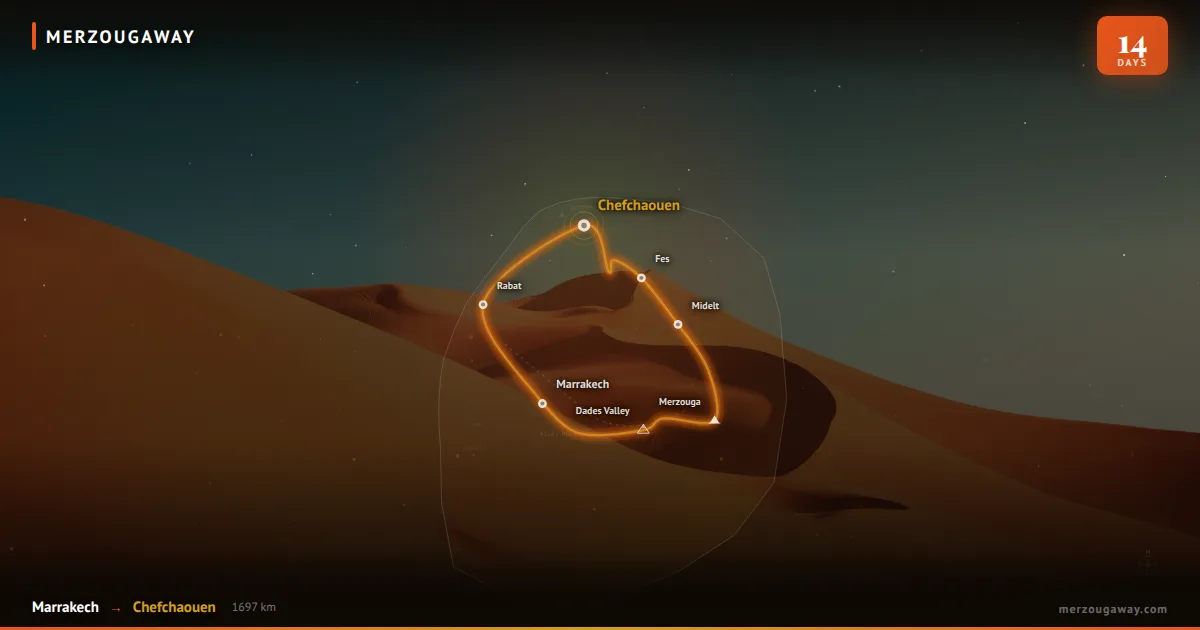
With two full weeks, you can complete the ultimate comprehensive loop encompassing northern Mediterranean Morocco, the Rif Mountains, the Imperial Cities, the High Atlas, the Sahara Desert, and the Atlantic Coast.
TANGIER (Port / TNG) ──▶ CHEFCHAOUEN (2 Nights - Blue City)
                              │
                              ▼
                         FES & MEKNES (2 Nights - Roman Ruins of Volubilis)
                              │
                              ▼
                         MERZOUGA SAHARA DESERT (2 Nights - Luxury Camp)
                              │
                              ▼
                         DADES & TODRA GORGES (1 Night - Kasbah Hotel)
                              │
                              ▼
                         MARRAKECH (3 Nights - Palaces, Souks & Gardens)
                              │
                              ▼
                         HIGH ATLAS MOUNTAINS / IMLIL (1 Night - Toubkal Valley)
                              │
                              ▼
                         ESSAOUIRA (2 Nights - Coastal Fortress & Seafood)
                              │
                              ▼
                         CASABLANCA (1 Night - Hassan II Mosque & CMN Flight)
Highlights of the 14-Day Grand Odyssey:
- Volubilis & Moulay Idriss: Explore the best-preserved Roman ruins in North Africa, complete with 2,000-year-old mosaic floors depicting Bacchus and the Labors of Hercules.
- High Atlas Alpine Retreat (Imlil): Spend a peaceful night in a Berber mountain lodge at the base of Mount Toubkal (4,167m), walking through walnut groves and drinking fresh spring water.
- Chefchaouen Immersion: Two full nights in the Blue City allow for quiet early-morning photography before day-trippers arrive from Tangier.
- Essaouira Coastal Riad: Dine on sea urchins, oysters, and grilled sea bass straight off the fishermen's wooden boats in the port.
Part 4: Real Budget Comparison (7 vs 10 vs 14 Days)
Here is a realistic per-person cost breakdown based on private 4x4 transport with dedicated driver-guide, 4-star boutique riads/kasbahs, luxury desert camps (half-board), monument tickets, and daily lunches:
| Budget Level | 7-Day Itinerary | 10-Day Itinerary | 14-Day Itinerary | | :--- | :--- | :--- | :--- | | Budget Traveler (Hostels / Minibus) | €450 – €650 | €650 – €950 | €950 – €1,400 | | Mid-Range (Private 4x4 & 4-Star Riads) | €1,100 – €1,650 | €1,550 – €2,300 | €2,200 – €3,200 | | Luxury (VIP Mercedes & 5-Star Palaces) | €2,800 – €4,500 | €3,800 – €6,200 | €5,500 – €9,500 |
Note on Value: Because private vehicle and driver costs are fixed per day, traveling with a partner, family, or friend group of 3 to 5 people significantly reduces the per-person cost.
Part 5: Best Time of Year by Region
Morocco spans four distinct climate zones: the Atlantic Coast, the Rif & Middle Atlas, the High Atlas, and the Sahara Desert.
┌─────────────────────────────────────────────────────────────────────────────────┐
│                    REGIONAL CLIMATE & SEASONALITY MATRIX                        │
├────────────────────┬──────────────────────┬─────────────────────────────────────┤
│ REGION             │ BEST MONTHS          │ WEATHER PROFILE                     │
├────────────────────┼──────────────────────┼─────────────────────────────────────┤
│ Sahara (Merzouga)  │ Oct–Nov & Mar–Apr    │ Sunny 22–28°C; crisp clear nights   │
│ Imperial Cities    │ Sep–Nov & Mar–May    │ Warm 20–26°C; perfect walking temp  │
│ Atlantic Coast     │ May–Oct (Year-round) │ Mild 20–24°C; constant ocean breeze │
│ High Atlas (Imlil) │ May–Oct (Trekking)   │ Fresh alpine air; snow in winter    │
└────────────────────┴──────────────────────┴─────────────────────────────────────┘- Best Overall Months for 7, 10, or 14 Days: October, November, March, April, and May. These months offer the ideal sweet spot of pleasant desert warmth, clear mountain passes, and comfortable city walking temperatures.
❓ Frequently Asked Questions (FAQ)
Is 7 days really enough to see Morocco?
Yes, provided you do a One-Way route (such as Marrakech to Fes via the Sahara). Seven days gives you an extraordinary cross-section of Morocco: imperial cities, High Atlas mountain passes, UNESCO kasbahs, and a night in a luxury Sahara desert camp. However, 7 days is not enough for a circular loop or to visit northern cities like Chefchaouen without rushing.
Can I do a self-drive road trip for these itineraries?
While self-driving on toll highways between Casablanca, Rabat, and Marrakech is straightforward, we strongly recommend hiring a private driver-guide for routes crossing the High Atlas (Tizi n'Tichka) and the Sahara Desert. Mountain switchbacks, aggressive commercial trucks, lack of desert road signage, and police checkpoints add significant stress that a professional driver completely removes.
How do domestic trains fit into these itineraries?
Morocco has an outstanding high-speed train network called Al Boraq connecting Tangier, Kenitra, Rabat, and Casablanca in just 2 hours and 10 minutes, as well as regular comfortable ONCF trains from Casablanca to Marrakech and Fes. However, trains do not run to the Sahara Desert or across the Atlas Mountains. The best hybrid approach is taking the train between coastal imperial cities and using a private 4x4 for the desert crossing.
What is the difference between flying into Casablanca vs Marrakech?
Casablanca (CMN) receives the largest number of long-haul international flights from North America, the Middle East, and Asia. Marrakech (RAK) and Fes (FEZ) have extensive direct low-cost flights from major European hubs (London, Paris, Madrid, Rome, Frankfurt). For the most efficient 7 or 10-day trip, book a multi-city ticket: fly into Casablanca or Fes and fly home from Marrakech.
What should I pack for a multi-region Morocco trip?
Because your trip crosses coastal, mountain, and desert zones, dress in versatile layers. Pack breathable lightweight cotton or linen for daytime, comfortable walking shoes for cobblestone medinas, and a warm fleece or packable down jacket for cold desert nights (where temperatures can drop to 4°C/40°F between November and March). Modest clothing covering shoulders and knees is recommended for historical mosques and rural villages.
🇲🇦 Plan Your Custom Morocco Itinerary with MerzougaWay
Need help tailoring a 7-day, 10-day, or 14-day itinerary to your exact flight dates, group size, or budget? MerzougaWay designs bespoke private Morocco expeditions starting from Casablanca, Marrakech, Fes, or Tangier.
- Explore All Tour Packages: Multi-Day Morocco Desert Tours & Itineraries
- Direct WhatsApp Consultation: +212 675 203 319 / +212 668 534 981
- Email Custom Inquiries: [email protected]
Guide updated and verified for 2026 travel season.
Sahara Route & Drive-Time Estimator
Calculate realistic driving hours across the High Atlas (Tizi n'Tichka pass), compare scenic stops (Dadès, Todra, Ziz), and plan your custom desert itinerary.
MerzougaWay Team
We are a passionate team of local guides dedicated to sharing the beauty and culture of our home, Morocco. Our journey began with a simple desire to offer authentic, memorable experiences that go beyond the typical tourist trails.