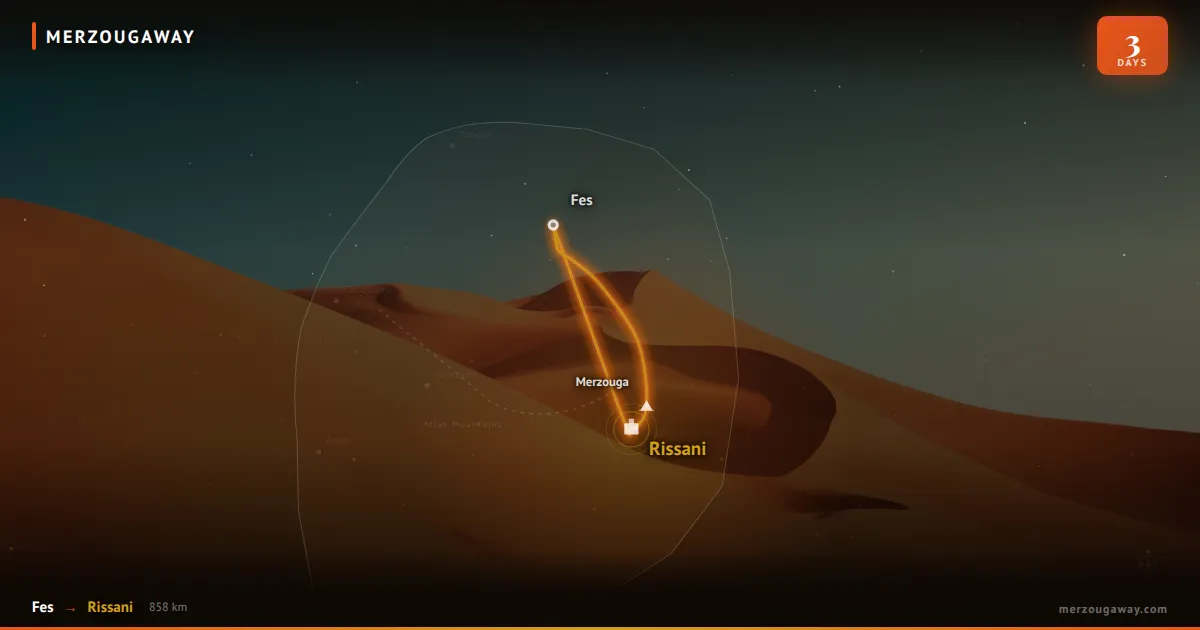
Classic 3-Day Fes to Merzouga: Camel Trek + Erg Chebbi Sunrise
This classic 3-day tour from Fes to Merzouga is the perfect introduction to Morocco's Sahara Desert. You'll journey through the Middle Atlas Mountains, pass through charming cedar-scented mountain towns, ride camels across the golden Erg Chebbi dunes, and spend a magical night under a canopy of stars in a traditional Berber camp. From the medieval medina of Fes to the ancient sea of sand at Merzouga, this route is one of the most spectacular road journeys in all of Africa.
This high-demand tour combines stunning landscapes, authentic cultural experiences, and unforgettable desert moments — and it remains, despite its popularity, one of Morocco's most rewarding adventures.
Tour Highlights
- Discover Ifrane, known as Morocco's "Little Switzerland"
- Meet wild Barbary macaques in the ancient Azrou cedar forest
- Enjoy a panoramic drive through the dramatic Ziz Valley gorge and its lush palm groves
- Experience a sunset camel trek deep into the Sahara Desert
- Sleep under the stars in a luxury Berber desert camp
- Watch the sunrise over Erg Chebbi dunes from the crest of a golden ridge
- Explore Rissani souk and traditional markets steeped in Alaouite dynasty history
- Visit Erfoud's fossil workshops and marvel at 350-million-year-old craftsmanship
- Enjoy traditional Berber music around the campfire under an infinite desert sky
Why Start from Fes?
Fes is Morocco's most underrated desert departure point — and arguably its best. While most desert tours originate in Marrakech, the Fes-to-Merzouga route offers a quietly superior experience for travelers who want more variety, fewer crowds, and a deeper immersion into Morocco's geographic and cultural layers.
The distance advantage is real. Merzouga sits approximately 470 km from Fes compared to roughly 560 km from Marrakech. That extra distance means Marrakech-based tours often rush through the landscapes that this route savors. Departing from Fes, you cross three distinct ecological zones — the fertile Middle Atlas plateau, the high-altitude cedar forests, and the pre-Saharan river valleys — without feeling hurried.
The route is less touristed. The road south from Fes through Ifrane, Azrou, and Midelt sees a fraction of the coach traffic that clogs the Marrakech-Ouarzazate-Dades corridor. At Azrou's cedar forest, you're genuinely walking among ancient trees rather than navigating a roadside spectacle. At the Ziz Valley viewpoint, you may find yourself almost alone at one of Morocco's most breathtaking panoramas.
Fes itself sets the tone perfectly. Departing from the world's oldest medieval medina — a UNESCO World Heritage city that has barely changed in a thousand years — and arriving two days later at the edge of the Sahara creates a journey arc that is simply unmatched. Ancient meets ancient, and every kilometre in between tells a part of Morocco's story.
If you're flying into Morocco and want the most geographically logical, scenically varied, and culturally rich route to the desert, Fes is where your journey should begin.
Who Is This Tour For?
| Traveller Type | Is This Tour Right for You? |
|---|---|
| First-time visitors to Morocco | ✅ Perfect — this route covers the country's greatest natural and cultural highlights |
| Couples and honeymooners | ✅ Romantic sunsets, private camp options, and starlit dinners make this ideal |
| Solo travellers | ✅ Your own private vehicle and guide; solo surcharges are minimal |
| Families with children (8+) | ✅ Camel rides, Barbary macaques, and campfire music are unforgettable for kids |
| Seniors or limited mobility | ✅ Camel rides can be swapped for 4x4 transfers; pace is flexible |
| Photographers and landscape lovers | ✅ Dawn light on the dunes and Ziz Valley vistas are world-class subjects |
| Travellers on a tight schedule | ✅ Three days is enough to experience the desert fully without rushing |
| Luxury seekers | ✅ Premium camp upgrades with private en-suite tents are available on request |
Itinerary
Day 1 — Fes → Ifrane → Azrou → Midelt → Ziz Valley → Merzouga
Your driver-guide will collect you from your accommodation in Fes at around 8:00 AM, giving you the coolest part of the morning for the first stretch of the journey. As the taxi-brousse lanes and ancient city walls of Fes fall behind you, the road begins to climb almost immediately, threading through terraced hillsides and eucalyptus groves before opening onto the broad, pine-scented plateau of the Middle Atlas.
Your first stop is Ifrane, roughly an hour south of Fes. Known as Morocco's "Little Switzerland," this planned resort town sits at 1,650 metres and surprises almost every visitor who encounters it for the first time. Red-roofed alpine chalets, manicured public gardens, and immaculate streets stand in deliberate contrast to the dusty medina world most travellers associate with Morocco. Take a short photo stop, stretch your legs, and absorb the strangeness of it — a perfectly transplanted European mountain village in the heart of North Africa.
From Ifrane, the road curves deeper into cedar country toward Azrou, and this is where the journey earns its first genuine magic. Pull off the main road and step into a forest of Atlas cedars, some of them over 800 years old, their trunks the diameter of small cars. The air smells of resin and cool shadow. And then you hear them — rustling branches and a crash of movement overhead — the Barbary macaques. Morocco's only wild primates, these sturdy, expressive creatures descend to ground level with a confidence that borders on entitlement. Watch them groom each other, steal snacks from distracted tourists, and wrestle in the undergrowth. Your guide will point out which behaviours signal curiosity versus agitation. Plan for at least 30–40 minutes here; it's genuinely difficult to leave.
By early afternoon, you'll arrive in Midelt — a working Berber market town perched at the foot of the Jbel Ayachi massif, where snow lingers on the peaks well into spring. Stop for lunch at one of the town's no-frills local restaurants (own expense), where the harira soup is consistently excellent and the tagine arrives with homemade khobz bread still hot from the clay oven. This is emphatically not a tourist restaurant — it is exactly the kind of place your guide eats when travelling this road, which is all the recommendation you need.
South of Midelt, the terrain transforms rapidly. The cedar and scrubland give way to a vast, bone-dry plateau, and then — with almost no warning — the earth cracks open before you at the Ziz Valley gorge. Stop at the panoramic viewpoint above the valley and take it in: a cathedral of rust-red rock walls dropping hundreds of metres to a ribbon of green below, where tens of thousands of date palms crowd the banks of the Oued Ziz river. This is one of Morocco's most arresting landscapes, and it photographs magnificently in the late-afternoon light. The road descends through the gorge, past the Hassan Addakhil dam reservoir and through villages of pale pisé houses, before the landscape flattens into the stony hammada of the pre-Sahara.
You'll arrive in Merzouga as the last light fades, the silhouette of Erg Chebbi's enormous dunes visible against the darkening sky to the east. Check in to your riad or hotel, take a shower, and settle into a warm dinner. You're at the edge of the Sahara now, and tomorrow it awaits.
Day 2 — Merzouga Desert Experience: Camel Trek + Berber Camp
Wake without an alarm. The morning in Merzouga belongs to you. Take breakfast on the riad terrace — fresh mint tea, msemen flatbreads, argan honey, and amlou almond paste — and let the day begin at its own pace. The rose-orange flanks of the Erg Chebbi dunes, rising to over 150 metres directly to the east, will be your constant companion throughout the morning, shifting colour as the sun climbs higher.
The free morning offers several optional activities that your guide can arrange. A visit to Khamlia village, a short drive south, is quietly extraordinary — a small community descended from sub-Saharan slaves brought to Morocco centuries ago, who have preserved a tradition of Gnawa trance music unlike anything else in the Sahara. Sit in a low-ceilinged room while musicians in black robes play the sintir bass lute and iron krakeb castanets in mesmerising, hypnotic cycles. Alternatively, your guide can introduce you to a local nomad family living on the desert margins, where you'll drink tea in a goathair tent and understand something of what desert life actually entails beyond the tourist experience. For the more adventurous, quad biking across the sand flats at the base of the dunes is available to book locally.
In the late afternoon, around 4:00–4:30 PM depending on the season, your camel handler will be waiting. You'll mount your dromedary — a far more dignified animal than its grumpy reputation suggests, once you've established a mutual understanding — and begin the slow, swaying trek into the interior of Erg Chebbi. The camels move in single file along the ridge lines, their footprints the only marks on a sea of perfectly rippled sand. As the sun descends, the dunes shift through amber, copper, and deep crimson, and the shadows in the wind-sculpted ridges grow long and theatrical.
Arrive at your luxury Berber desert camp just as the last ember of daylight disappears. Your tent — a proper canvas structure with real beds, woven rugs, and lantern light — is far more comfortable than it has any right to be in the middle of the Sahara. After washing off the day's dust, gather around the central fire pit as your camp hosts serve a full traditional Moroccan dinner: harira, a slow-cooked lamb or vegetable tagine, couscous, and sweet pastilla. As dinner winds down, the musicians take their place around the fire — drums, sintir, and call-and-response singing that has no obvious beginning or end. The sky above you, free of any light pollution, is extraordinary: the Milky Way is not a concept here but a physical presence overhead, close enough to feel personal.
Day 3 — Sunrise in the Desert → Rissani → Erfoud → Return to Fes
Set your alarm for 6:00 AM. This is non-negotiable, and you will not regret it.
In the soft indigo dark before dawn, follow your guide on foot to the top of the nearest high dune. It takes effort — sand shifts underfoot with every step — but the summit rewards everything. As the first pale light grazes the eastern horizon, the desert transforms minute by minute: from grey to lavender to gold, the shadows retreating as if the dunes are slowly waking. The silence is absolute except for the wind. This is the moment the entire journey has been building toward, and it delivers completely.
Return to camp for a final glass of mint tea before the morning camel ride back to Merzouga — a gentler, more meditative journey in the cool early light. Back at your hotel or riad, there is time for breakfast, a hot shower, and repacking before departure.
The drive north begins in earnest by mid-morning. Your first stop is Rissani, the ancient capital of the Tafilalet region and the birthplace of the Alaouite dynasty — the royal family that rules Morocco to this day. The town's souk operates on market days (Tuesday, Thursday, and Sunday) and is one of the most authentic in the south: date merchants, livestock traders, fabric stalls, and spice vendors occupying a warren of covered arcades that have functioned this way for centuries. If your visit falls on a non-market day, the quieter streets and old ksar ruins are worth exploring on foot. Don't leave without visiting the Moulay Ali Cherif Mausoleum, the tomb of the dynasty's founder, where the architecture is a refined example of Alaouite craftsmanship.
Next stop is Erfoud, the region's administrative centre and a town with a remarkable geological secret beneath its feet. Stop at one of the working fossil workshops on the edge of town, where craftsmen cut and polish enormous slabs of Devonian limestone packed with trilobites, ammonites, and ancient marine organisms that lived here when this desert was the floor of a prehistoric ocean — over 350 million years ago. Watch the artisans work, browse the finished pieces, and consider how the Sahara's apparent lifelessness is built upon an almost incomprehensible depth of ancient life.
The return drive retraces the Ziz Valley and Middle Atlas corridor northward. Consider this second pass through the gorge from the opposite perspective — the light falls differently, and a landscape you absorbed in the excitement of outbound travel now settles into something more familiar and more beloved. You'll arrive back in Fes at approximately 8:00 PM, dropped off directly at your accommodation with a full set of memories and a phone full of photographs.
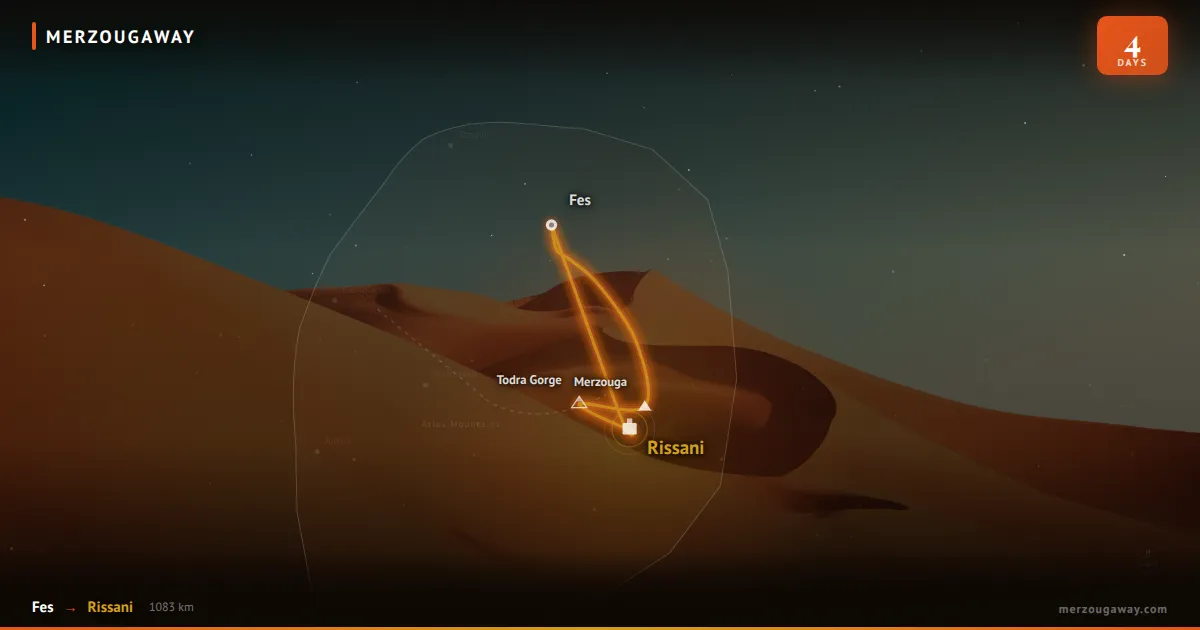
Return route variation: On request, your guide can arrange a slightly different return via Midelt and the N13 with a stop at the striking Aït Benhaddou-adjacent kasbahs of the Todra or Dadès region if you're extending to a 4-day itinerary. Ask us about flexible routing when you book.
📅 Book your classic 3-day Fes to Merzouga desert tour now and experience the magic of the Sahara with camel trekking, Berber culture, and unforgettable sunrises over Erg Chebbi.
Included & Not Included
- • Private air-conditioned 4x4 or minivan
- • Professional English-speaking driver/guide
- • 2 nights accommodation (1 night in hotel/riad + 1 night in a luxury desert camp)
- • Camel ride in Erg Chebbi dunes
- • Pick-up and drop-off at your Fes accommodation
- • Sandboarding (optional)
- • 4x4 dunes tour (1.5 to 2h)
- • Traditional Berber cheche (turban/scarf) — yours to keep
- • Polished fossil souvenir from Erfoud
- • Lunches and drinks
- • Entrance fees to monuments and attractions
- • Tips for guides and drivers
What Travelers Say
Last week I did a trip from Fes to Merzouga, leaving the desert camp and guided desert activities all in the hands of MerzougaWay and Hamid, and I can only say that everything was perfectly organized, right on time. Thanks to everyone at the riad we stayed at and the desert camp, as well as the guides who joined us for the 4x4 experience, Berber culture, and camel transfer. Thanks to Hamid and MerzougaWay for that quad-bike ride back to the riad across the dunes early in the morning. If you're thinking of traveling to Merzouga, I definitely recommend Hamid as the organizer of your adventure.
Frequently Asked Questions
Is this tour suitable for seniors or people with limited mobility?
Yes, this tour is thoughtfully adaptable for travellers of most fitness levels. The driving days are long but comfortable, conducted in private air-conditioned 4x4s or minivans with regular stops. The camel ride can be replaced entirely with a short 4x4 transfer directly into the dune interior and out to the camp, with zero compromise on the sunset, dinner, and stargazing experience. Please inform us of any mobility considerations at the time of booking so we can plan accordingly.
What clothing and gear should I bring?
Pack light, breathable fabrics for daytime travel — linen and cotton perform well in the heat. Bring a warm fleece or jacket for desert evenings, which can be surprisingly cold even in spring and autumn. Closed-toe shoes are preferable to sandals in the dunes, where sand becomes very fine and very hot by midday. A wide-brimmed hat, quality sunscreen, UV-protection sunglasses, and a reusable water bottle are essential. Desert camps provide blankets and warm bedding, so a sleeping bag is generally unnecessary unless you are visiting in December or January.
When is the ideal season to take this tour?
The best months to travel are October through May. Autumn (October–November) brings warm days, cool evenings, and a post-summer freshness to the landscapes. Spring (March–May) is arguably the most beautiful season, when the Middle Atlas valleys are green, wildflowers bloom along the Ziz Valley, and the desert air is clear and mild. December and January are magical for stargazing and solitude, though nights can be very cold. We advise against July and August for the Fes–Merzouga route, as midday temperatures in the desert regularly exceed 45°C.
What temperatures should I expect in the desert at night?
Desert temperature swings are dramatic and should not be underestimated. Winter nights (December–February) can drop to 3–7°C in the Sahara, occasionally colder. Spring and autumn evenings typically range from 12–18°C — pleasant around the fire, but cool enough for a jacket once you stop moving. Summer nights remain warm at 25–28°C. Our desert camps provide quality blankets and proper beds, but we always recommend packing at minimum a thermal base layer and a mid-weight fleece for evenings around the campfire, regardless of the season.
What is included and not included in the tour price?
Your tour price includes: private transport in an air-conditioned vehicle, an experienced English-speaking driver-guide, one night's accommodation at a hotel or riad in Merzouga (half-board: dinner and breakfast), one night in a luxury Berber camp (dinner and breakfast included), camel trek at sunset and sunrise, and all camp activities. Not included: lunches on all three days, personal travel insurance, optional activities (quad biking, Gnawa music experience), gratuities, and any personal purchases at souks or fossil markets. A detailed inclusions list is provided at booking confirmation.
How do I book and what payment is required?
Booking is simple and flexible. We require only a 10% deposit via PayPal or bank transfer to confirm your dates, with the remaining balance payable in cash on arrival — euros, US dollars, and Moroccan dirhams are all accepted. Once your deposit is received, you'll receive a full confirmation with your pickup time, meeting point details, and a short packing guide tailored to your travel dates.
Duration
3 Days, 2 Nights
Group Type
Private
Transportation
4×4 or Minibus
Payment Methods
PayPal
Bank Transfer (IBAN)
Only 10% deposit required
Email:
[email protected]What Our Travelers Say
Real reviews from Google and TripAdvisor
We traveled to Morocco in a group of 6 adults, including my parents, who are already seniors, in the middle of summer. For my family it was a leap of faith to trust an agency we found online for the first time, but it turned out to be a wonderful surprise. Hamid, the trip organizer, was very kind and attentive both before and throughout the whole tour. It was a fully personalized tour - we got to do everything we wanted, from visiting the Sahara to enjoying the beach. He always looked out for our comfort, especially my parents': comfortable transport, well-timed stops at places with restrooms, beautiful air-conditioned hotels, and varied, plentiful food. Thanks to his organization we were able to enjoy the trip with real peace of mind. It was a great experience we would absolutely recommend.
Last week I did a self-drive trip from Fes to Merzouga, leaving the car rental, the riad in Merzouga, the desert camp, and the guided desert activities all in the hands of MerzougaWay and Hamid, and I can only say that everything was perfectly organized, right on time. Thanks to everyone at the riad we stayed at and the desert camp, as well as the guides who joined us for the 4x4 experience, Berber culture, and the camel transfer. Thanks to Hamid and MerzougaWay for that quad-bike ride back to the riad from the camp - what an experience, riding a quad across the dunes early in the morning. If you're thinking of traveling to Merzouga, I definitely recommend Hamid as the organizer of your adventure.
Excellent!! We loved the tour. Thank you Hamid for everything. Everything well organized, the guide Eljo (Elhousain) was very attentive, highly recommend. Everything super clean, we had a great driver, we felt very safe with him. Unbeatable desert excursion. Thanks MerzougaWay!
Trustworthy tour agency. I wrote Hamid what I wanted and he just made it happen. He arranged everything so quick and smooth. We had a 3-day Merzouga tour from Marrakech. Said was our guide and he made me and my wife very comfortable. He took us from our riad and carried us in his modern 4x4 Toyota to magnificent places. He gave us the confidence to ask him whatever we wanted to do and wherever we wanted to drive - like old friends. He is open-minded and respectful. I recommend asking the agency for Said to be your driver. In the 3-day tour you cross the Atlas mountains, stay one night in a perfect hotel in Dades with great food, then stay one night in Erg Chebbi dunes in a luxury glamp camp. One night wasn't enough for a real desert experience - if you have time, take two nights in the desert.
Unforgettable holiday. An 8-day itinerant tour in Morocco, including 3 days organized by Hamid - MerzougaWay: a route from Fes to Marrakech, spending a night in the desert and in Ouarzazate. Our guide Youssef, who drove us all along the way, was very professional and took us to try real experiences that not all tourists get to see. Breathtaking landscapes - Morocco amazed and fascinated us. We drove many miles but still traveled comfortably. Absolutely recommend it - they are a highly professional agency and managed to take us to unique places, like a Berber village in the desert where we were the only tourists. A spectacular, unforgettable experience.
Morocco from the heart with MerzougaWay. Heartfelt congratulations to Hamid, who organized our trip impeccably - present, correct, and extremely helpful. A special mention for our driver Ali, who was by our side through 3 intense days toward the desert: attentive, polite, discreet, and a genuinely good, nice driver. We found snow in the Atlas range and then sun in Ait Ben Haddou, visited women's cooperatives working argan oil and roses, saw the Dades Gorges, and finally reached the Sahara dunes by camel before sleeping in a tented desert camp. 3 intense and exciting days. Next time in Morocco I'll rely on you again, inshallah!
Read more reviews on
Ready to Start Your Adventure?
Contact us today and let's plan your perfect Moroccan desert experience

MerzougaWay Team
We are a passionate team of local guides dedicated to sharing the beauty and culture of our home, Morocco. Our journey began with a simple desire to offer authentic, memorable experiences that go beyond the typical tourist trails.
Complete Your Morocco Trip
Two more services from our team, based in Marrakech.
You Might Also Like
Discover more amazing tours in Morocco
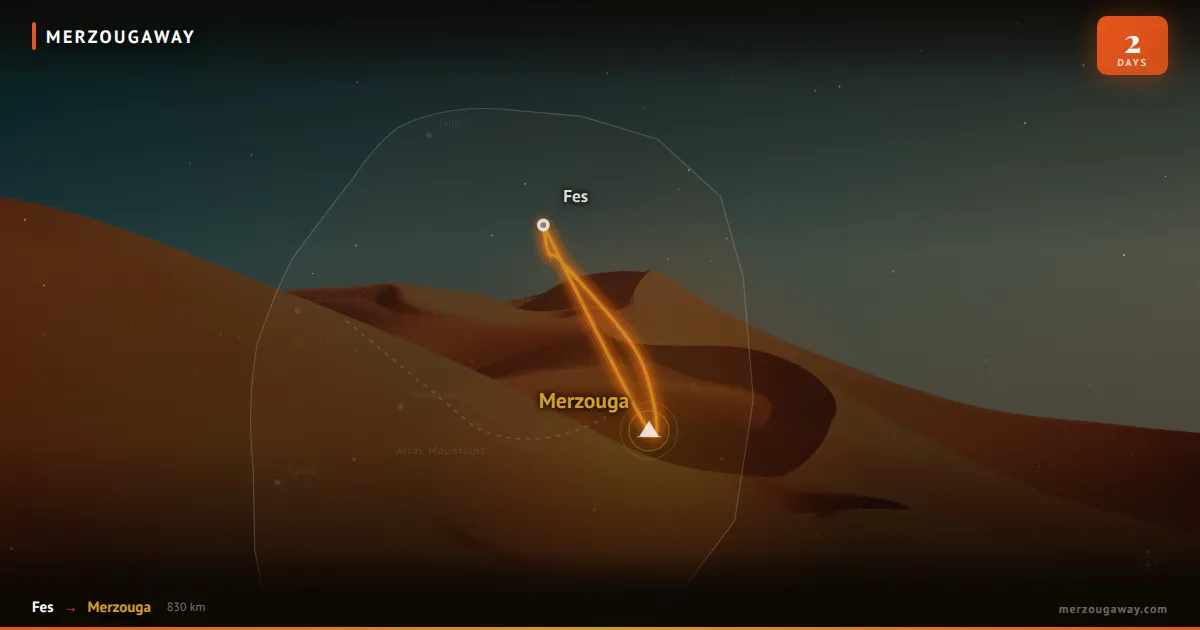
Express 2-Day Fes to Merzouga: Desert Adventure & Camel Trek
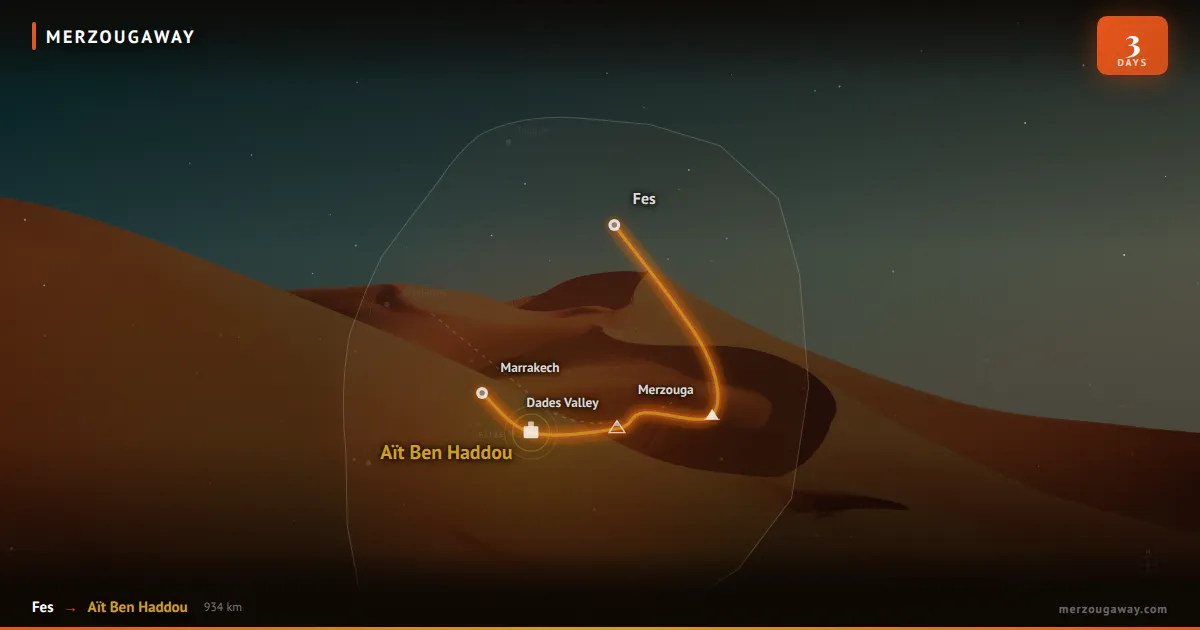
3-Day Fes to Merzouga to Marrakech One-Way Desert Tour