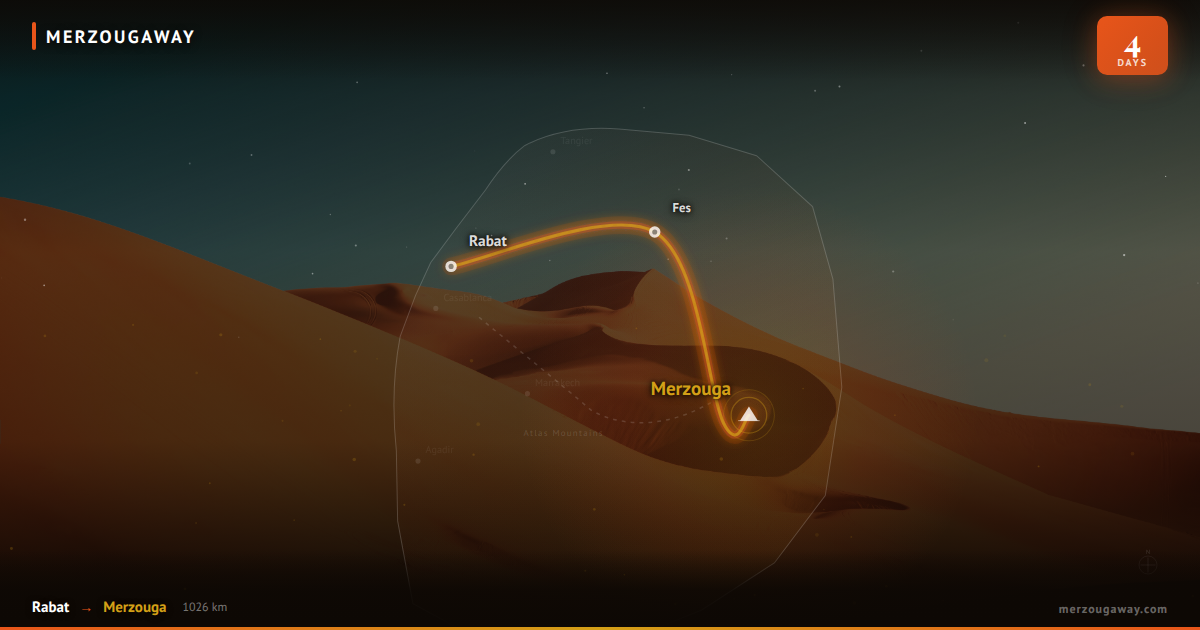
4-Day Rabat to Merzouga Sahara Desert Tour via Fes & Ziz Valley
🌟 Overview
Morocco's capital rarely gets the credit it deserves. While Casablanca draws the business travelers and Marrakech seduces the package tourists, Rabat quietly goes about its business as one of North Africa's most livable and underrated cities — a place where Art Deco French Protectorate architecture meets ancient Almohad monuments, where the Atlantic breeze keeps the summer heat at bay, and where the pace of life feels refreshingly unhurried. Starting your Sahara journey here is not a compromise for travelers who happen to fly into Rabat. It is, in fact, a genuinely richer way to begin.
This four-day tour traces one of the great overland routes of Morocco: south from the Atlantic coast through Fes, the world's oldest continuously inhabited medieval city, then climbing into the cedar-blanketed ridges of the Middle Atlas before the landscape opens dramatically into the pre-Saharan plains of the Tafilalet. By the time you reach Merzouga and the towering amber dunes of Erg Chebbi, you will have crossed four distinct ecological and cultural zones — coastal Atlantic Morocco, imperial Arab-Andalusian Morocco, Berber mountain Morocco, and finally the deep Sahara, where the Amazigh nomadic tradition has endured for millennia. Few itineraries in the country pack this much geographic and cultural diversity into such a focused journey.
The route is designed for efficiency without sacrificing depth. You cover serious ground each day, but there is always time to stop, breathe, and absorb — whether that means watching a craftsman at the Fes tanneries lay out freshly dyed leather to dry in the afternoon sun, spotting a Barbary macaque reaching through a car window on the road through Azrou, or standing at the rim of the Ziz Valley gorge while the canyon turns gold in the late-day light below you. By the final morning, when you climb the dune behind camp to watch the sun rise over the Sahara, you will understand exactly how far you have traveled — not just in kilometers, but in experience.
Tour Highlights
- Depart from Rabat, Morocco's elegant and often-overlooked capital, directly accessible by international airport and high-speed TGV rail from Casablanca, Tangier, and beyond.
- Explore the Fes medina, a UNESCO World Heritage labyrinth of over 9,000 alleyways that has changed little since the 12th century — the most authentically preserved medieval city on earth.
- Drive through the Middle Atlas cedar forests, where ancient trees tower over the road and wild Barbary macaques — the only free-living primates in Africa outside of sub-Saharan Africa — come right up to the roadside.
- Panoramic viewpoints over the Ziz Valley, where the gorge cuts hundreds of meters through limestone plateaus and the valley floor below is a dense carpet of date palms stretching as far as the eye can see.
- Sunset camel trek across the Erg Chebbi dunes, riding single-file into the orange light while the shadows of the dunes lengthen and the temperature drops into perfect evening coolness.
- Sleep under the stars in a luxury desert camp, with private en-suite tents, traditional Berber decor, and a fire circle where musicians play late into the night.
Why Choose This Tour?
Capital City Start — Convenience Without Compromise Rabat's Rabat-Salé Airport receives direct flights from across Europe and the Gulf, and the city sits at the western anchor of Morocco's TGV high-speed rail network, connecting it to Casablanca in 45 minutes and Tangier in under two hours. If you are flying into Morocco rather than transiting through Casablanca, beginning here simply makes sense — and unlike Casablanca, Rabat itself is worth exploring before you leave.
Two Imperial Cities in One Journey Morocco has four imperial cities — Fes, Marrakech, Meknes, and Rabat — and this tour passes through two of them. You experience Rabat's monumental grandeur and seaside calm before driving to Fes, which offers an almost polar contrast: chaotic, sensory, ancient, and utterly unlike anywhere else in the world. Travelers doing this route come away with a far more nuanced picture of Moroccan urban identity than those who see only one imperial city.
A Route That Tells Morocco's Full Story The south-to-north axis of this tour is essentially a cross-section of Moroccan geography and history. You begin on the Atlantic coast with Roman and Almohad ruins, pass through the Arab-Andalusian heart of Fes, climb into the indigenous Amazigh heartland of the Middle Atlas, descend through the pre-Saharan plains, and arrive at the edge of the Sahara Desert itself. Each transition is visible and felt — the air changes, the architecture changes, the language on the street shifts between Arabic, Tamazight, and French.
Flexible Ending to Match Your Onward Journey This is a one-way tour, which means your driver and vehicle are working with your actual travel plans rather than a round-trip that returns you where you started. Whether you need to be back in Rabat, want to continue to Marrakech, or prefer to base yourself in Fes for a few more days, we can tailor the Day 4 return to suit you.
Why Start in Rabat?
Most Morocco desert tours depart from Fes or Marrakech. Rabat departure tours exist, but they are rarely designed to take advantage of what the capital actually offers. This section is for travelers wondering whether it is worth adjusting their itinerary to start here rather than simply taking the train to Fes and beginning there.
Rabat is the political and administrative capital of Morocco, home to the royal palace, the parliament, and the country's diplomatic quarter — a city that functions less as a tourist spectacle and more as a genuine, breathing capital. That is precisely what makes it interesting. The medina is walkable and pressure-free compared to Fes or Marrakech. The Kasbah of the Oudayas sits above the mouth of the Bou Regreg river like a fortified village, its blue-and-white alleyways offering views over the Atlantic that feel more like a Portuguese coastal town than a North African city. The Hassan Tower — the unfinished minaret of what would have been the largest mosque in the medieval Islamic world — stands surrounded by hundreds of broken columns in a vast open plaza, an accidental monument to ambition and impermanence.
For travelers who have been to Morocco before and already know Fes and Marrakech, a Rabat departure adds a genuinely new layer. For first-time visitors, it provides a gentler, more manageable introduction to Moroccan urban life before the sensory intensity of Fes. Either way, it is not a lesser starting point. It is simply a different one — and on this particular route, a deeply appropriate one.
Itinerary
Day 1 — Rabat → Fes
Your guide and driver will collect you from your Rabat hotel, the airport, or the train station at a time that suits your schedule — typically between 8:00 and 9:30am, depending on how much time you want in the capital before departing. If you are arriving the evening before and have a morning free, we can arrange an optional early walk through Rabat's highlights before hitting the road.
Rabat rewards a brief exploration. Begin at the Hassan Tower and Mohammed V Mausoleum, where the 12th-century minaret — left incomplete when the Almohad sultan Yacoub al-Mansour died in 1199 — presides over a field of ancient columns and the beautifully ornate royal mausoleum beside it. The contrast of the rough, unfinished tower and the exquisitely tiled mausoleum says something profound about the sweep of Moroccan history. From there, walk or drive to the Kasbah of the Oudayas, a fortified 12th-century district that perches above the confluence of the Bou Regreg river and the Atlantic Ocean. Wander its narrow blue-and-white lanes, peer through carved doorways into courtyard gardens, and step onto the platform at the northern wall for a sea view that stops most visitors in their tracks. The Andalusian Garden inside the kasbah is one of Rabat's quiet treasures — shaded, fragrant, and almost always uncrowded.
By mid-morning you are on the road south. The drive from Rabat to Fes takes approximately two and a half hours on the A2 motorway, passing through rolling Atlantic farmland before the terrain begins to rise toward the Sais plain. You arrive in Fes in time for a proper afternoon immersion. Your guide will lead you into the Fes el-Bali medina — the older of the city's two historic quarters and a UNESCO World Heritage Site since 1981. There is no adequate way to prepare first-time visitors for this experience: over 9,000 alleyways, no cars, no logical grid, just a continuous dense fabric of commerce, craft, worship, and domestic life that has operated without fundamental interruption since the 9th century.
You will visit Al-Qarawiyyin University, founded in 859 AD and recognized by UNESCO as the oldest continuously operating university in the world. Stand at the entrance to the great mosque and look into the courtyard — non-Muslims cannot enter, but the architecture visible from the threshold is extraordinary. Continue to the Bou Inania Madrasa, a 14th-century theological school with some of the finest zellij tilework and carved cedarwood in all of Morocco. Then navigate up through the leather workers' quarter to a terrace overlooking the Chouara Tanneries — one of the most photographed sights in Morocco, and rightly so. The circular stone vats below, filled with white chalk and colored dyes, have been used to treat and color leather hides since the 11th century. The smell is powerful; the view is unforgettable. Dinner and overnight in a traditional riad in the medina.
Day 2 — Fes → Middle Atlas → Errachidia
Breakfast at your riad early — you have a long and spectacular day ahead. You depart Fes heading south on the N8, and within forty minutes the city's urban density gives way entirely to open mountain landscape as you climb into the Middle Atlas. This is Amazigh (Berber) heartland, and the transition is immediate and striking: the signage shifts to Tifinagh script, the architecture changes from Arab-urban to Berber-mountain, and the air noticeably freshens.
Your first stop is Ifrane, a town built almost entirely during the French Protectorate period in a deliberately Alpine style — chalets, pitched roofs, clean streets, and a stone lion sculpture that has become the town's unofficial mascot. At over 1,600 meters altitude, Ifrane is genuinely cool even in summer, and in winter it receives enough snow that Moroccan skiing holidays are possible in the nearby Michlifen resort. It is an incongruous sight in North Africa, and that is exactly why it is worth a short stop — Morocco contains multitudes, and Ifrane is one of its more surprising chapters.
Continuing south through the cedar forest, you reach the area around Azrou, where the trees grow enormous and ancient and the roadside is reliably populated by Barbary macaques. These are the only wild primates on the African continent outside sub-Saharan Africa, and they are thrillingly unbothered by visitors. They will approach vehicles, accept food offered through windows, and pose with an unselfconscious dignity that makes every encounter feel special. Your guide will advise on responsible interaction — these are wild animals, and feeding them thoughtfully (or not at all) keeps the population healthy.
The road climbs to over 2,000 meters before beginning its long descent toward the pre-Saharan south. You pass through Midelt, a small market town famous for its mineral traders and apple orchards, sitting in the shadow of the Jbel Ayachi massif — a mountain that holds snow well into spring. A lunch stop here offers a chance to try roadside harira soup and browse the stalls of semi-precious stones that the region's geology throws up in abundance.
In the afternoon, the landscape transforms completely. The mountains fall away, the color palette shifts from green to ochre and rust, and the road descends toward one of Morocco's most dramatic viewpoints: the Ziz Valley gorge. Stop at the belvedere above the Tunnel du Legionnaire and look south — the canyon carved by the Ziz river drops away below in great limestone walls, and beyond it the valley opens into a vast corridor of date palms, one of Morocco's most important palmeries. This is the beginning of the Sahara's reach, and the view makes that perfectly clear. You arrive in the Errachidia area for dinner and overnight.
Day 3 — Errachidia → Erfoud → Merzouga Desert
Depart after breakfast on what is arguably the most cinematic driving day of the tour. The road south from Errachidia follows the Ziz Valley directly, and it is one of the great Moroccan drives: the highway threads through the palmery floor with date palms crowding both sides of the road, traditional ksar (fortified village) walls rising in earthen red, and the occasional glimpse of nomadic encampments on the plain above. The Tafilalet region you are entering was historically one of the most important oasis territories in the Saharan trade routes, and the density of historic kasbahs and ksour in this stretch reflects centuries of settled prosperity at the edge of the desert.
In Erfoud, stop for an hour at one of the town's famous fossil workshops. The limestone strata beneath this part of Morocco are extraordinarily rich in marine fossils — ammonites, orthoceras, trilobites — dating from the Devonian and Carboniferous periods some 300-350 million years ago, when this region lay beneath a shallow tropical sea. Local craftsmen cut and polish the stone, and watching the transformation from rough rock to gleaming tabletop inlaid with perfect fossil spirals is genuinely fascinating. The quality ranges from tourist trinkets to museum-grade pieces, and your guide can help you identify the real from the replica.
From Erfoud, the road to Merzouga runs straight and increasingly dramatic across flat open erg, and then — quite suddenly — the dunes appear on the horizon. Erg Chebbi rises without warning from the flat stony plain: a range of Saharan sand dunes that reach up to 150 meters in height, stretching approximately 22 kilometers from north to south and 5 kilometers wide. The color shifts through the day from pale gold in morning light to deep amber and orange as the afternoon wears on. You arrive in the early-to-mid afternoon, giving you time to settle into your accommodation, take tea, and rest before the day's main event.
At around 4:30 to 5:00pm, your camel trek begins. Your guide will introduce you to your camel — these are working dromedaries, well-treated and accustomed to the route — and the convoy of riders sets off single-file into the dunes. The pace is gentle and swaying, the kind of movement that quickly becomes hypnotic. As you climb deeper into the erg, the sounds of the village fall away entirely and you are left with wind, sand, and the soft pad of camel feet. The dunes grow taller around you. At the summit of a high dune your guide will call a pause to watch the sun sink — the light at this moment is extraordinary, the kind of orange-pink that photographs cannot quite capture because the warmth of it is also physical, felt on your face in the cooling air.
Your desert camp sits in a hollow between dunes, invisible from the road. Private tents are furnished with proper beds, textiles, and en-suite bathroom facilities. Dinner is prepared over fire and served communally, with traditional Moroccan dishes — slow-cooked tagine, harira, fresh bread baked in the sand. After dinner, Berber musicians perform around the fire, playing the bendir frame drum and guembri bass lute in the hypnotic Gnawa rhythmic tradition. Later, away from the firelight, the Merzouga sky reveals itself: at this distance from any city, the Milky Way is not a faint smudge but a structure, a dense river of light overhead. Your guide can point out constellations and, if conditions permit, satellites and shooting stars are common. Sleep comes easily here.
Day 4 — Merzouga → Return
This is the morning that justifies everything that came before it.
Wake before dawn — your guide will ensure you are up in time — and walk or ride back up to the dune crest in the pre-dawn dark. The sky is already turning: deep indigo first, then a thin line of pale gold on the horizon to the east. As the sun clears the Algerian plateau, the light hits the dunes in a wave of color that moves visibly across the sand — shadow retreating, warmth advancing, the entire landscape reconfigured in minutes. Most guests spend forty-five minutes to an hour on the dune summit at sunrise. There is very little to say during this time. It speaks for itself.
Return to camp for breakfast with Berber pancakes (msemen or harsha), amlou (a rich almond and argan oil paste), honey, and several glasses of fresh mint tea. This is an unhurried meal — there is no rush to leave camp early, and the desert morning light is worth lingering in with a second cup of tea before you say goodbye to the dunes.
Once you're ready, the drive back retraces the Ziz Valley to Errachidia before continuing toward your chosen endpoint. As a one-way tour, this final leg is built around your onward plans — most guests are dropped in Fes for a train or flight connection, though we can route the return toward Marrakech, or back to Rabat itself, depending on what you arranged at booking. Whichever direction you're heading, the drive gives you one last look at the palmeries and ksour of the Tafilalet before the landscape shifts back toward the cities of the north.
Included & Not Included
- • Private air-conditioned 4x4 or minivan
- • Professional English-speaking driver/guide
- • 3 nights accommodation (Fes, Midelt or Errachidia, luxury desert camp)
- • Daily breakfast; dinners included at desert and kasbah accommodations only
- • Sunset camel trek in Erg Chebbi dunes
- • Pick-up at your Rabat accommodation; drop-off at your chosen endpoint (Fes, Marrakech, or back in Rabat, as arranged at booking)
- • Sandboarding (optional)
- • Traditional Berber cheche (turban/scarf) — yours to keep
- • Polished fossil souvenir from Erfoud
- • Lunches and drinks
- • Entrance fees to monuments and attractions
- • Tips for guides and drivers
Duration
4 Days, 3 Nights
Group Type
Private
Transportation
4×4 or Minibus
Payment Methods
PayPal
Bank Transfer (IBAN)
Only 10% deposit required
Email:
[email protected]What Our Travelers Say
Real reviews from Google and TripAdvisor
We traveled to Morocco in a group of 6 adults, including my parents, who are already seniors, in the middle of summer. For my family it was a leap of faith to trust an agency we found online for the first time, but it turned out to be a wonderful surprise. Hamid, the trip organizer, was very kind and attentive both before and throughout the whole tour. It was a fully personalized tour - we got to do everything we wanted, from visiting the Sahara to enjoying the beach. He always looked out for our comfort, especially my parents': comfortable transport, well-timed stops at places with restrooms, beautiful air-conditioned hotels, and varied, plentiful food. Thanks to his organization we were able to enjoy the trip with real peace of mind. It was a great experience we would absolutely recommend.
Last week I did a self-drive trip from Fes to Merzouga, leaving the car rental, the riad in Merzouga, the desert camp, and the guided desert activities all in the hands of MerzougaWay and Hamid, and I can only say that everything was perfectly organized, right on time. Thanks to everyone at the riad we stayed at and the desert camp, as well as the guides who joined us for the 4x4 experience, Berber culture, and the camel transfer. Thanks to Hamid and MerzougaWay for that quad-bike ride back to the riad from the camp - what an experience, riding a quad across the dunes early in the morning. If you're thinking of traveling to Merzouga, I definitely recommend Hamid as the organizer of your adventure.
Excellent!! We loved the tour. Thank you Hamid for everything. Everything well organized, the guide Eljo (Elhousain) was very attentive, highly recommend. Everything super clean, we had a great driver, we felt very safe with him. Unbeatable desert excursion. Thanks MerzougaWay!
Trustworthy tour agency. I wrote Hamid what I wanted and he just made it happen. He arranged everything so quick and smooth. We had a 3-day Merzouga tour from Marrakech. Said was our guide and he made me and my wife very comfortable. He took us from our riad and carried us in his modern 4x4 Toyota to magnificent places. He gave us the confidence to ask him whatever we wanted to do and wherever we wanted to drive - like old friends. He is open-minded and respectful. I recommend asking the agency for Said to be your driver. In the 3-day tour you cross the Atlas mountains, stay one night in a perfect hotel in Dades with great food, then stay one night in Erg Chebbi dunes in a luxury glamp camp. One night wasn't enough for a real desert experience - if you have time, take two nights in the desert.
Unforgettable holiday. An 8-day itinerant tour in Morocco, including 3 days organized by Hamid - MerzougaWay: a route from Fes to Marrakech, spending a night in the desert and in Ouarzazate. Our guide Youssef, who drove us all along the way, was very professional and took us to try real experiences that not all tourists get to see. Breathtaking landscapes - Morocco amazed and fascinated us. We drove many miles but still traveled comfortably. Absolutely recommend it - they are a highly professional agency and managed to take us to unique places, like a Berber village in the desert where we were the only tourists. A spectacular, unforgettable experience.
Morocco from the heart with MerzougaWay. Heartfelt congratulations to Hamid, who organized our trip impeccably - present, correct, and extremely helpful. A special mention for our driver Ali, who was by our side through 3 intense days toward the desert: attentive, polite, discreet, and a genuinely good, nice driver. We found snow in the Atlas range and then sun in Ait Ben Haddou, visited women's cooperatives working argan oil and roses, saw the Dades Gorges, and finally reached the Sahara dunes by camel before sleeping in a tented desert camp. 3 intense and exciting days. Next time in Morocco I'll rely on you again, inshallah!
Read more reviews on
Ready to Start Your Adventure?
Contact us today and let's plan your perfect Moroccan desert experience

MerzougaWay Team
We are a passionate team of local guides dedicated to sharing the beauty and culture of our home, Morocco. Our journey began with a simple desire to offer authentic, memorable experiences that go beyond the typical tourist trails.
Complete Your Morocco Trip
Two more services from our team, based in Marrakech.
You Might Also Like
Discover more amazing tours in Morocco
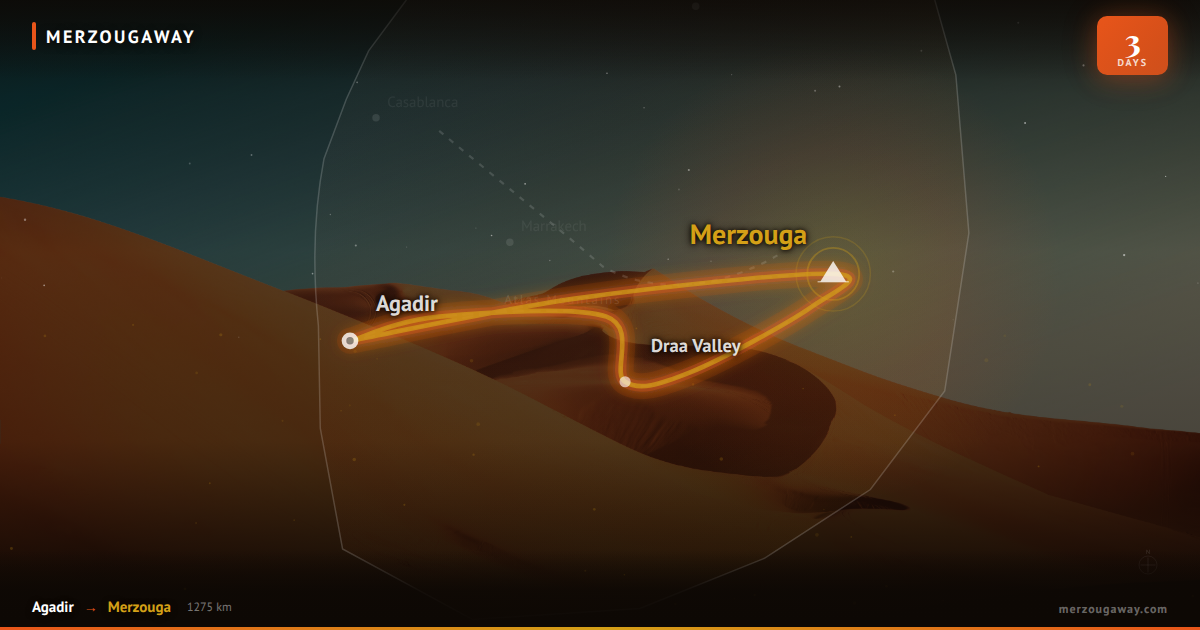
Classic 3-Day Agadir to Merzouga: Anti-Atlas & Sahara Desert Adventure
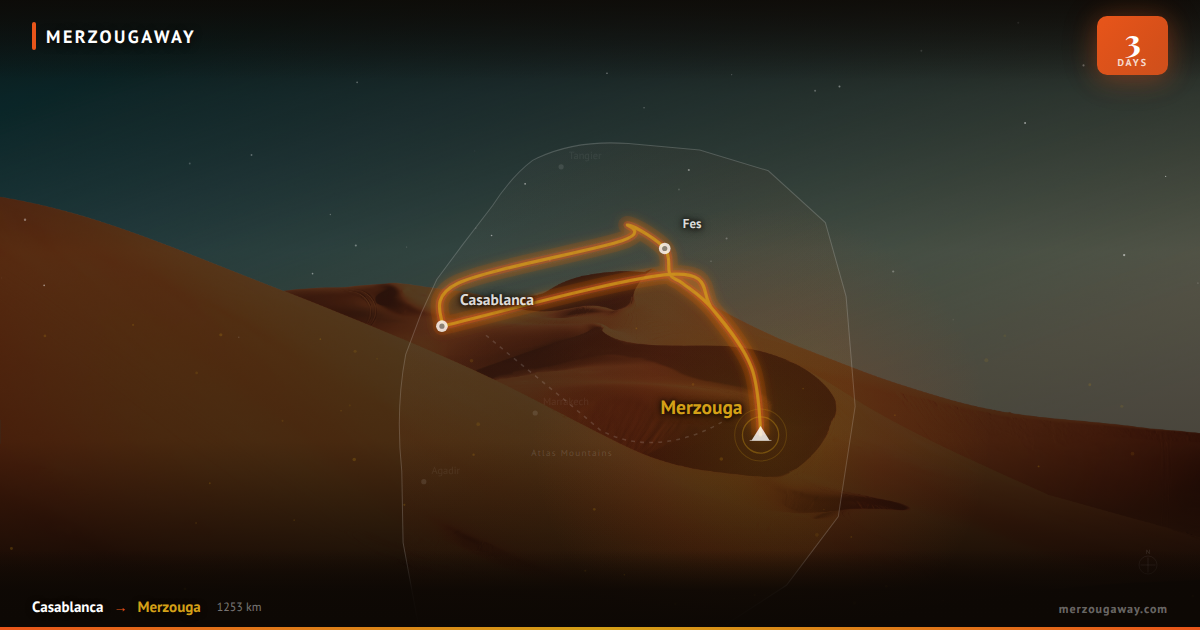
Classic 3-Day Casablanca to Merzouga: Imperial Cities & Sahara Desert
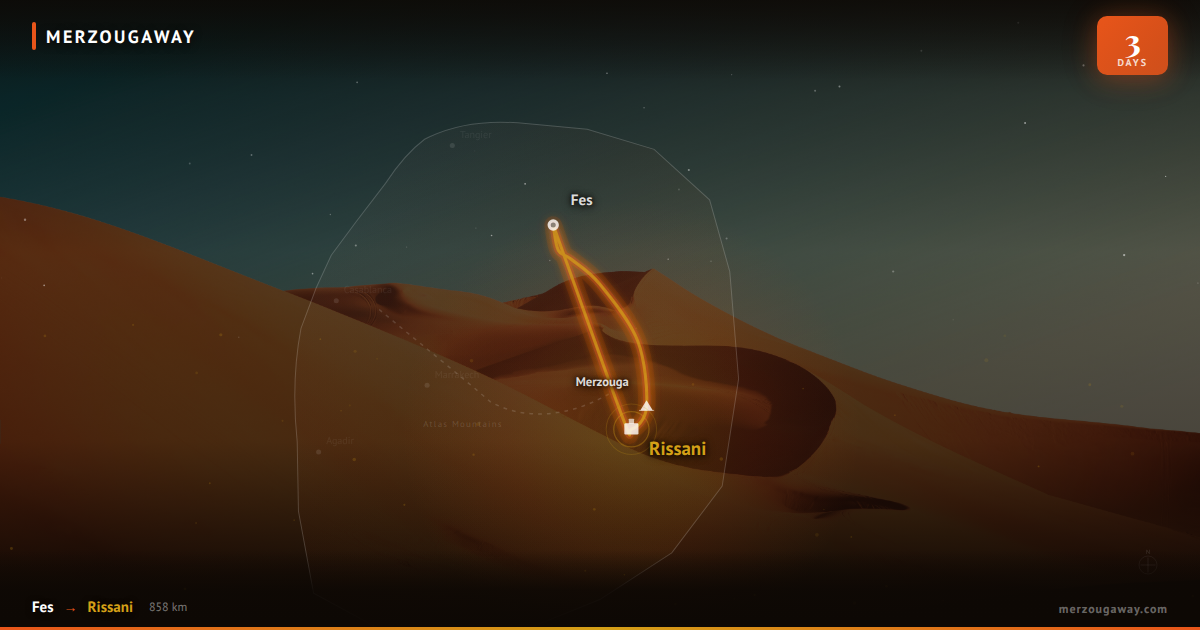
Classic 3-Day Fes to Merzouga: Camel Trek + Erg Chebbi Sunrise
More Activities You'll Love
Explore more things to do in Morocco
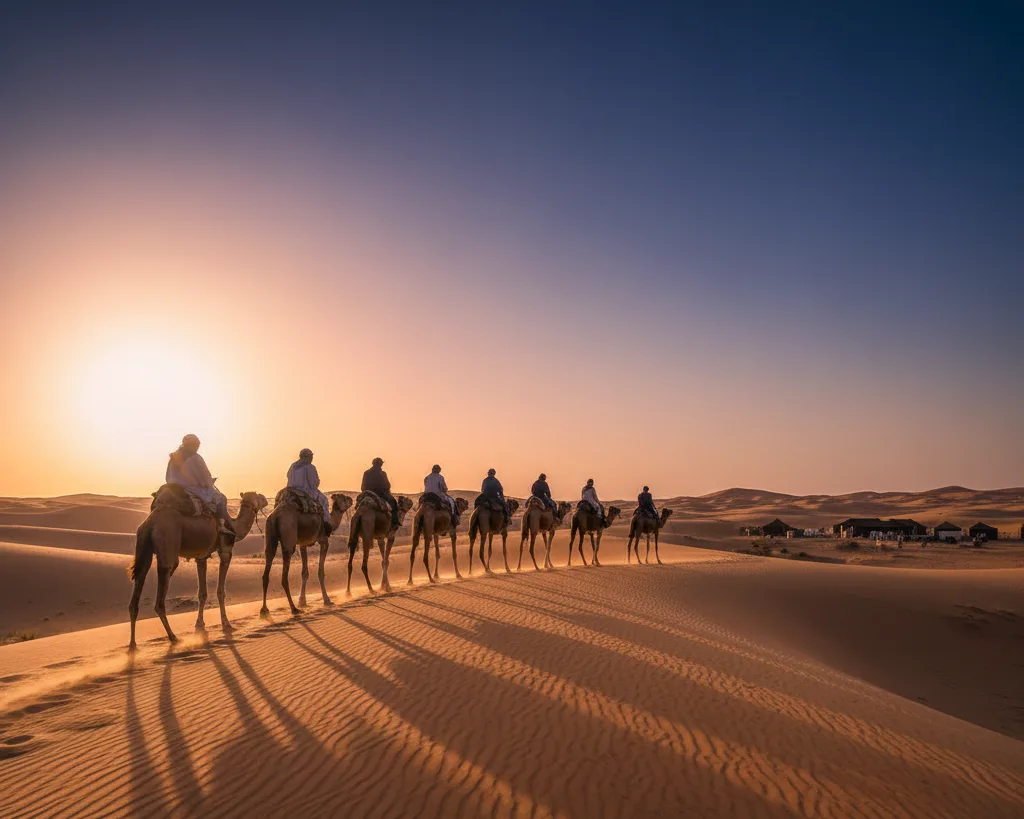
Camel Ride in the Sahara Desert
Experience the timeless magic of the Sahara on camelback. Watch the sun set over Erg Chebbi's golden dunes on a guided camel trek.
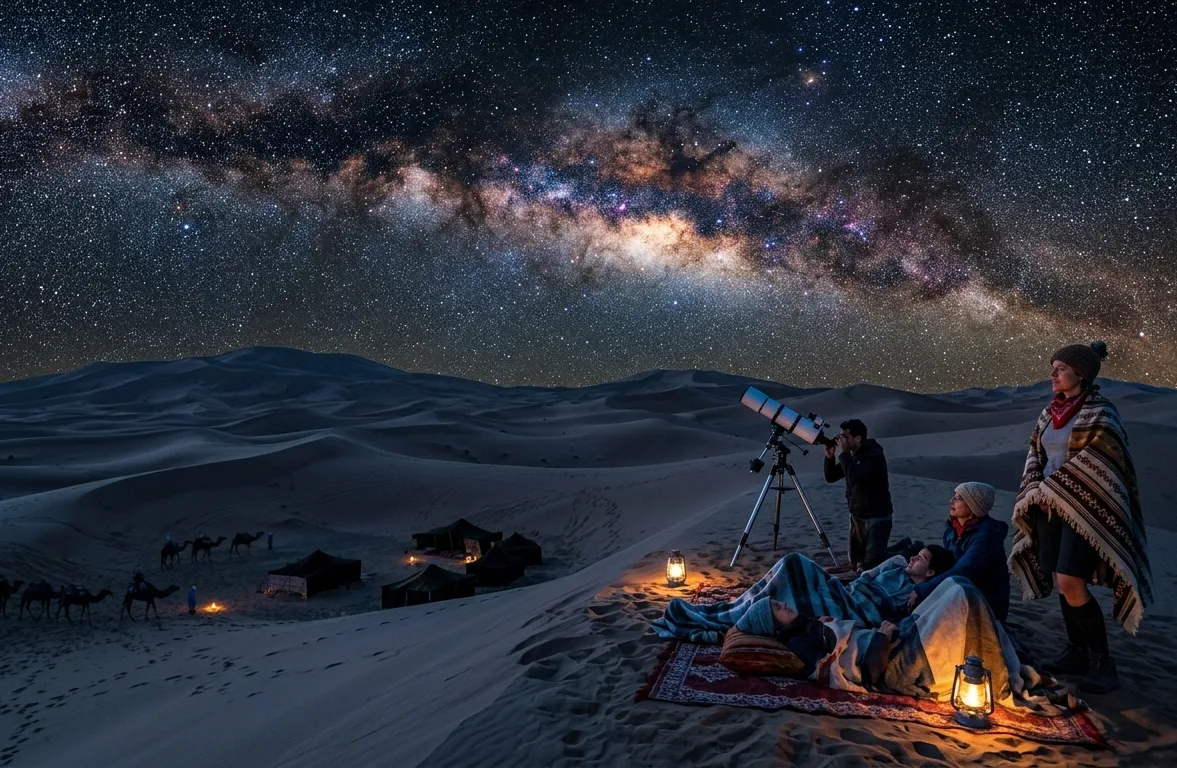
Sahara Stargazing Experience
The Sahara has zero light pollution and one of the clearest skies on Earth. A guided stargazing night in Merzouga is an astronomical experience you won't forget.
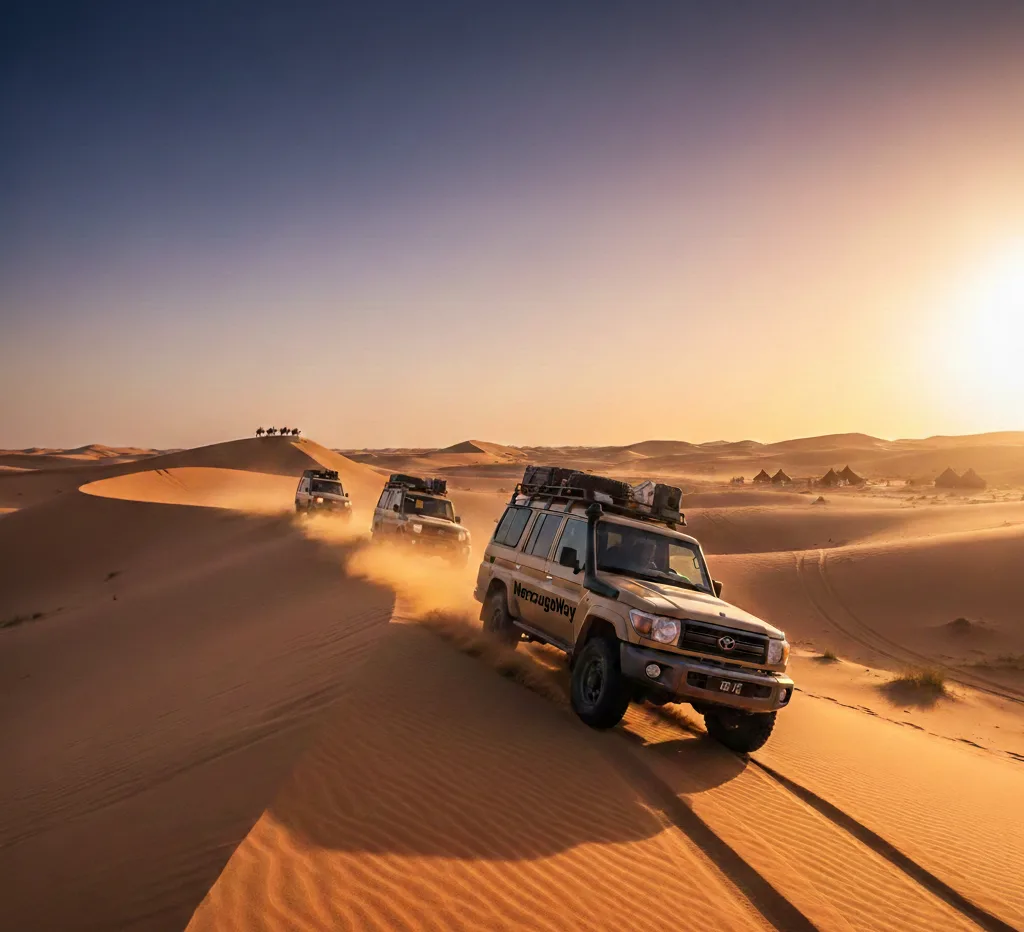
4x4 Dunes Tour in Erg Chebbi
Conquer the Erg Chebbi dunes in a powerful 4x4. An off-road adventure that takes you deep into the Sahara's most dramatic landscapes.