Best Tour from Marrakech to Merzouga: Ultimate Selection Guide 2026
How to actually choose the right Marrakech-to-Merzouga tour for you — the real tradeoffs between comfort tiers, what to check before booking, and honest red flags to watch for.
"Best" tour from Marrakech to Merzouga isn't a single answer — it depends on what you're actually optimizing for: comfort, price, pacing, or a specific interest like photography or camel trekking. This guide walks through how to think about that choice, using the tiers and tradeoffs that actually matter, rather than pointing you at ranked operator lists that go stale the moment they're published.
[!NOTE] Fast-Facts & Direct Answer Summary
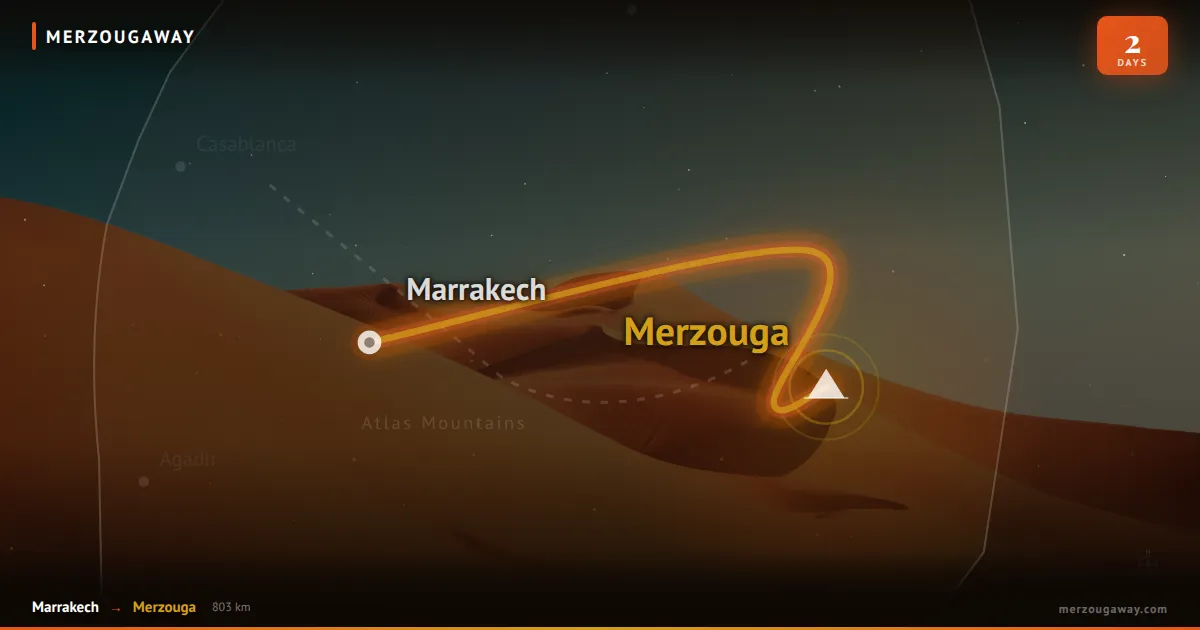
A desert journey from Marrakech to Merzouga spans ~560 km across the High Atlas Mountains (Tizi n'Tichka pass, 2,260m). The drive takes 9–10 hours, making a 3-Day or 4-Day tour the minimum recommended duration for safety and comfort.
- Recommended Duration: 3 Days (Classic) or 4 Days (Relaxed & In-Depth)
- Primary Road Routes: N9 across the Atlas ➔ N10 through Dadès Valley ➔ N13 to Erg Chebbi
- Realistic Pricing: 1,800–4,500 MAD (€180–€420) per person for private tours with luxury desert camp
- Key Highlights: Aït Benhaddou UNESCO ksar, Todra Gorge canyons, sunset camel trek, and Erg Chebbi dunes
- Local Expert Tip: Avoid 2-day Merzouga tours (18–20 hours driving in 48h). Opt for Agafay Desert if you only have 1–2 days.
What actually separates the tiers
At the top end, a premium private tour means a private 4x4, an upgraded desert camp with en-suite bathrooms and private tents, gourmet meals, and full flexibility on timing — this tier runs somewhere in the €400-600 per person range for a 3-5 day trip, and suits honeymooners, photographers who need flexible golden-hour timing, and anyone marking a special occasion. The middle tier — where most travelers land — trades some of that polish for a considerably lower price (roughly €200-300 per person for 2-4 days): a comfortable private vehicle, a solid 3-4 star camp, and knowledgeable guides, without the extras that push the luxury tier's price up. At the budget end (around €100-170 per person for 2-3 days), you're looking at a private tour with basic but clean facilities and a simpler camp — still private, still guided, just without the upgrades.
None of these tiers involve joining strangers on a shared departure — MerzougaWay runs every tour privately, so the price differences above come from comfort level and duration, not group size.
If you have a specific interest
Camel trekking enthusiasts who want more time in the dunes than the standard sunset-to-sunrise ride can ask about extending that portion of the itinerary rather than looking for a dedicated "camel trekking tour" brand — it's a request most operators, including us, can accommodate within a standard private booking. The same goes for photography: rather than searching for a named "photography tour" operator, ask directly whether your guide can build in flexible timing around golden hour and sunrise/sunset — a good private guide can do this without needing a specialized product built around it. Couples looking for a romantic framing (a private dinner setup, an extra-quiet camp) should ask for that specifically when booking rather than assuming it's a separate luxury sub-brand.
How to actually evaluate any tour before booking
Start with your budget and let that narrow the tier, then think about what matters most to you specifically — comfort, authenticity, pacing, or price — since "best" really does depend on that ranking. Read recent reviews (the last few months matter more than reviews from a year ago, since guides and operations change), and look for detail rather than star ratings alone: a review that mentions a specific guide's name, what the camp bathroom was actually like, or how long the driving days felt tells you more than a high rating with no context attached. Confirm exactly what's included in writing before paying anything, ask about the cancellation policy, and if you're booking with an operator you haven't used before, a quick direct message asking a specific question is a reasonable way to gauge how responsive and professional they actually are.
A rough day-by-day for the standard 3-day version
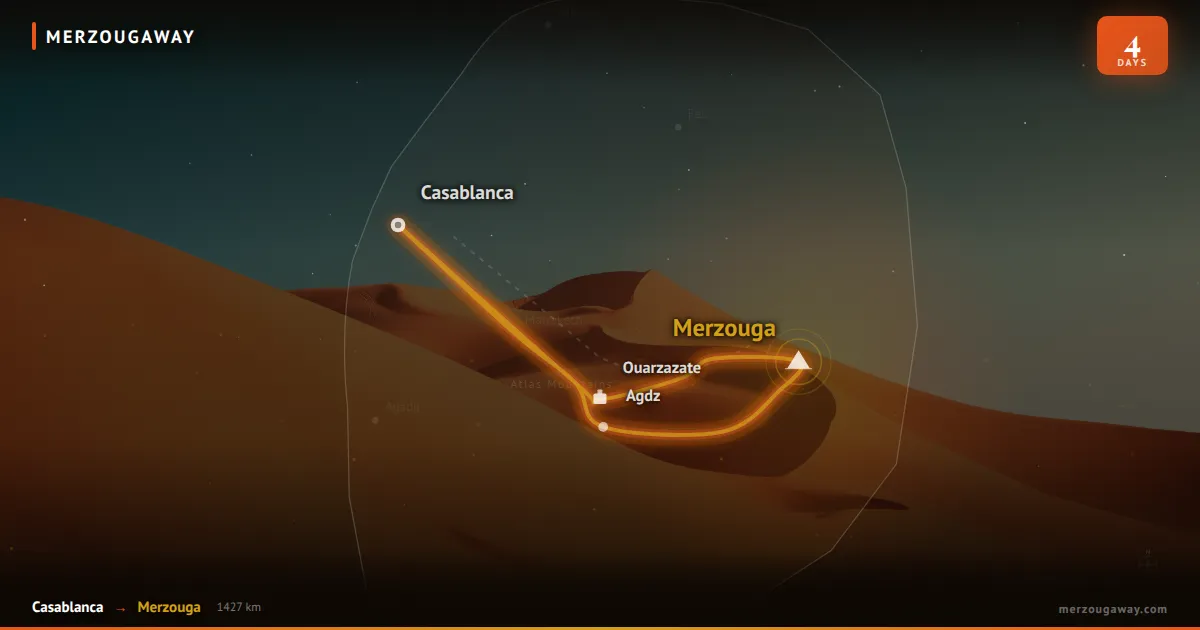
Day one crosses the High Atlas via Ait Ben Haddou and Ouarzazate to an overnight in the Dades Valley. Day two continues through Todgha Gorge to Merzouga, arriving in time for a sunset camel trek to camp and dinner under the stars. Day three is an optional sunrise walk, breakfast, and the return drive to Marrakech. Extending to 4-5 days typically adds a second full day around Merzouga (more time in the dunes, an extra activity like sandboarding or quad biking) or a stop in Fes or Essaouira on the way.
Red flags worth taking seriously
A price dramatically below the market range, no online presence or reviews at all, pressure to pay the full amount in cash upfront before any written confirmation, a vague itinerary that won't specify accommodation, or a driver without visible identification are all real reasons to look elsewhere — these are grounded, practical checks, not a sign that every budget option is risky.
Master Comparison Matrix: Evaluating Every Marrakech-to-Merzouga Tour Format
With hundreds of agencies, web aggregators, and street kiosks in Marrakech marketing tours to the Sahara Desert, distinguishing between an uncomfortable commercial endurance test and an extraordinary, authentic desert journey is essential. The route across the High Atlas mountains to Erg Chebbi covers 560 kilometers each way, and the format you select fundamentally dictates your travel comfort, flexibility, and cultural depth.
The following master evaluation matrix compares every primary tour structure available on the market:
| Tour Format & Structure | Average Price per Person (MAD / EUR) | Vehicle Specification & Spacing | Itinerary Flexibility & Pace | Desert Camp Quality Included | What You Sacrifice / Gain | | :--- | :--- | :--- | :--- | :--- | :--- | | Private Chauffeur 4x4 (3 or 4 Days) — MerzougaWay Standard | 2,500 – 4,800 MAD (€230 – €450) per person (based on 2-4 travelers) | Modern climate-controlled Toyota Land Cruiser Prado; luxury leather seats | 100% Total Control: Stop anywhere, adjust schedule, unhurried pacing | Luxury Glamping Camp with private en-suite bathroom & heating | The Gold Standard: Stress-free luxury, authentic local guidance, zero commercial stops | | Shared Small-Group Minibus (3 Days / 2 Nights) | 1,200 – 1,600 MAD (€110 – €150) per person | 14 to 17-passenger Mercedes Sprinter van; cramped legroom | Rigid commercial schedule; hurried 40-min stops at major sites | Basic rustic camp with shared outdoor toilets & cold bucket showers | Budget Saver: Cheap upfront cost, but hidden restaurant traps and cramped seating | | Self-Drive Rental Car (4 to 5 Days) | 3,000 – 4,500 MAD (~€280 – €420) total vehicle + fuel/tolls | Compact SUV or Dacia Duster hatchback | Full autonomy on paved roads; cannot drive into deep dunes | Traveler must research and book camps independently | Independence: Complete freedom, but driver endures 20+ hrs of intense mountain driving | | Public Transit (Supratours Bus + Local Taxi) | ~600 MAD (~€55 EUR) round-trip transit only | Full-sized 50-passenger commercial coach | Fixed point-to-point transit; zero sightseeing stops en route | Must book desert camp separately in Merzouga village | Pure Transit: Cheap, but completely skips Ait Benhaddou, Dades, and Todra Gorges |
The Critical Route Choice: 3-Day Round Trip vs 3-Day Open-Jaw vs 4-Day Deep Circuit
When selecting your tour structure, matching duration to your overall Moroccan itinerary is critical:
- The 3-Day / 2-Night Southern Round Trip (Marrakech to Marrakech): The classic, most popular choice. It divides the journey into three balanced chapters: Day 1 crosses the High Atlas to overnight in Dades or Tinghir; Day 2 visits Todra Gorge and reaches Erg Chebbi for sunset camel trekking and desert glamping; Day 3 returns to Marrakech via the N10 or N12. It delivers the complete Sahara experience in a concise timeframe.
- The 3-Day Open-Jaw Crossing (Marrakech to Fes via Merzouga): The most intelligent itinerary design for multi-city travel. You begin in Marrakech, cross the Atlas to Erg Chebbi, and instead of backtracking 10 hours along the same highway, you head north through the spectacular Ziz River Valley, Midelt apple orchards, and Azrou cedar forests to finish in Fes. This completely eliminates 10 hours of wasted driving while connecting Morocco's two premier imperial capitals seamlessly.
- The 4-Day Deep Immersion Circuit: The premier choice for families, photographers, and culture enthusiasts. By spending two consecutive nights in the Merzouga dunes, you avoid the exhausting single-night rush. Day 3 becomes an unforgettable full-day desert exploration: taking an off-road 4x4 perimeter safari around Erg Chebbi, listening to spiritual Gnawa music in Khamlia, visiting nomad families in the hammada, and climbing the massive 150-meter crest of Lalla Merzouga.
Key Waypoints Along Highways N9 and N10
A world-class desert tour is defined as much by the intermediate journey as the dunes themselves:
- Tizi n'Tichka Pass (2,260m / 7,415 ft): The highest major paved mountain pass in North Africa. Modernized with smooth dual lanes and reinforced crash barriers, the N9 highway provides breathtaking alpine vistas sweeping across terraced walnut orchards and jagged High Atlas peaks.
- Ksar Ait Benhaddou (UNESCO World Heritage Site): An extraordinary 11th-century earthen citadel built along the ancient salt caravan corridor. Walking through its winding red clay alleys and climbing to the fortified communal granary (Agadir) at the summit offers unmatched photography.
- The Valley of the Roses & Dades Gorge: Traveling along the N10 "Route of a Thousand Kasbahs," admire millions of wild Damask roses in Kelaat M'Gouna before ascending into the dramatic red rock switchbacks and "Monkey Fingers" conglomerate formations of Dades Gorge.
- Todra Gorge (Tinghir): A monumental 300-meter vertical limestone canyon slot where the cliff walls narrow to just 10 meters apart, with a pristine mountain river running through the base.
What Distinguishes MerzougaWay from Commercial Street Agencies
- Indigenous Amazigh Ownership: MerzougaWay is owned, operated, and staffed by native Berber families whose ancestral roots belong directly to Merzouga and Erg Chebbi. Our drivers and guides are local desert natives who share genuine cultural heritage with pride.
- Direct Camp Ownership: Unlike middleman agencies in Marrakech that resell seats on outsourced third-party tours, we own and manage our private luxury camps directly, ensuring uncompromising quality control over hygiene, gourmet cuisine, and heated tent amenities.
- Zero Captive Shopping Traps: We enforce an absolute ban on forced commercial stops. You will never be dumped at aggressive spice pharmacies or overpriced tourist cafeterias where drivers collect commissions. You eat where real Moroccans eat, paying local prices for exceptional food.
Essential Road Trip Refreshment and Hygiene Checklist
During the 10-hour traverse across the High Atlas and Southern oasis valleys, maintaining personal comfort makes the difference between fatigue and pleasure:
- Hydration Strategy: Drink small, frequent sips of mineral water (aim for 2.5 to 3 liters daily) rather than chugging large amounts at once. Pre-Saharan air has less than 15% ambient relative humidity, which causes rapid, invisible dehydration.
- Sanitary Essentials: While major highway service plazas (Afriquia, Total, Shell) feature modern, clean restrooms, smaller rural roadside cafes may offer traditional squat toilets without toilet paper. Always carry a small daypack stocked with a packet of tissues, biodegradable wet wipes, a travel-sized bottle of hand sanitizer, and 2, 5, and 10 MAD coins for restroom attendants.
- Motion Sickness Management: The northern approach to Tizi n'Tichka features over 60 kilometers of continuous switchbacks. If you are susceptible to motion sickness, take dimenhydrinate 30 minutes before leaving Marrakech, sit in the front passenger seat, focus your gaze on the distant horizon, and avoid reading or looking at phone screens while climbing the mountain passes.
Cultural Sensitivity: Dress Codes and Photographing Rural Communities
Traveling through the High Atlas and rural desert regions requires respectful cultural mindfulness:
- Modest Dress in Oasis Communities: While Marrakech is cosmopolitan, conservative Islamic dress standards prevail in rural oasis villages like Skoura, Boumalne Dades, and Tinghir. Both men and women should wear clothing covering shoulders and knees (loose linen trousers, lightweight cotton shirts, and maxi skirts are ideal).
- Respecting Local Privacy: Always seek courteous verbal permission ("Mumkin soura?") before photographing local villagers, artisans, or elders. Many rural women prefer not to be photographed for religious and modesty reasons; graciously honor their privacy. When visiting lively weekly souks, photographing broad market scenes and produce displays is generally welcomed, but avoid shoving cameras into vendors' faces.
Ethical Animal Interaction and Responsible Camel Trekking
A premier desert tour prioritizes the highest standards of animal welfare throughout the expedition:
- Dromedary Care Standards: MerzougaWay partners exclusively with local Amazigh families who treat their working camels with gentle respect and compassion. Our dromedaries are well-fed, hydrated daily from deep oasis wells, receive regular veterinary care, and work only in comfortable morning and evening hours with generous seasonal rest rotations.
- Riding Weight Guidelines: For rider safety and animal comfort, camel saddles are fitted with thick woolen pads that distribute weight evenly across the rib cage without pressing on the sensitive spine. Camels carry only one adult rider, and our guides walk alongside on foot, maintaining a calm, unhurried pace across the dunes.
Frequently Asked Questions (FAQ)
Why should I book directly with a local Berber tour operator in Merzouga?
Booking directly with MerzougaWay guarantees your money supports local desert communities and nomadic staff directly without international middlemen fees. You also receive direct communication, customized departure times, and guaranteed luxury camp allocations.
How does the route from Marrakech to Merzouga break down day by day?
Day 1: Marrakech over Tizi n'Tichka pass to Ait Benhaddou, Ouarzazate, and Dades Valley. Day 2: Dades Gorge, Tinghir palm oasis, Todra Gorge, Erfoud, arriving in Merzouga for sunset camel ride. Day 3: Sunrise over Erg Chebbi dunes, return trip via Draa Valley or one-way transfer to Fez.
Is Wi-Fi available during the tour and at the desert camp?
Hotels in Dades and Ouarzazate offer solid Wi-Fi. Merzouga luxury desert camps provide satellite or 4G Wi-Fi in dining lounges and tents, though cellular data (Maroc Telecom) works reliably throughout most of Erg Chebbi.
What should I wear during the camel ride?
Wear long, loose pants (linen, cotton, or denim) to prevent skin chafing against camel saddles, closed-toe sneakers or hiking shoes, sunglasses, and a traditional Berber cotton turban (tagelmust) to protect against sun and windblown sand.
Booking directly vs. a marketplace
Booking directly with an operator (us included) tends to be better value since there's no third-party commission built into the price, provided you do your own verification first — reviews, clear written confirmation, and a responsive answer to a specific question. Marketplaces like Viator or GetYourGuide add a layer of review visibility and payment protection at a modest markup, which is a reasonable tradeoff if you'd rather have that safety net, especially for a first-time booking with an operator you don't know.
Ready to plan your Marrakech-to-Merzouga trip? Contact us and we'll help you figure out the right tier and pace for what you're after.
Last updated: August 2026.
Sahara Route & Drive-Time Estimator
Calculate realistic driving hours across the High Atlas (Tizi n'Tichka pass), compare scenic stops (Dadès, Todra, Ziz), and plan your custom desert itinerary.
MerzougaWay Team
We are a passionate team of local guides dedicated to sharing the beauty and culture of our home, Morocco. Our journey began with a simple desire to offer authentic, memorable experiences that go beyond the typical tourist trails.