Casablanca to Merzouga to Marrakech: The Ultimate Morocco Desert Triangle Itinerary (2026)
The complete Casablanca to Merzouga to Marrakech desert triangle route guide. Master 7-day and 10-day itineraries crossing the Sahara, Hassan II Mosque, Fes, Todra, and Marrakech.
The Casablanca to Merzouga to Marrakech Triangle represents the definitive grand circuit of Morocco. Combining Morocco's main international Atlantic gateway (Casablanca), the imperial heritage of Rabat and Fes, the towering golden dunes of Erg Chebbi in Merzouga, and the sensory magic of the "Red City" of Marrakech, this route captures the complete essence of the country in one seamless journey.
Because over 70% of long-haul international flights arrive at Casablanca's Mohammed V International Airport (CMN), planning your overland route from Casablanca down through the Sahara Desert and ending in Marrakech is the most geographically efficient and visually rewarding circuit possible.
In this comprehensive 2026 planning guide, our local team at MerzougaWay provides the complete 7-day and 10-day step-by-step itineraries, driving times, luxury camp standards, transport comparisons, and transparent budget breakdowns for the Grand Morocco Triangle.
⚡ Quick Summary: The Grand Desert Triangle at a Glance
[!NOTE] At a Glance — The Casablanca ➔ Merzouga ➔ Marrakech Grand Circuit
- Total Route Distance: ~1,650 km (1,025 miles) across a complete loop without duplicate driving
- Recommended Duration: 7 Days (Fast-Paced Highlights) to 10 Days (Ideal Immersive Pace)
- Key Highlights: Hassan II Mosque on the Atlantic Ocean (Casablanca), Rabat (Hassan Tower & Kasbah Udayas), Fes Medina (UNESCO), Ifrane, Azrou Cedar Forest (wild Barbary macaques), Ziz Valley Gorge, Erg Chebbi Luxury Desert Camp (Merzouga), sunset camel caravan, Todra Gorges, Dades Valley, Kelaat M'Gouna (Rose Valley), Aït Benhaddou Kasbah (UNESCO), Tizi n'Tichka High Atlas Pass (2,260m), and Marrakech (Jemaa el-Fnaa & Bahia Palace)
- Ideal Season: October through May (pleasant temperatures across both coast, mountains, and desert)
- Best Direction: Casablanca ➔ Rabat ➔ Fes ➔ Merzouga ➔ Dades ➔ Marrakech (Saves transit time & optimizes golden-hour lighting)
┌─────────────────────────────────────────────────────────────────────────────────┐
│              THE GRAND MOROCCO DESERT TRIANGLE: 7-DAY vs 10-DAY                 │
├─────────┬───────────────────────────────┬───────────────────────────────────────┤
│ DAY     │ 7-DAY EXPRESS ITINERARY       │ 10-DAY RELAXED IMMERSIVE ITINERARY    │
├─────────┼───────────────────────────────┼───────────────────────────────────────┤
│ Day 1   │ Casablanca Arrival ➔ Fes      │ Casablanca Arrival & Hassan II Mosque │
│ Day 2   │ Fes Medina Tour ➔ Midelt      │ Casablanca ➔ Rabat ➔ Fes              │
│ Day 3   │ Midelt ➔ Merzouga Desert Camp │ Full Day Fes Medina Guided Exploration│
│ Day 4   │ Merzouga ➔ Dades Valley       │ Fes ➔ Ifrane ➔ Ziz ➔ Merzouga Camp    │
│ Day 5   │ Dades ➔ Aït Benhaddou ➔ Kech  │ Full Day Erg Chebbi (4x4 & Nomads)    │
│ Day 6   │ Marrakech City Exploration    │ Merzouga ➔ Todra Gorges ➔ Dades Valley│
│ Day 7   │ Marrakech Departure (or CMN)  │ Dades ➔ Aït Benhaddou ➔ Marrakech     │
│ Day 8   │ —                             │ Full Day Marrakech (Palaces & Souks)  │
│ Day 9   │ —                             │ Day Trip: Agafay Desert or Ourika     │
│ Day 10  │ —                             │ Departure from Marrakech (or CMN train)│
└─────────┴───────────────────────────────┴───────────────────────────────────────┘
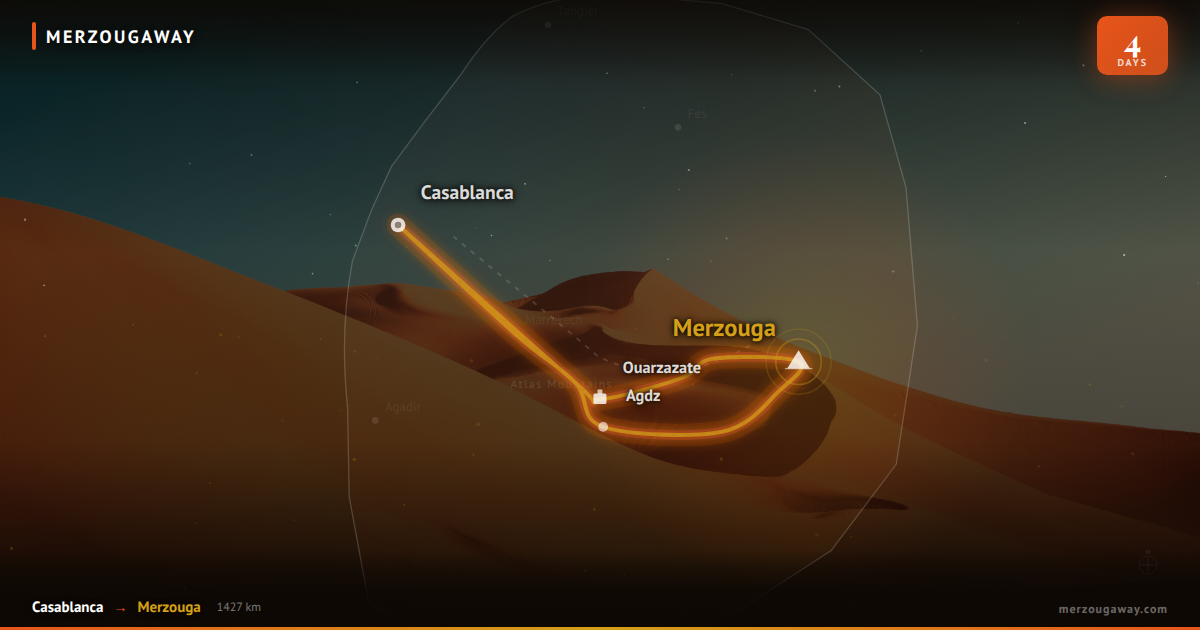
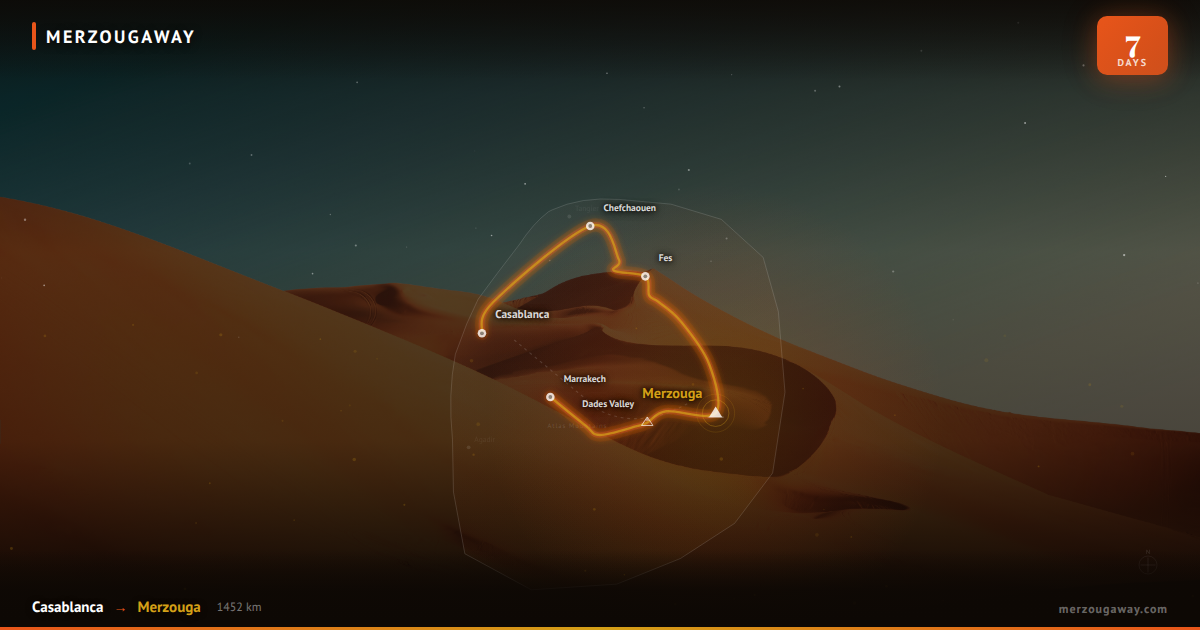
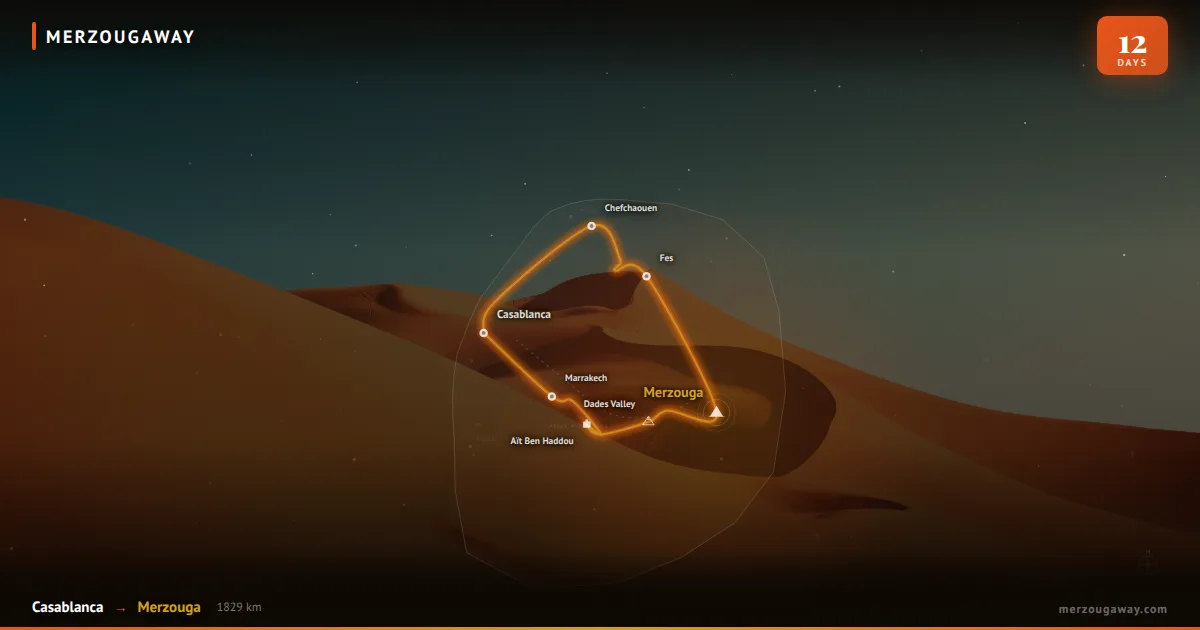
Visual Route Map: The Grand Triangle Circuit
                      [ATLANTIC OCEAN]
                             │
                      CASABLANCA (CMN Airport)
                             │ (Fast Al Boraq Train or Highway / 1h)
                             ▼
                           RABAT (Capital)
                             │ (A2 Highway / 2h)
                             ▼
                            FES (Ancient Medina)
                             │
                             ▼ (Middle Atlas: Ifrane & Cedar Forest)
                           MIDELT
                             │
                             ▼ (Ziz Valley Canyon & Erfoud)
                      MERZOUGA SAHARA CAMP (Erg Chebbi Dunes)
                             │
                             ▼ (Todra Gorges & Road of 1,000 Kasbahs)
                        DADES VALLEY
                             │
                             ▼ (Rose Valley & Skoura Oasis)
                        OUARZAZATE ──▶ Aït Benhaddou Kasbah (UNESCO)
                                             │
                                             ▼ (High Atlas: Tizi n'Tichka 2,260m)
                                         MARRAKECH
Part 1: The Master 7-Day Casablanca-to-Marrakech Itinerary
This 7-day itinerary is designed for travelers with one week of vacation who want to see Morocco's absolute best highlights without wasting a single hour.
Day 1: Casablanca Arrival, Hassan II Mosque & Drive to Fes
- 09:00 AM — Arrival at Casablanca Airport (CMN): Meet your private driver/guide at the airport arrivals terminal.
- 10:30 AM — Tour the Hassan II Mosque: Drive along the Atlantic Boulevard to the magnificent Hassan II Mosque, one of the largest mosques in the world and an architectural wonder built directly over the crashing waves of the Atlantic. Non-Muslim visitors can enter on official interior guided tours to marvel at hand-carved cedar domes, titanium doors, heated marble floors, and the 210-meter minaret.
- 01:00 PM — Oceanfront Lunch on the Corniche: Enjoy fresh Atlantic seafood (grilled sea bass, calamari, Moroccan salads) at a seaside restaurant along the Ain Diab Corniche.
- 02:30 PM — Scenic Drive to Fes via Rabat: Head northeast along modern toll highways, pausing briefly in Rabat to view the exterior of the Royal Palace, the 12th-century Hassan Tower, and the blue-and-white clifftop Kasbah of the Udayas.
- 06:30 PM — Arrival in Fes (Night 1): Arrive in the spiritual capital of Morocco. Check into your luxury boutique riad inside the ancient medina (e.g., Riad Fes, Riad Salam, or Karawan Riad). Enjoy dinner in the riad courtyard.
Day 2: Fes Medina Exploration & Afternoon Drive to Midelt
- 08:30 AM — Guided Walking Tour of Fes el-Bali (UNESCO): Meet your licensed local historian guide for a 3.5-hour private walking tour through Fes el-Bali, the world's largest car-free urban area containing over 9,000 labyrinthine alleyways. Highlights include:
- Chouara Tannery: Watch artisans dye leather in stone vessels filled with natural pigments using 1,000-year-old medieval methods.
- Al-Qarawiyyin Mosque & University: Founded in 859 AD by Fatima al-Fihri, recognized by UNESCO as the oldest continually operating university on earth.
- Al-Attarine & Bou Inania Madrasas: Intricate 14th-century Marinid architecture with sculpted stucco and zellij tilework.
- Bab Bou Jeloud (The Blue Gate): The ornate tiled entrance to the old city.
- 01:00 PM — Traditional Fassi Lunch: Dine on chicken or pigeon Pastilla (a savory-sweet layered phyllo pastry spiced with almonds and cinnamon) in a restored palace.
- 02:30 PM — Middle Atlas Ascent via Ifrane & Cedar Forest: Drive south through Ifrane ("The Switzerland of Morocco") and the Azrou Cedar Forest, stopping to meet the wild Barbary macaques.
- 06:30 PM — Arrival in Midelt (Night 2): Arrive in the peaceful apple capital nestled between the Middle and High Atlas mountains. Check into a charming mountain hotel (e.g., Hotel Kasbah Asmaa or Hotel Tadart) for dinner and overnight.
Day 3: Midelt to Merzouga Sahara Dunes via Ziz Gorge & Camel Trek
- 08:00 AM — Breakfast & Crossing the Eastern Atlas: Depart Midelt, passing through the rugged volcanic plateaus of the eastern High Atlas and through the "Tunnel of the Legionnaire."
- 10:30 AM — Ziz Valley Canyon & Palm Oasis: Pause at the breathtaking Mirador du Ziz overlooking millions of date palms stretching through red canyon cliffs.
- 01:00 PM — Erfoud Fossil Workshops & Berber Lunch: Visit an artisan workshop in Erfoud to view 380-million-year-old marine fossils. Enjoy traditional Berber Medfouna for lunch.
- 04:30 PM — Arrival in Merzouga & Erg Chebbi: Arrive at the edge of the golden sand sea. Leave your main luggage for 4x4 transfer to camp.
- 05:30 PM — Sunset Camel Caravan: Mount your camel and trek across the 150-meter-high dunes as the sun sets over the Sahara, turning the sands fiery amber and violet.
- 07:00 PM — Merzouga Luxury Desert Camp (Night 3): Check into your private canvas tent suite equipped with king beds, electricity, and private en-suite bathroom with hot shower and flushing toilet.
- 08:30 PM — Starlit Dinner, Bonfire & Berber Drumming: Dine under the stars, gather around the roaring campfire for live Saharan drumming music, and stargaze under zero light pollution.
Day 4: Sahara Sunrise, Todra Gorges & Dades Valley
- 06:30 AM — Sahara Sunrise: Climb the dunes at dawn for the breathtaking sunrise over Algeria.
- 08:00 AM — Camp Breakfast & Sandboarding: Enjoy a rich breakfast at camp and try sandboarding down the dunes.
- 09:30 AM — Rissani Souk & Drive to Tinghir: Visit the historic desert market of Rissani before driving west toward Tinghir.
- 12:30 PM — Walking Through Todra Gorges: Walk beneath the sheer 300-meter (almost 1,000-foot) limestone canyon walls of Todra Gorges along the crystal-clear river.
- 05:30 PM — Arrival in Dades Valley (Night 4): Wind up into the Dades Gorge, passing the bizarre "Monkey Fingers" rock formations. Check into your boutique Kasbah hotel (e.g., Hotel Xaluca Dades or Chez Pierre) for a multi-course dinner and overnight.
Day 5: Dades Valley to Marrakech via Rose Valley & Aït Benhaddou
- 08:30 AM — Valley of the Roses & Skoura Oasis: Drive along the "Road of a Thousand Kasbahs" through Kelaat M'Gouna and the date palm groves of Skoura.
- 11:00 AM — Ouarzazate & Atlas Film Studios: View the exterior of Taourirt Kasbah and the famous film studios of Ouarzazate.
- 12:30 PM — Aït Benhaddou Kasbah (UNESCO World Heritage): Explore North Africa's most famous 11th-century fortified clay village. Climb to the ancient hilltop granary for panoramic views. Enjoy a traditional lunch on a shaded terrace.
- 03:30 PM — Crossing High Atlas via Tizi n'Tichka (2,260m): Cross the High Atlas Mountains on the newly renovated highway (N9), taking in dramatic alpine vistas.
- 07:30 PM — Arrival in Marrakech (Night 5): Arrive in Marrakech. Check into your luxury riad in the Medina (e.g., La Sultana, Riad Kniza, or Riad Dar Anika). Step out for an evening mint tea at Jemaa el-Fnaa square.
Day 6: Full Day Exploring Marrakech (The Red City)
- 09:00 AM — Historical Monuments Tour: Visit the breathtaking tilework and cedar ceilings of Bahia Palace, the ruined grandeur of El Badi Palace, and the 14th-century Ben Youssef Madrasa.
- 01:00 PM — Rooftop Lunch: Dine at Nomad or Le Jardin overlooking the Medina rooftops.
- 02:30 PM — Jardin Majorelle & YSL Museum: Visit the electric-blue villa, exotic botanical gardens, and the Yves Saint Laurent Museum in Guéliz.
- 05:30 PM — Souks & Jemaa el-Fnaa at Sunset: Wander through the spice and lantern souks of the Medina. Settle onto a rooftop cafe at dusk to watch Jemaa el-Fnaa square come alive with storytellers, musicians, and food stalls.
- 08:30 PM — Moroccan Farewell Dinner (Night 6): Enjoy dinner at a fine-dining Moroccan restaurant with live Andalusian lute music.
Day 7: Marrakech Departure (or High-Speed Train Back to Casablanca)
- Morning: Enjoy a relaxed breakfast on your riad rooftop. Pick up last-minute Moroccan spices, argan oil, or leather goods.
- Departure Logistics:
- Flying out of Marrakech (RAK): Your driver transfers you 15 minutes to Marrakech Menara Airport.
- Flying out of Casablanca (CMN): Your driver drives you directly to Casablanca Airport (2.5 to 3 hours via A3 toll highway), or you take the comfortable 1st-Class Al Boraq / ONCF train from Marrakech railway station directly to Casablanca Oasis/Airport.
Part 2: The 10-Day Extended Immersive Itinerary
If you have 10 days, this extended version allows for a 2nd night in the Sahara Desert (Day 5) and an extra full day in Fes and Casablanca, eliminating any rushed travel days:
| Day | 10-Day Extended Route Plan | Overnight Stay | | :--- | :--- | :--- | | Day 1 | Arrive Casablanca, Hassan II Mosque, Corniche & Habous Quarter | Casablanca Hotel (Hyatt / Four Seasons) | | Day 2 | Casablanca ➔ Rabat (Hassan Tower & Kasbah Udayas) ➔ Fes | Luxury Fes Medina Riad | | Day 3 | Full Day Guided Fes Exploration (Souks, Tannery, Madrasas) | Luxury Fes Medina Riad | | Day 4 | Fes ➔ Ifrane ➔ Azrou Cedar Forest ➔ Ziz Gorge ➔ Merzouga | Merzouga Luxury Desert Camp | | Day 5 | Full Day Desert Discovery: 4x4 Dunes Loop, Khamlia Gnawa, Nomads | Merzouga Luxury Desert Camp (Night 2) | | Day 6 | Merzouga ➔ Rissani Market ➔ Todra Gorges ➔ Dades Valley | Dades Boutique Kasbah Hotel | | Day 7 | Dades ➔ Rose Valley ➔ Skoura ➔ Aït Benhaddou ➔ Marrakech | Luxury Marrakech Medina Riad | | Day 8 | Full Day Marrakech: Bahia Palace, Ben Youssef, Souks, Jemaa el-Fnaa | Luxury Marrakech Medina Riad | | Day 9 | Jardin Majorelle, YSL Museum, Traditional Hammam & Spa | Luxury Marrakech Medina Riad | | Day 10| Departure from Marrakech Airport (RAK) or Transfer to CMN | Departure Flight |
Part 3: Transport Comparison (Private Driver vs Rental Car vs Train)
Choosing how to travel between Casablanca, Merzouga, and Marrakech is critical for your safety and comfort:
| Feature | Private 4x4 with Dedicated Driver (Recommended) | Self-Drive Rental Car | Public Trains & Buses | | :--- | :--- | :--- | :--- | | Comfort & Stress | ⭐⭐⭐⭐⭐ Zero stress; relax and enjoy scenery | ⭐⭐⭐ Demanding mountain & desert driving | ⭐⭐ Very exhausting; rigid timetables | | Mountain Pass Safety | Highly experienced local driver on Tizi n'Tichka | You navigate steep drop-offs & mountain trucks | Public bus drivers maintain fixed speeds | | Desert Dune Access | Private 4x4 enters dunes and drives to camp door | Standard car cannot drive on sand (risk stuck) | Must arrange separate local desert transfers | | Photo Stop Freedom | Stop anywhere, anytime for viewpoints and tea | Total freedom to stop | Zero flexibility (fixed highway stops) | | Estimated Cost | €850 – €1,600 total per vehicle (split by party) | €40 – €80/day rental + fuel & tolls | €80 – €120 per person total | | Best Suited For | Couples, families, photographers, first-timers | Experienced confident road-trippers | Solo shoe-string budget backpackers |
Part 4: Real Budget Breakdown for the Grand Desert Triangle
Here is the realistic all-inclusive budget for the 7-day Grand Triangle circuit per person:
| Expense Category | Budget Traveler (Shared/Self) | Mid-Range (Private 4x4 & 4-Star) | Luxury (Private VIP & 5-Star Riads) | | :--- | :--- | :--- | :--- | | Accommodation (6 Nights) | €180 – €240 (Hostels & basic guesthouses) | €450 – €750 (Boutique Riads & Kasbahs) | €1,400 – €2,800 (Palaces & VIP Suites) | | Desert Camp Experience | €60 – €90 (Standard shared camp) | €180 – €260 (Luxury private en-suite tent) | €400 – €750 (VIP Private Oasis Camp) | | Transport & Driver | €80 – €150 (Public bus/train) | €350 – €550 (Private 4x4 split by group) | €700 – €1,200 (Mercedes VIP Van) | | Meals & Dining (7 Days) | €90 – €140 (€15–€20/day) | €180 – €280 (€25–€40/day) | €450 – €800 (Fine dining & wine) | | Monument Tickets & Guides | €30 – €50 | €60 – €100 (Official local guides) | €150 – €250 (Private VIP curators) | | Total Estimated Cost | €440 – €670 per person | €1,220 – €1,940 per person | €3,100 – €5,800 per person |
❓ Frequently Asked Questions (FAQ)
Can I do the Casablanca to Merzouga to Marrakech tour in 5 days?
A 5-day tour is technically possible, but it involves intense daily driving (6 to 8 hours in a vehicle almost every day) with very little time to enjoy Fes or Marrakech. If you only have 5 days, we strongly recommend flying directly from Casablanca to Errachidia or taking a direct 3-day or 4-day tour from Marrakech to Merzouga instead of trying to circle the entire country.
What is the best airport to fly into and out of for this tour?
The most efficient setup is an Open-Jaw (Multi-City) Flight: fly into Casablanca Mohammed V Airport (CMN) on Day 1, and fly home directly from Marrakech Menara Airport (RAK) on Day 7 or 10. This eliminates the 3-hour return drive from Marrakech to Casablanca at the end of your holiday.
Is the drive from Casablanca to Fes and Merzouga safe?
Yes, absolutely. The highways connecting Casablanca, Rabat, and Fes are modern multi-lane toll expressways (A1 & A2). The route from Fes to Merzouga and across the High Atlas to Marrakech follows well-paved national highways (N13, N10, and N9). When traveling with an experienced professional driver, the route is extremely safe and comfortable.
Can we visit Chefchaouen (The Blue City) on this route?
Yes! If you have 8 to 10 days, you can easily add Chefchaouen between Casablanca and Fes. On Day 2, drive from Casablanca/Rabat north through the Rif Mountains to Chefchaouen (overnight in the Blue City), and on Day 3 drive south to Fes to resume the desert itinerary.
Are meals included on the private tour?
All boutique Kasbah hotels and luxury desert camps include multi-course dinners and full breakfasts. Lunches during transit days are taken at handpicked local restaurants along the route (typically €7 to €12 per person for delicious salads, fresh bread, and tajines).
How do we get from Marrakech back to Casablanca if our return flight is from CMN?
You have two great options:
- Private Driver Transfer: Your private driver drives you directly from your Marrakech riad to Casablanca Airport (2.5 to 3 hours via the A3 toll highway).
- First-Class Train (Al Boraq / ONCF): Take the comfortable train from Marrakech railway station directly to Casablanca Oasis or Casa-Voyageurs station, which connects to the airport train shuttle.
🇲🇦 Book Your Grand Desert Triangle Tour with MerzougaWay
Turn your arrival in Casablanca into an extraordinary Saharan expedition with MerzougaWay—Morocco's leading desert tour operator based in Merzouga and Marrakech.
- View All Tour Circuits: Merzouga Desert Tours & Multi-City Routes
- Direct WhatsApp Inquiries: +212 675 203 319 / +212 668 534 981
- Email: [email protected]
Guide updated and verified for 2026 travel season.
Sahara Route & Drive-Time Estimator
Calculate realistic driving hours across the High Atlas (Tizi n'Tichka pass), compare scenic stops (Dadès, Todra, Ziz), and plan your custom desert itinerary.

MerzougaWay Team
We are a passionate team of local guides dedicated to sharing the beauty and culture of our home, Morocco. Our journey began with a simple desire to offer authentic, memorable experiences that go beyond the typical tourist trails.