Road Trip Planner: Driving Marrakech to Merzouga
Self-driving the 560km from Marrakech to Merzouga is genuinely doable, but the Tizi n'Tichka mountain pass and sparse desert fuel stations demand real preparation. Here's what to actually plan for.
Self-driving from Marrakech to Merzouga gives you a freedom a guided tour can't quite match — stop where you want, linger where something catches your eye, and set your own pace across one of Morocco's most dramatic drives. It also asks more of you than a shorter road trip would, mostly because of one long mountain crossing and a stretch of genuinely remote road near the end. Here's what actually matters in planning it.
[!NOTE] Fast-Facts & Direct Answer Summary
A desert journey from Marrakech to Merzouga spans ~560 km across the High Atlas Mountains (Tizi n'Tichka pass, 2,260m). The drive takes 9–10 hours, making a 3-Day or 4-Day tour the minimum recommended duration for safety and comfort.
- Recommended Duration: 3 Days (Classic) or 4 Days (Relaxed & In-Depth)
- Primary Road Routes: N9 across the Atlas ➔ N10 through Dadès Valley ➔ N13 to Erg Chebbi
- Realistic Pricing: 1,800–4,500 MAD (€180–€420) per person for private tours with luxury desert camp
- Key Highlights: Aït Benhaddou UNESCO ksar, Todra Gorge canyons, sunset camel trek, and Erg Chebbi dunes
- Local Expert Tip: Avoid 2-day Merzouga tours (18–20 hours driving in 48h). Opt for Agafay Desert if you only have 1–2 days.
Before you go
You'll need a valid passport, a driver's license, and — depending on your nationality — an International Driving Permit; check current requirements for your specific country before booking a rental, since rules vary and many nationalities can drive on a standard license alone. Travel insurance with vehicle coverage is worth having regardless. Rental cars in Morocco are available from the major international chains (Hertz, Europcar, Avis all operate in Marrakech) as well as local companies that are often cheaper but more variable in quality and included insurance — read the contract carefully either way, since collision coverage terms differ a lot between operators. For this specific route, a standard compact car handles the paved roads fine; you don't need a 4x4 unless you're planning to leave the main road and drive into the dunes themselves, which most rental agreements don't actually permit anyway.
The route and the road
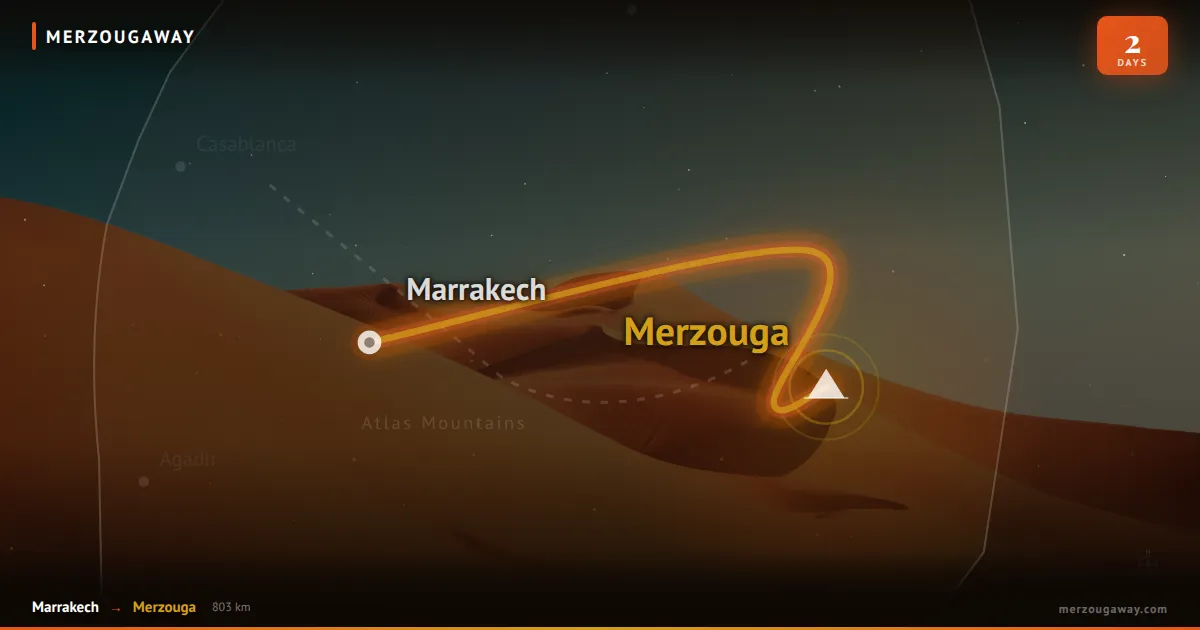
The total distance is around 560km, crossing the High Atlas via the Tizi n'Tichka pass — the highest point on the route at roughly 2,260m — before descending toward Ouarzazate and continuing through increasingly dry country via the Dades Valley or a more direct road through Errachidia, then Erfoud and Rissani into Merzouga. The mountain section is genuinely winding, with switchbacks that demand slow, attentive driving rather than confidence in the road's overall good condition; the desert stretch past Ouarzazate is straighter and faster but has long gaps between fuel stations, so filling up in every town you pass through is a habit worth building rather than waiting until the tank runs low.
Splitting the drive over two days is what most self-drivers end up doing, and it's the sensible choice: a first day to Ouarzazate or Ait Ben Haddou with time to actually see them, and a second day continuing on to Merzouga. Doing it in one very long day is possible but tiring, and driving the mountain pass in the dark isn't something to plan for regardless of how the schedule works out.
Safety and driving conditions
Morocco's main roads are well-maintained and driving here is generally straightforward, but a few things are worth knowing going in: horn use is more of a communication tool than an aggressive signal, roundabouts give priority to traffic already in the circle, and animals or pedestrians on rural roads are a real hazard worth watching for, especially near dusk. Night driving on the mountain sections in particular isn't recommended — poor lighting and unfamiliar curves are a bad combination. If something does go wrong, 112 is the universal emergency number that works from any mobile; specifically, it's 19 for police in towns, 177 for the Gendarmerie Royale on rural roads and highways (which is what covers most of this route), and 15 for civil protection, fire, and ambulance dispatch. Keep your rental company's roadside assistance number handy too — on the remote stretches near Ouarzazate and beyond, it may reach help faster than a general emergency call.
Mobile coverage is solid through Marrakech, the Atlas crossing, and Ouarzazate, but gets patchier the further into the desert you go — download offline maps (Google Maps and Maps.me both support this) before you leave rather than relying on a live connection the whole way.
Fuel and costs
Fuel prices in Morocco fluctuate with the wider market, so treat any specific per-liter figure as a snapshot rather than something to rely on when budgeting — check current prices locally rather than planning around a number from months ago. As a rough sense of scale, covering the full round trip in a compact car typically runs somewhere in the low hundreds of dirhams to a bit more depending on the car and current prices; a larger SUV will use noticeably more. This route runs on ordinary national highways rather than Morocco's toll autoroute network, so tolls aren't really a factor here the way they are on, say, the Casablanca-Marrakech corridor.
Self-Drive Road Trip Guide: Route Milestones and Navigation
Driving a rental car across southern Morocco gives you total schedule flexibility:
+------------------+---------------+----------------+--------------------------------+
| Highway Leg      | Distance (km) | Driving Time   | Road Number & Key Stops        |
+------------------+---------------+----------------+--------------------------------+
| Marrakech ->     | 200 km        | 4.5 hrs        | N9 via Tizi n'Tichka (2,260m)  |
| Ouarzazate       |               |                | & Ait Benhaddou ksar           |
+------------------+---------------+----------------+--------------------------------+
| Ouarzazate ->    | 165 km        | 2.5 hrs        | N10 through Skoura palm oasis  |
| Tinghir (Todra)  |               |                | and Kelaat M'gouna Rose Valley |
+------------------+---------------+----------------+--------------------------------+
| Tinghir ->       | 195 km        | 3.0 hrs        | N10 & N13 via Erfoud fossil    |
| Merzouga Dunes   |               |                | quarries and Rissani medina    |
+------------------+---------------+----------------+--------------------------------+
All roads on this itinerary are fully paved asphalt highways accessible by standard 2WD rental sedans. However, you cannot drive a standard rental car into the loose sand dunes; upon reaching Merzouga, you park at your base lodge or camp meeting point, where a 4x4 transfers your luggage to camp.
Police Checkpoints and Speed Radar Protocols
Driving through Morocco requires respecting highway traffic enforcement:
- Gendarmerie Checkpoints: Slow down to 20 km/h when approaching police checkpoints marked "Ralentir" or "Halte". Stop completely if an officer signals you, present your rental agreement, passport, and driving license politely.
- Speed Radar Teams: Laser speed radar teams are stationed along open highway stretches. Strictly observe the posted speed limits: 60 km/h in villages and 100 km/h on open highways.
- On-the-Spot Fines: Fines for minor speeding range from 150 to 300 MAD, payable immediately in cash with an official paper receipt.
Essential Rental Car Insurance and Navigation
Navigating southern Morocco in a rental vehicle requires the right coverage and tools:
- Comprehensive Insurance (Zero Excess): Opt for comprehensive collision damage waiver (CDW) with tire and windshield protection to cover loose gravel on mountain passes.
- Offline GPS Navigation: Download offline maps for Marrakech, Ouarzazate, and Errachidia provinces on Google Maps or Maps.me before leaving your hotel Wi-Fi.
- Cash for Tolls and Gas: Keep at least 500 MAD in cash in your glove box for highway tolls and rural fuel stations that do not accept cards.
Critical Road Rules for Foreign Drivers
Driving in Morocco is straightforward once you know local road customs:
- Never Drive at Night: Avoid driving through mountain passes or rural desert highways after dark. Unlit tractors, cyclists, stray sheep, and pedestrians walk along road shoulders with zero reflective gear.
- Passing Trucks on Tichka: Heavy commercial trucks travel slowly up mountain inclines. Only pass when road markings permit and oncoming visibility is completely clear.
- Roundabouts (Rond-Points): In Moroccan traffic circles, vehicles already inside the roundabout have the right-of-way unless a police officer signals otherwise.
Recommended Roadside Lunch Stops
Break up your drive with authentic local dining along Highway N10:
- Taddert (High Atlas): Savor fresh lamb tagines and freshly pressed walnut oil on cliffside terraces.
- Skoura Oasis: Enjoy organic farm salads and grilled skewers in quiet palm grove riads.
- Tinghir: Relax with fresh mint tea and Berber omelets overlooking the green Todra river valley.
What to Do in Case of a Mechanical Breakdown
If your rental car encounters an issue on the road:
- Gendarmerie Assistance: Dial 177 for the Royal Gendarmerie; patrol vehicles regularly monitor national highways N9, N10, and N13.
- Local Mechanic Garages (Mécanique Auto): Every town (Ouarzazate, Tinghir, Erfoud) features skilled mechanics capable of handling tire punctures, radiator coolant top-ups, and suspension checks quickly and inexpensively.
- Spare Tire Check: Always verify that your rental vehicle has a fully inflated spare tire, working jack, and lug wrench before driving out of Marrakech.
The Scenic Ounila Valley Shortcut (Route P1506)
If you are confident driving on winding mountain roads, take the Ounila Valley detour:
- Leaving the N9: Turn left shortly after crossing Tizi n'Tichka toward the historic village of Telouet.
- Kasbah Telouet: Explore the ruined 19th-century palace of the Glaoui family, featuring hand-carved stucco, cedar ceilings, and zellij mosaics hidden behind crumbling exterior walls.
- The Red Canyon Drive: Follow Route P1506 as it hugs the canyon walls above the green Ounila River, passing ancient cliff dwellings and almond orchards before emerging directly at the UNESCO ksar of Ait Benhaddou.
Vehicle Maintenance Checks Before Driving South
Before setting off on an 1,100-kilometer road trip, perform these quick vehicle inspections:
- Tire Pressure and Tread: Ensure all four tires and the spare have at least 32 PSI (2.2 bar) and adequate tread depth for gravel shoulders.
- Radiator Coolant and Windshield Fluid: Long mountain climbs strain vehicle cooling systems; verify that coolant and washer fluid reservoirs are filled.
- Fuel Reserve Rule: As a golden rule, never let your fuel gauge drop below one-quarter tank. Fuel stations are frequent between Marrakech and Tinghir, but become spaced 60 to 80 kilometers apart in desert stretches.
Detailed Southern Morocco Road Conditions
Highway infrastructure across southern Morocco has seen extensive modernization:
- Highway N9 (Tizi n'Tichka): Fully widened with dual climbing lanes on steep uphill sections, heavy steel guardrails, and reinforced concrete retaining walls.
- Highway N10 (Boumalne to Tinghir): Smooth, level asphalt cutting through broad pre-Saharan river valleys with excellent road signage in Arabic, French, and Tifinagh.
- Highway N13 (Erfoud to Merzouga): A straight, well-maintained two-lane road flanked by date palm groves and distant red sand dune vistas.
Mountain Driving Etiquette and Right-of-Way Rules
Driving through the High Atlas switchbacks requires clear adherence to mountain road etiquette:
- Uphill Traffic Right-of-Way: On narrow mountain ascents, ascending vehicles have the right-of-way because restarting a heavy vehicle uphill is difficult. Descending vehicles must yield or pull into passing bays.
- Using Horn on Blind Curves: In narrow mountain canyons along the Dades and Todra gorges, tap your horn lightly before blind corners to alert oncoming traffic.
- Roundabout Precedence: Vehicles already circulating inside roundabouts have the right-of-way over entering vehicles. Always indicate clearly when exiting.
- Avoid Overtaking on Double Solid Lines: Moroccan highway police strictly enforce lane markings with mobile radar teams; crossing solid double lines carries immediate cash fines.
The Return Route via the N12 Southern Loop: N'Kob and Agdz
Instead of retracing the N10 highway on Day 3, self-drive travelers can complete the journey via the N12 Southern Loop:
- From Rissani to Alnif: Cross the striking volcanic stone plains of the Jbel Saghro range along smooth, uncrowded asphalt.
- N'Kob (The Kasbah Capital): An ancient Berber oasis village boasting 45 fortified mud-brick kasbahs set against lush date palm groves; perfect for lunch at a kasbah terrace.
- Draa Valley along the N9: Follow Morocco's longest palm oasis through Agdz, passing fortified ksour and sweeping views of the historic Jbel Kissane mountain ridge before ascending Tizi n'Tichka back into Marrakech.
Fuel Planning and Cash Protocols on the Road
Maintaining your vehicle's fuel level across southern Morocco requires smart planning:
- Major Service Stations: Modern brands like Afriquia, Shell, Total, and Winxo are available in Marrakech, Ouarzazate, Boumalne Dades, and Tinghir, offering clean restrooms, espresso cafes, and convenience groceries.
- Payment Realities: While highway stations near Marrakech accept international credit cards, rural pumps in pre-Saharan desert corridors frequently suffer card terminal network outages. Always carry at least 500 to 800 MAD in physical cash dedicated for fuel purchases.
Returning Your Rental Car in Marrakech
Conclude your road trip smoothly with these practical steps:
- Refuel Before Airport Drop-Off: Gas stations near Marrakech Menara Airport (RAK) can be busy; top up your fuel tank at an Afriquia station on the road inbound from the High Atlas.
- Inspect Vehicle Exterior: Take quick walkaround photos of the vehicle body and windshield upon return to document that no damage occurred along the gravel roads.
Summary: The Legendary Southern Road Trip
Driving from Marrakech to Erg Chebbi is an epic road trip that showcases the full geographic and cultural grandeur of Morocco. From snow-capped alpine passes to ancient river canyons and towering golden sand dunes, every mile offers pure discovery.
Frequently Asked Questions (FAQ)
Do I need a 4x4 to drive from Marrakech to Merzouga?
No. The entire route follows well-paved national highways (N9 across Tizi n'Tichka, N10 through Dadès, and N13 into Merzouga). A standard 2WD rental car is completely sufficient on the tarmac; you only need a 4x4 once you leave the road to enter deep sand dunes.
Is it safe to drive to Merzouga solo as an international traveler?
Yes, the route is safe with frequent police checkpoints ensuring road security. However, mountain switchbacks, winding gorges, and rural livestock require attentive daytime driving. We strongly advise against driving through mountain passes after dark.
What should I do if my rental car breaks down on the desert highway?
Contact your rental company's 24/7 roadside assistance immediately. In addition, rural Moroccan locals and mechanics are exceptionally hospitable and helpful. Save emergency numbers before departing: Police (190) and Gendarmerie Royale (177).
Thinking about combining the freedom of a self-drive with local expertise instead? A private driver covers the same route and pace without you needing to handle the mountain switchbacks yourself.
- WhatsApp: +212675203319 / +212668534981
- Email: [email protected]
Last updated: August 2026.
Sahara Route & Drive-Time Estimator
Calculate realistic driving hours across the High Atlas (Tizi n'Tichka pass), compare scenic stops (Dadès, Todra, Ziz), and plan your custom desert itinerary.
MerzougaWay Team
We are a passionate team of local guides dedicated to sharing the beauty and culture of our home, Morocco. Our journey began with a simple desire to offer authentic, memorable experiences that go beyond the typical tourist trails.